

Description
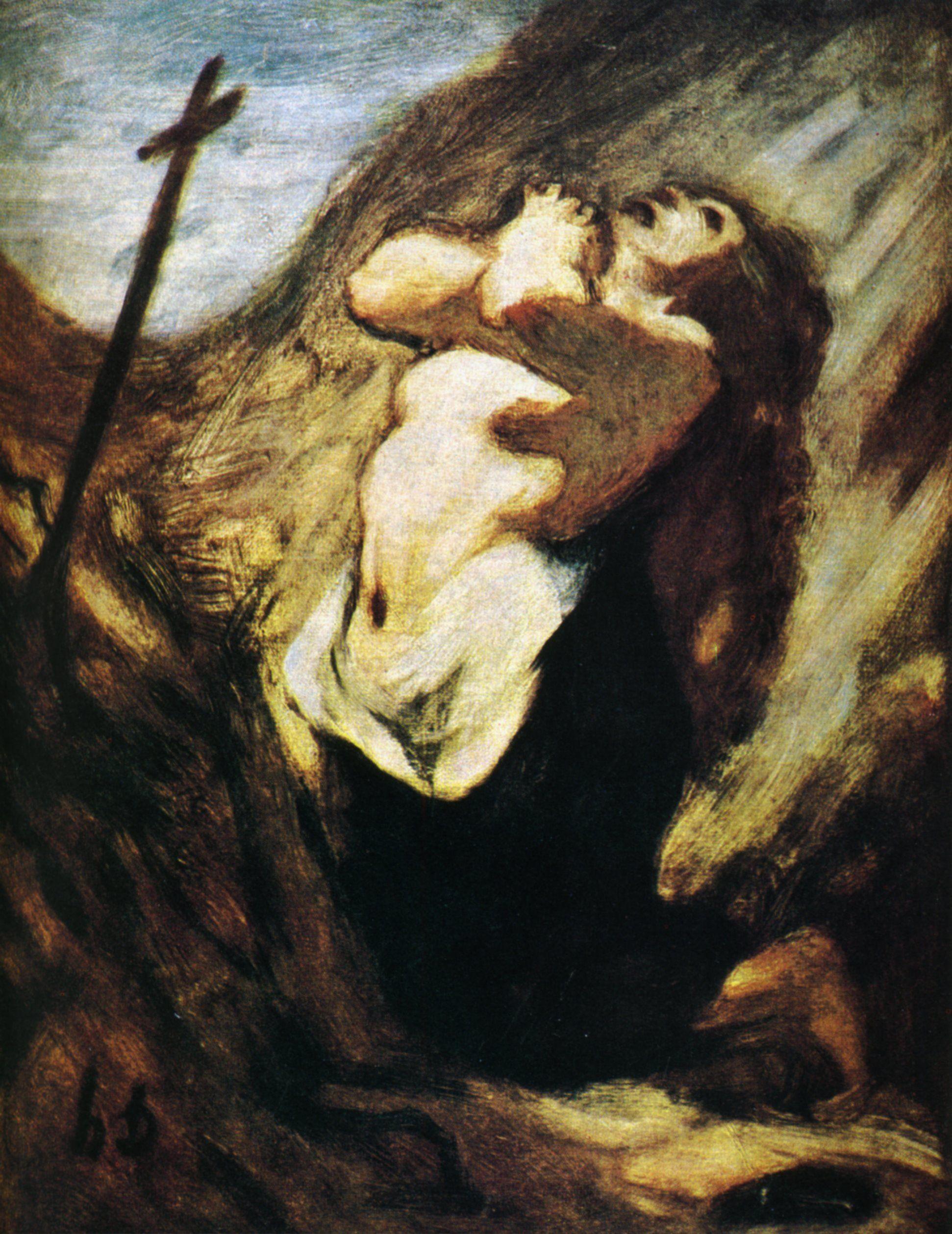
The painting shows Mary Magdalene in a secluded, rocky landscape, leaning back with her face raised toward the upper part of the scene. Her dark hair falls around her head and shoulders, while her light robe draws attention to her solitary figure. A darkly silhouetted cross rises to the left, firm and vertical, accompanying the figure without competing with her. Rock formations and slopes in shades of brown, olive green, and ochre enclose the space on both sides, as if the saint were withdrawn into a narrow natural refuge. Beneath her, a deep area of shadow heightens her separation from the ground and lends visual weight to the composition.
The scene depicts Mary Magdalene in penitential retreat, removed from everyday life and turned toward the cross as a sign of contemplation, repentance, and Christian devotion. Religious tradition closely associates her with conversion and penance, and Western imagery often portrays her in a natural, solitary, or desert setting. Here, the desert is not presented as an expanse of sand, but as a rugged terrain of rocks, uneven ground, and isolation. This choice makes the landscape an essential part of the story: spiritual retreat is expressed through the distance from any human presence and through the harshness of the surroundings that envelop the saint.
The cross on the left serves both as a devotional attribute and as a reference to the Passion of Christ. Its darkness contrasts with the lightness of the tunic and establishes a spiritual axis alongside Mary Magdalene’s physical one. Her upturned face and meditative posture suggest prayer and contemplation, while her loose hair and solitude reinforce the traditional image of the penitent. The rocks, slopes, and enveloping shadow invite an interpretation of austerity and inner transformation: the outside world becomes rugged and severe, while the luminous figure emerges as the center of attention and reflection.
The formal structure depends on very precise contrasts. The vertical composition places Mary Magdalene at the center, while the diagonals of the rocks frame her and lead the eye toward her face. The cross introduces a straight, stable line on the left, balancing the tilt of her body and the broken movement of the landscape. At the top, the grayish-blue and whitish sky opens onto an area of restrained light; below, dark browns, muted greens, and dense ochres lend depth to the scene. The cream-colored tunic acts as a luminous focal point, while the shadow below provides a counterweight that anchors the figure to the ground.
Within Honoré Daumier’s body of work, this painting presents a dramatic vision of spiritual isolation: a luminous, vulnerable figure stands out against a mineral landscape, while the cross defines the horizon of her contemplation. The painting’s appeal lies in the way it brings narrative and visual intensity together without separating the saint from her surroundings. Follow the gaze from the dark cross to her upturned face, then to the shadow that supports the scene. Along this path, penitential retreat becomes more than a religious episode: it becomes an experience of silence, effort, and inner concentration.
Have questions about our oil painting reproductions? See our frequently asked questions.