

Description
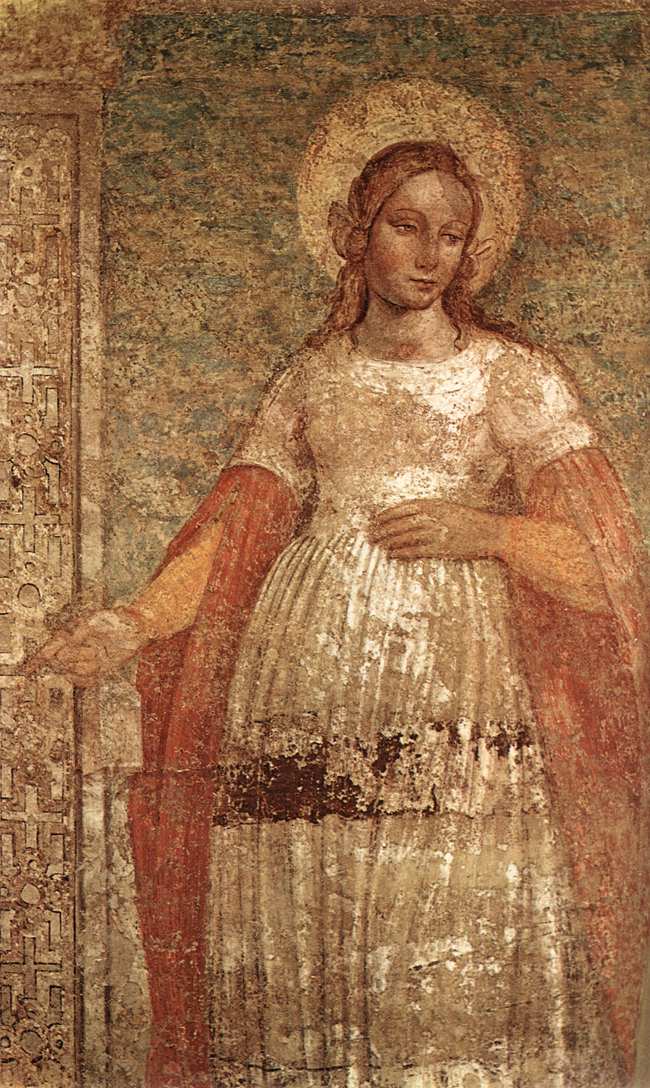
The painting shows Saint Agnes of Rome standing, depicted almost full-length and positioned at the center of a vertical composition. Her frontal face, with its serene expression, is encircled by a pale halo that draws attention to the upper part of the painting. A reddish mantle falls from her shoulders, framing a light-colored garment with short sleeves, while her long dress descends in a series of vertical folds. One hand rests on the middle of her skirt, and the other arm extends toward the left edge. There, an ornamental band of geometric and architectural forms runs along much of the height, integrating the figure into a mural-like space that appears ancient and carefully ordered.
Agnes of Rome is venerated as an ancient Christian saint and martyr. Tradition associates her with virginity, fidelity to the faith and resistance in the face of persecution—qualities expressed here in a restrained visual language. Rather than depicting a scene of action, the painting presents a steady, focused devotional presence. The figure’s frontal pose invites direct contemplation, almost as if the saint were appearing to the viewer from a sacred space. Her identity is conveyed through her solemn bearing and halo, signs that place the human body in a spiritual sphere.
The halo serves as a luminous symbolic center, separating the head from the earthy background and affirming her sacred nature. The red mantle lends intensity to the figure, while the light-colored dress and its ordered folds suggest purity, discipline and contemplative reserve. The hand resting on her garment introduces a gesture of restraint and self-control, far removed from any sense of drama. The band at the side can be read as an architectural or decorative frame, making the isolated figure part of a larger religious structure. In this way, the composition conveys holiness, stability and isolation through a sparing use of visible attributes.
The formal structure relies on serene symmetry and a strongly defined vertical axis. The halo establishes a circular focal point in the upper area; from there, the eye descends over the face, the mantle, and the rhythmic pattern of the folds to the lower edge. The ochres, browns, beige, muted reds, and grayish greens form a restrained palette, consistent with the aged, worn surface. Against this matte background, the circle of the halo takes on a particular clarity. The vertical lines of the dress stabilize the figure, while the band along the left margin introduces a geometric variation that keeps the frontal composition from feeling rigid. Depth is limited: the work’s power comes from its monumental presence, not from a developed narrative space.
The work is consistent with the Lombard devotional style associated with Ambrogio Bergognone, characterized here by serene sacred figures, balanced composition, restrained coloring, and a close relationship between religious imagery and architectural elements. The wear on the surface does not diminish this presence; on the contrary, it adds a temporal dimension that makes visible the figure’s endurance beneath the layers of time. It is worth observing how the halo, the reddish mantle, and the ornamental band work together: they are not isolated elements, but devices that transform Saint Agnes into a silent, monumental, and deeply contemplative presence.
Have questions about our oil painting reproductions? See our frequently asked questions.