

Description
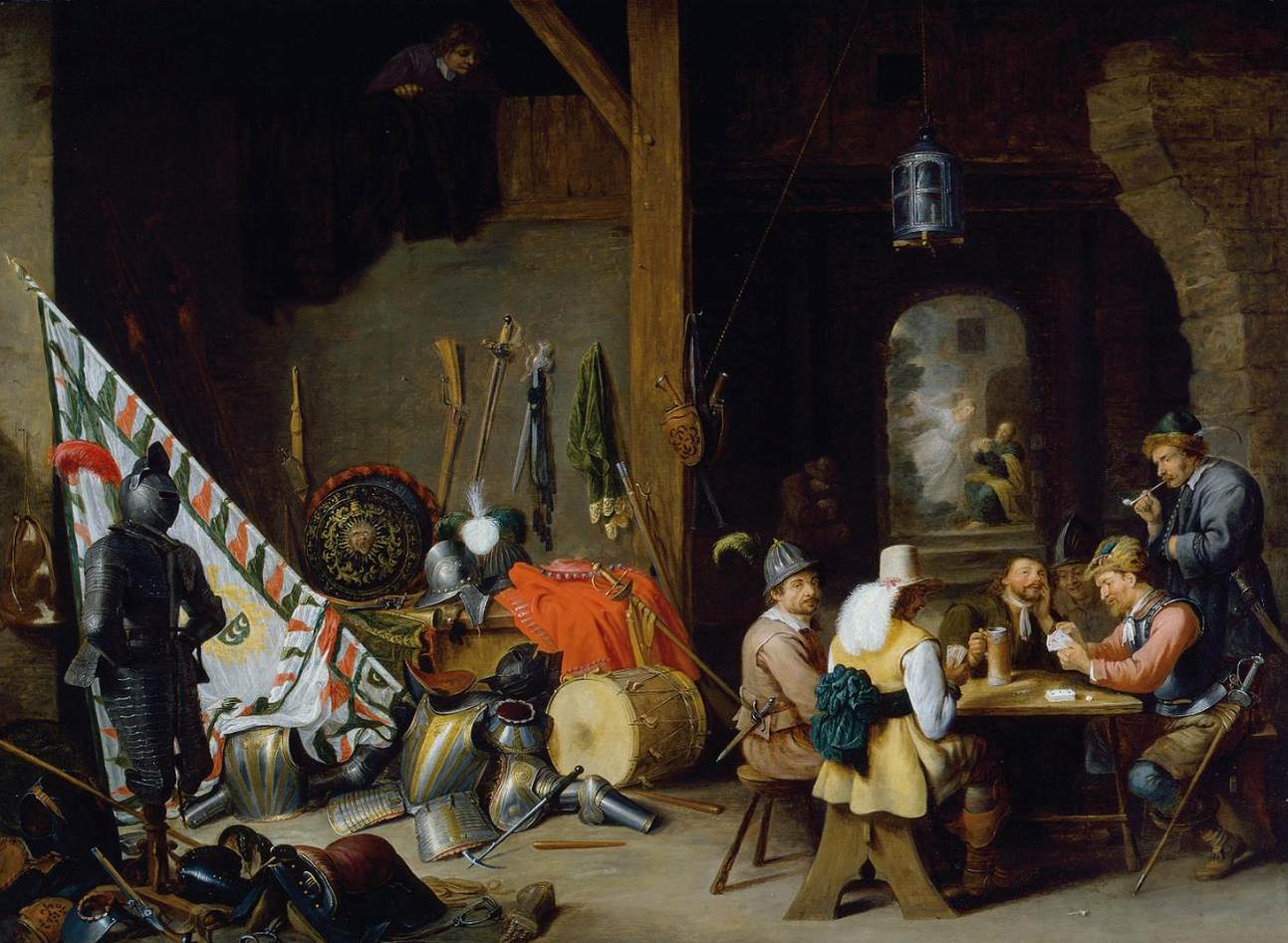
The painting depicts a dark, densely populated interior, where a suit of armor stands at the far left while several soldiers gather around a table on the right. Amid benches, glasses, and jugs, the figures play cards, drink, or smoke in a leisurely scene of conviviality. The floor and foreground are strewn with helmets, shields, swords, spears, pieces of armor, a standard, and a large drum. Above, another figure peers out from a wooden structure; in the background, a metal lamp hangs from the beams, and through an open doorway, the angel leading Saint Peter out of prison can be seen. It is titled Guardroom with the Liberation of Saint Peter.
The work combines genre painting with an episode from the Acts of the Apostles: imprisoned by Herod, Saint Peter was freed at night by an angel while his guards remained unaware. This is not a battle scene, but a moment of pause, games, and rest among objects that evoke soldiers’ lives. The table introduces a domestic and social dimension, while the miracle, set in the background, takes place behind the guards’ backs.
The accumulation of armor, helmets, shields, and weapons serves as a visual inventory of strength, discipline, and conflict, but also as the material setting for relaxed sociability. The drum and decorated textiles heighten the scene’s military resonance while adding patches of color amid the dark metal. The soldiers’ distraction around the table contrasts with the sacred scene in the background: while the guards play, the prisoner escapes under the angel’s guidance, a small scene within the larger one that gives the whole composition its meaning.
The horizontal composition is structured around a pronounced division between the arsenal on the left and the group of people on the right. A central vertical beam acts as an axis, separating the two areas without completely isolating them. The diagonals of swords, spears and timber lead the eye toward the table, where faces, hands and vessels focus the action. Warm, restricted light emerges against brown and black backgrounds, bringing out the gleam of the metal, the red fabrics and the ochre tones of the clothing. Depth is created through overlapping layers: objects in the foreground, figures in the middle distance and the illuminated doorway at the back.
In Mattheus Van Helmont’s work, this attention to popular or military interiors, groups of figures and the tactile richness of objects relates to the Flemish tradition of genre painting. The scene derives its strength from the interplay between material detail and everyday behavior: every helmet, glass, plank and garment helps define the atmosphere. It is worth noting how the table draws the eye not because it stands alone, but because it is surrounded by the organized disorder of military equipment. In this way, the work transforms a guardroom into a place of conversation, allowing the miracle to take place discreetly in the light at the back.
Have questions about our oil painting reproductions? See our frequently asked questions.