

Description
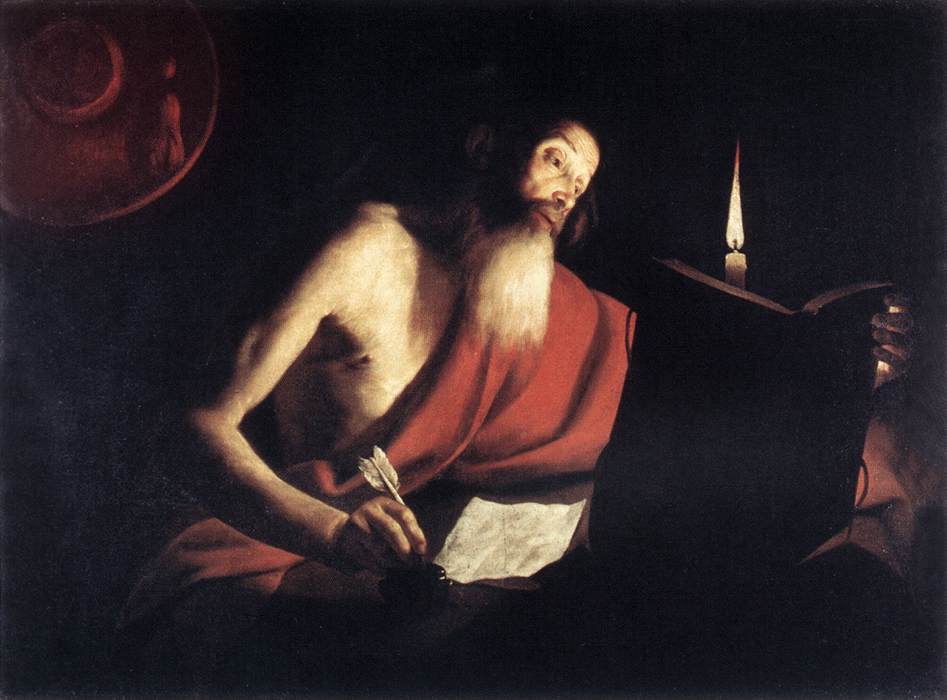
The painting shows Saint Jerome leaning over a sheet as he writes with a quill, absorbed in the focused light of a candle. The saint appears at the center of the scene, his torso bare, his beard and face bathed in warm light, while a red cloth wraps around part of his body and falls toward the lower area. In front of him lies the light-colored surface on which he is working. On the right, a darkly dressed figure holds or accompanies an open book, blending into the gloom beside the candlestick. The background remains almost entirely black, so the interior is constructed through the proximity of bodies, books, writing, and light.
The depiction brings together two essential aspects of Saint Jerome. On the one hand, he appears as a Christian scholar, devoted to the study, writing, and translation of the Bible; on the other, as a penitent withdrawn from ordinary life. His bare torso, the austerity of the space, and his silent concentration evoke the tradition that places him in a secluded setting, far from the bustle of the world. The books and quill are not mere accessories: they make his connection to religious knowledge visible and place intellectual activity at the center of the scene’s narrative. The candle extends this idea of vigil and devotion.
The iconography is structured through contrasts rich in meaning. The exposed skin and red cloth evoke renunciation, penance, and a corporeality subjected to spiritual discipline, while the sheet and books represent the word studied and transmitted. The dark figure on the right serves as a counterpoint to the illuminated saint and expands the scene of reading, companionship, and shared knowledge. Rather than depicting an everyday setting, the darkness seems to remove everything incidental, focusing attention on the act of writing. The candle thus takes on visual and symbolic significance: its small glow guides the eye and transforms a solitary task into an act of contemplation.
The horizontal, asymmetrical composition is organized around a luminous diagonal that leads from the flame to the face, torso, and sheet. The black and deep browns absorb the contours of the background and the secondary figure, while the cloth’s crimson red introduces an intense note that connects the figure’s body with the lower surface. The candle’s golden ochres and the paper’s cream tones establish the brightest areas. This theatrical chiaroscuro does more than model the saint’s form: it also regulates the rhythm of the gaze, alternating areas of revelation and concealment. The space seems to tighten around the act of writing, and the body’s inclination reinforces the sense of physical concentration.
In Trophime Bigot’s interpretation, St Jerome is presented as a figure of intellectual intensity and penitence, shaped by the tension between the body’s vulnerability and the steadfastness of study. The work needs no detailed setting to suggest a retreat: the darkness, the candle, and the small circle of objects are enough to create an inward, silent, secluded space. Notice how the light brings together three elements—the face, the hand holding the quill, and the sheet of paper—and makes their relationship the painting’s true focal point. Around them, the red cloth, the books, and the shadowy presence deepen the meaning of a scene that is at once an image of prayer, penitence, and intellectual work.
Have questions about our oil painting reproductions? See our frequently asked questions.