

Description
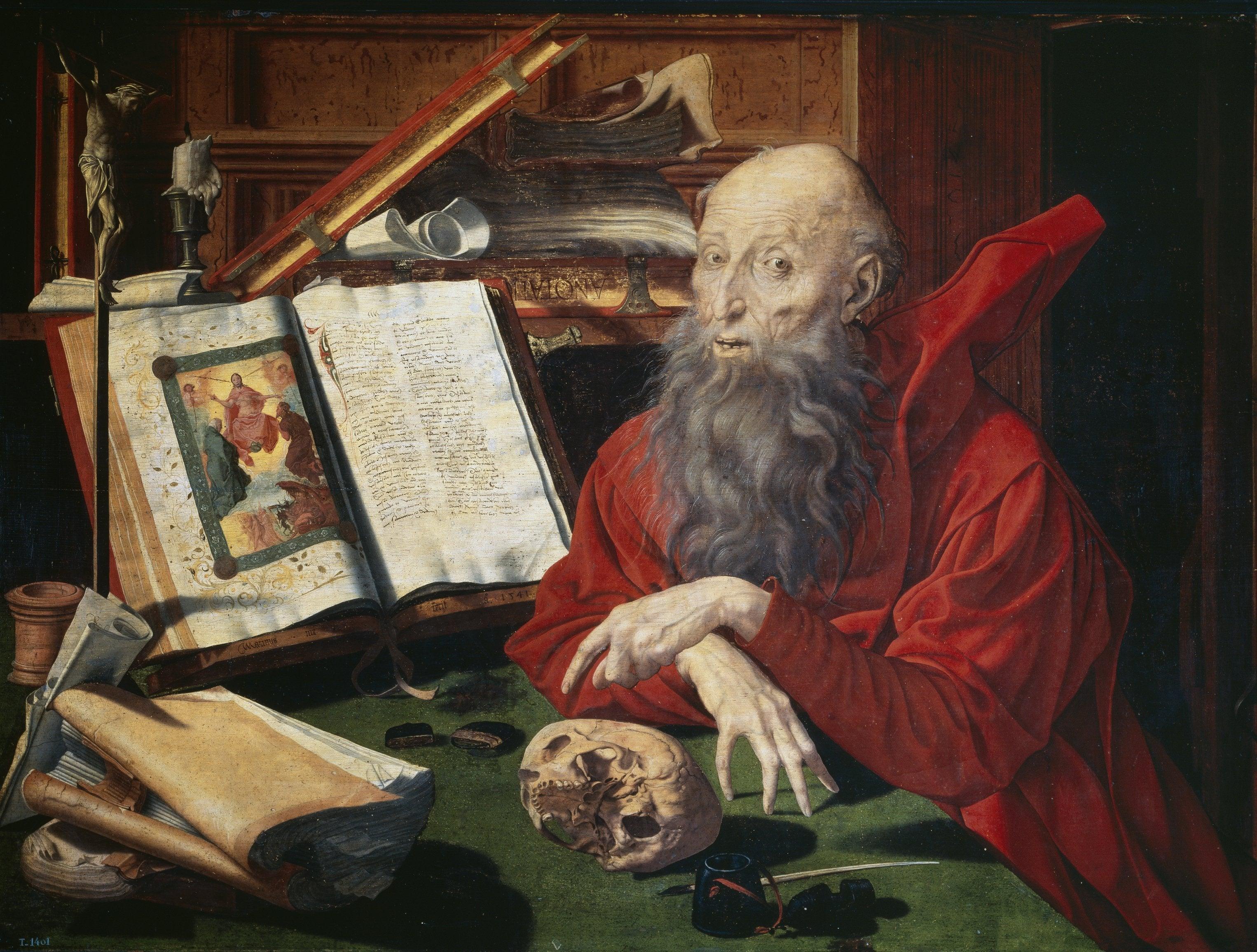
An elderly human figure, partially bald with a long light beard, leans over a table crowded with books, manuscripts and small objects. He wears a deep red robe or mantle that stands out forcefully against the dark interior. The forward‑leaning posture, with hands resting on the surface, focuses attention on the relationship between the figure and the materials before him.
The open book occupies a central place in the composition. Its pages show numerous lines of handwritten text and, on one of them, a painted image that introduces a secondary focal point. Around it are other volumes, rolls or sheets and several elongated dark objects whose exact nature cannot be determined from the image alone. The table forms a diagonal axis that leads the eye from the lower left toward the center, where the hands, the book and the skull in the foreground are located.
The illumination is carefully concentrated on the figure and the objects on the table. The pale skin of the face and hands emerges from the shadowy background, while the red of the garment provides the principal chromatic accent. Dark browns, blacks, muted greens, beige and aged golds complete a restrained palette with great visual density. The contrast between the lit areas and the surrounding gloom creates an intense chiaroscuro and makes each element seem to acquire weight within the space.
The background is composed of shelves or wooden panels, barely differentiated due to the scarcity of light. In the upper left corner a small sculpted figure can be made out, a detail that broadens the reading of the setting without overwhelming the main figure. The marks and letters visible on the books and papers add texture and rhythm to the surface, though they do not allow a signature to be confirmed or specific contents to be read. This painting by Marinus van Reymerswale thus presents a compact interior built through layers of objects, shadows and aged surfaces.
The composition guides the gaze gradually. First the red of the robe appears; then the face and beard; finally the open book and the skull establish a line of attention that runs across the table. The figure occupies mainly the right half, while the objects extend to the left and balance the visual weight of the body. The proximity between the figure and the books reduces the sense of free space and reinforces the concentrated character of the scene.
The whole may suggest an atmosphere of study, reading or contemplation, although the image does not allow the identity of the figure or the meaning of all the objects to be specified. The skull, placed in a particularly visible spot, introduces a note of gravity in contrast to the intellectual activity represented by the manuscripts. Rather than offering a single interpretation, the painting seems to establish a contrast between the figure’s silent concentration, the accumulation of written knowledge and the physical presence of what remains beyond the pages.
Also significant is the tension between the legible and the inaccessible. The pages are covered with writing, but their words do not reach us; the book contains images, yet its internal scene cannot be identified with certainty. That distance invites observation rather than deciphering. The beard, the hands, the open volume and the skull form a visual chain that can be read as a meditation on time, memory or fragility, but these associations belong to the viewer’s experience and should not be taken as a confirmed explanation. The light seems to gather all these elements into a single moment of attention while the background remains deliberately reserved.
It is worth pausing on the dialogue between the red of the robe and the beige of the pages: there the scene’s clearest contrast is concentrated.
Do you have questions about our oil‑painting reproductions? See our frequently asked questions.