

Description
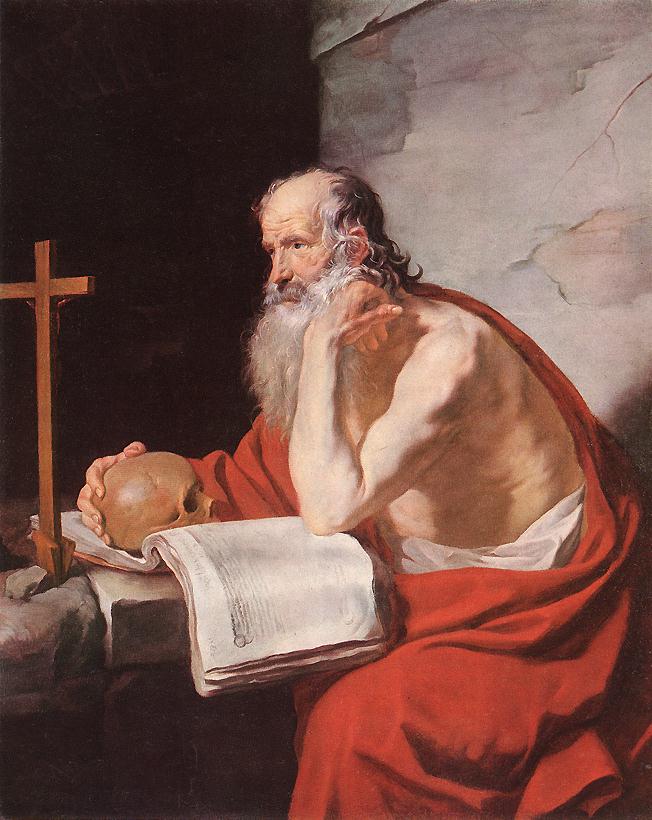
The painting depicts Saint Jerome in penitential retreat, seated in a stark, stone-like setting. His aged figure dominates the center and right of the composition: his long white beard, bare torso, light cloth tied around his waist and ample red mantle create an intense, focused physical presence. Beside him, a simple wooden cross stands out on the left, while a skull rests near his hand and a large open book fills the foreground. His head tilted to the left and his contemplative gesture draw the viewer’s gaze toward this group of devotional objects.
Saint Jerome is traditionally associated with the study of Scripture and religious scholarship. The open book therefore serves not merely as an element in the scene, but as a key to understanding the saint as a hermit, penitent and scholar. The austerity of the shelter, his partial nudity and the absence of other figures place the depiction in a realm of spiritual retreat. The image does not narrate an external action; its meaning is concentrated in meditation, bodily discipline and attention directed toward the signs of faith and mortality.
The cross establishes the Christian framework for contemplation, while the skull introduces reflection on death, transience and the vanity of worldly things. The book lends an intellectual dimension to a scene that might otherwise be read solely as physical penance. These attributes form a visual chain: the cross evokes devotion, the skull awareness of death, and the book spiritual knowledge. The red mantle adds a note of dignity and drama, enveloping the saint in folds that contrast with the austere gray and ochre of the stones.
The vertical, asymmetrical composition concentrates the visual weight in the body of Saint Jerome, while guiding the eye along a diagonal descending from his face to the cross, the skull, and the book. The almost-black background on the left makes the silhouette of the cross stand out and heightens the warm glow of the skin, beard, and foreground objects. On the right, the pale, cracked surface introduces a luminous pause, setting off the mantle and enhancing the sense of depth. The vivid reds serve as a chromatic focal point, while ivory whites, ochres, and grays sustain a restrained palette. The alternation between dark areas and illuminated surfaces creates a measured rhythm, suited to a scene of inner contemplation.
In Saint Jerome, Jacques Blanchard connects the chromatic sensibility of French Baroque painting with a pronounced interest in color and warm lighting, broadly associated with Venetian colorism. The intensity of the mantle and the figure’s luminous modeling turn a scene of retreat into an image of great visual presence. Notice how the red first draws the eye, but ultimately leads it toward the face, the cross, the skull, and the open pages. In this way, the formal composition and the saint’s attributes work together: color draws attention, light focuses it, and the symbols transform the stillness of the refuge into a meditation on faith, knowledge, and mortality.
Have questions about our oil painting reproductions? See our frequently asked questions.