

Description
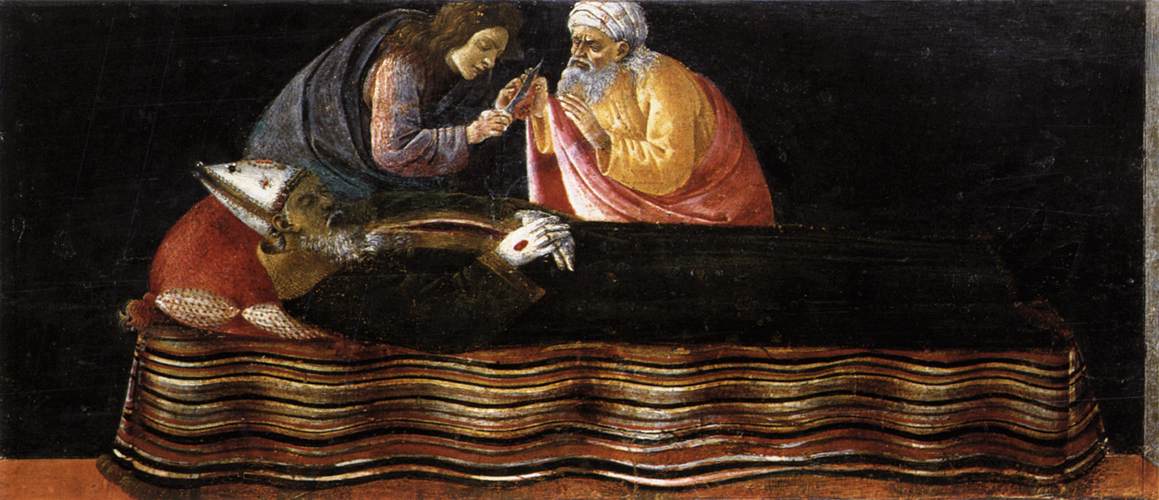
The painting depicts a hagiographic scene of intense concentration: two figures lean over the reclining body of Saint Ignatius, stretched horizontally beneath a broad, dark covering. On the left, a figure wrapped in a very deep blue or black cloak approaches the center and holds a small object beside the face of the bearded figure. Facing him, an elderly man with a white beard, light-colored headdress, ochre tunic and reddish cloth holds his hands aloft in a gesture of intervention or guardianship. The scene unfolds against an almost black background, while a textile band of undulating red, green, white and ochre stripes runs along the lower edge.
The title places the action within the sphere of religious devotion and the veneration of relics. The extraction of the heart makes the saint’s body the focus of an episode of particular intensity: bodily matter ceases to be merely mortal remains and takes on a sacred dimension. The attendants gather around this moment with a grave and concentrated bearing, as if they were guarding a spiritual legacy. The composition does not present the scene as an everyday activity, but as a solemn rite suspended in a dark space where every gesture carries narrative significance.
The reclining, partially covered figure introduces the themes of death, passage and sacred memory. The heart, suggested by the central action and the figures’ attention, concentrates the narrative as a sign of inner life and spiritual devotion. The black background heightens the separation between the event and the outside world, and makes the illuminated garments function almost like visual attributes. The dark cloak of the figure on the left establishes an area of solemn reflection, while the white headdress and the red and ochre tones of the bearded figure create a clear chromatic hierarchy. The undulating band below adds a rhythmic, material counterpoint to the gravity of the scene.
The horizontal structure guides the eye from one end of the covered body to the other, but the two figures above draw attention back to the center, where the decisive gesture takes place. The diagonals formed by their arms and torsos create a restrained tension: both lean forward, yet neither disrupts the visual silence of the composition. The dominant black compresses the space and reduces its depth, making the bodies and fabrics emerge with an almost theatrical presence. Against this darkness, golden ochre, deep red, and ivory white serve as points of chromatic light. The undulating bands along the lower edge introduce repetition, movement, and a decorative rhythm that balances the density of the central area.
In relation to Sandro Botticelli, the work can be viewed through its interest in well-defined drawing, stylized figures, chromatic refinement, and the tradition of religious and devotional imagery associated with his output. Here, these qualities take shape in a scene of pronounced spatial economy: the drama arises less from overt action than from the proximity of the figures, their hands, and the covered body. The relic heart simultaneously concentrates the narrative, the color contrast, and the direction of the gazes. The work transforms an intervention on the body into a ritual drama, in which darkness, gesture, and fabric combine to create an image of bodily devotion and sacred memory.
Have questions about our oil painting reproductions? See our frequently asked questions.