

Description
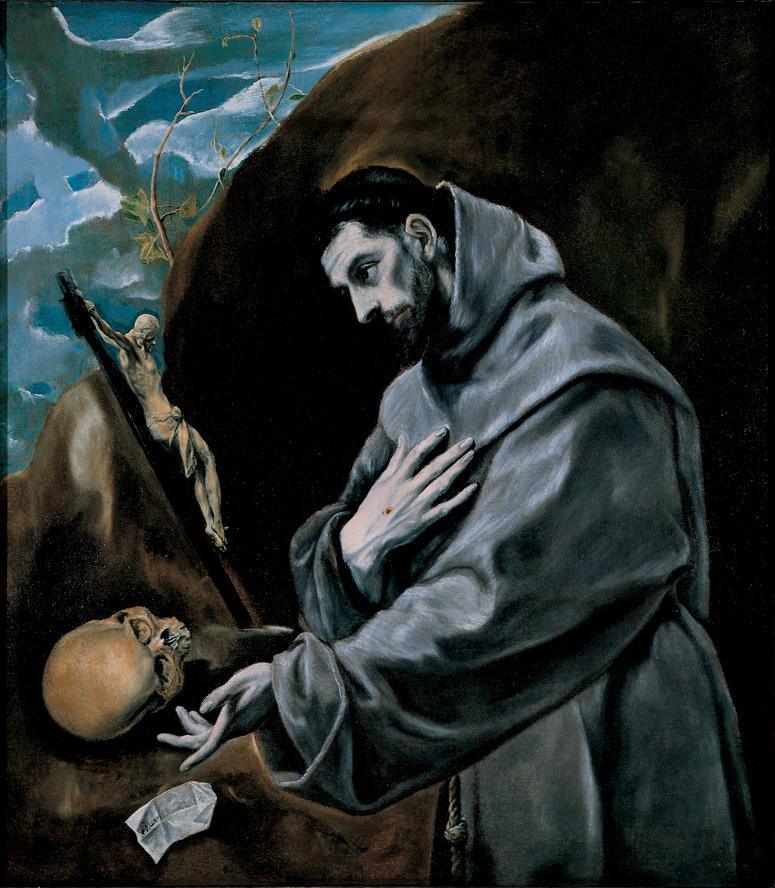
The painting shows Saint Francis of Assisi kneeling in a rocky landscape, absorbed in prayer before a crucifix. The bearded figure, dressed in a loose bluish-gray robe, occupies the center and right side of the composition. One hand rests on his chest, while the other reaches toward the ground, in a gesture that combines physical composure with humility. On the left, the dark cross leans diagonally, bearing the figure of Christ crucified. In the foreground are an ochre skull, a pale sheet with small, indistinct marks, and rocky terrain. Behind the saint, a rocky mass resembling a shelter rises beneath a greenish-blue sky covered with clouds; bare branches accentuate the austerity of the setting.
The scene shows Saint Francis withdrawn in an austere setting and absorbed in contemplation of the Passion of Christ. As the founder of the Franciscan tradition, the saint embodies a spirituality associated with voluntary poverty, humility, and devotion. His simple habit and the absence of sumptuous elements place his prayer far from the inhabited world, amid a rugged natural setting that serves as a place of inner discipline. The image creates a devotional scene in which the presence of the crucifix shapes the character’s entire experience. Prayer thus becomes a means of drawing closer to Christ spiritually.
The crucifix forms the iconographic center of the work and the focus of Saint Francis’s gaze. Its tilt makes the cross an active part of the scene’s diagonal structure, as if descending from the space above toward the signs of penitence in the foreground. The skull introduces the traditional reminder of mortality and connects religious contemplation with an awareness of human frailty. The cave or rocky refuge can be read as a place of retreat and isolation, while the bare branches and cloudy sky reinforce the severity of the landscape. Together, these elements shape a meditation on renunciation, death, and spiritual concentration.
The formal construction directs the viewer’s attention through striking contrasts of scale, light, and direction. The monumental figure of Saint Francis dominates the space, but the cross and skull establish a descending axis that leads the eye toward the lower-left corner before returning it to the saint’s face and torso. The bluish grays of his habit stand out against the dark browns of the rock, while the bright sky opens up a visual breathing space behind the scene. Deep shadows lend weight to the cave and the ground; the clouds, by contrast, introduce movement in the upper part of the composition. The vertical composition and diagonal lines transform a static scene into an experience of contained tension.
In this work by El Greco, the elongated figure, spiritual expressiveness, cool, vibrant palette, and dramatic lighting transform the landscape into a setting for devotion. Nature is not merely a backdrop: its rocks, branches, and sky contribute to the saint’s isolation and heighten the distance between everyday life and sacred contemplation. Notice how the gesture of the hand on the chest finds its visual counterpart in the cross, while the skull establishes the earthly dimension of the scene. These three points—the body, the crucifix, and the symbol of mortality—organize an image in which human frailty becomes inseparable from prayer.
Have questions about our oil painting reproductions? See our frequently asked questions.