

Description
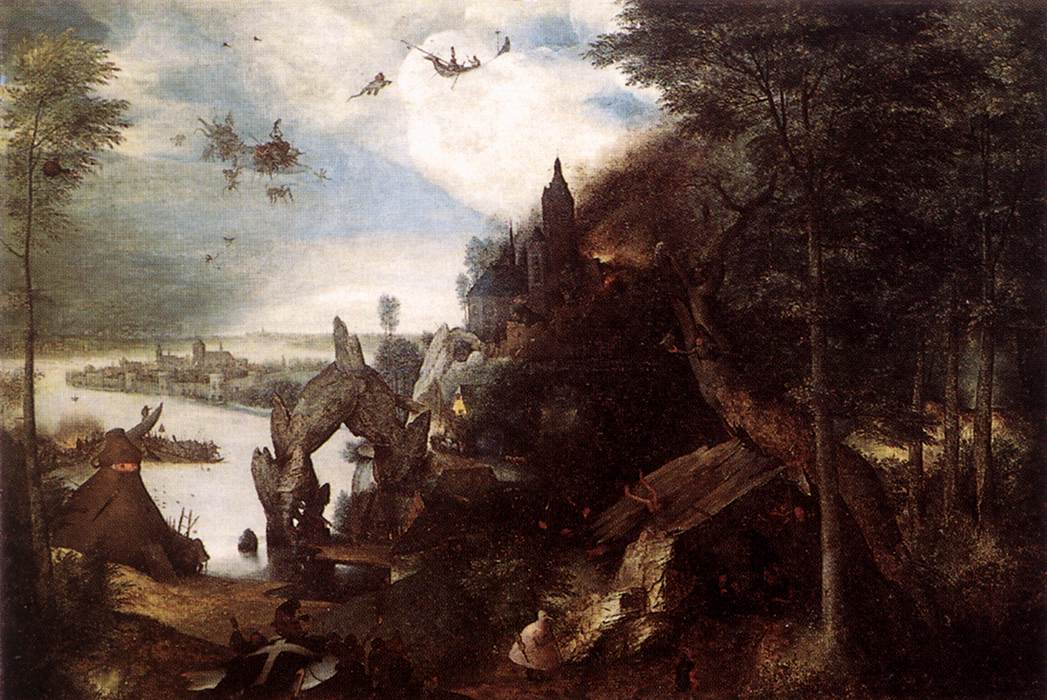
The painting depicts The Temptation of Saint Anthony as an unsettling vision of eremitic life in a remote landscape. A clear river flows from the distance toward the lower left edge, leading the eye between rocks, slopes and low vegetation. In the center, on the riverbank, stands a creature with a reptilian appearance and pointed forms, its scale dominating the surroundings. A dark, conical shelter occupies the foreground, accompanied by a small human figure, while a distant settlement and a slender tower with a sharp peak are hidden among the trees. The dense forest concentrates the visual weight in the right half, and a few birds cross the bright sky.
The scene alludes to Saint Anthony the Abbot, one of the great Christian exemplars of a secluded, penitential life. According to tradition, the hermit faced temptations and attacks by demons during his solitary retreat; for this reason, his story is often depicted in art through hybrid, monstrous or fantastic creatures. Here, the saint is reduced to a tiny presence within a vast natural setting, as if the spiritual trial were unfolding far from the inhabited world. The shelter conveys poverty and isolation, while the buildings in the background serve as a reminder that a distant community exists, separate from this place of contemplation and danger.
The central creature can be read as a visible manifestation of temptation and the forces besieging the hermit. Its body occupies the point of greatest narrative tension, among fallen trunks, rocks and vegetation, turning the riverbank into a scene of menace. The contrast between the open river and the enclosed forest heightens the opposition between light and confinement, serenity and disturbance. The small figure beside the shelter provides a fragile human scale against the monster and the landscape. Even the pointed tower and remote settlement contribute to this reading: they are signs of an ordered world that remains beyond Saint Anthony’s isolation.
The composition is structured around a diagonal that begins in the sky and the river, crosses the center occupied by the creature, and ends in the tangle of tree trunks in the foreground. The left side, bathed in pale blues, cloudy whites, and bright reflections, provides depth and a sense of openness; by contrast, the browns, olive greens, and blacks of the forest form a dense mass that arrests the gaze. The fallen trunk introduces jagged, rough lines, while the flow of water establishes a fluid direction. The differences in scale—tiny birds, human figures, a shelter, trees, and a monster—create a sense of an immense world and keep the eye moving.
In relation to Pieter Bruegel the Elder, the work can be placed within a conception of narrative landscape that combines expansive settings, secondary details, and fantastical episodes with moral resonance. Nature does not function as a mere backdrop: it shapes the spiritual experience and makes visible the distance between the saint’s retreat and the everyday world. When viewing the painting, it is worth first following the river into the distance and then returning to the central creature; this journey reveals how the open light gradually leads into the gloom. In this way, the religious theme, the monster, and the landscape’s structure come together in a single experience of isolation, threat, and inner resilience.
Have questions about our oil painting reproductions? See our frequently asked questions.