

Description
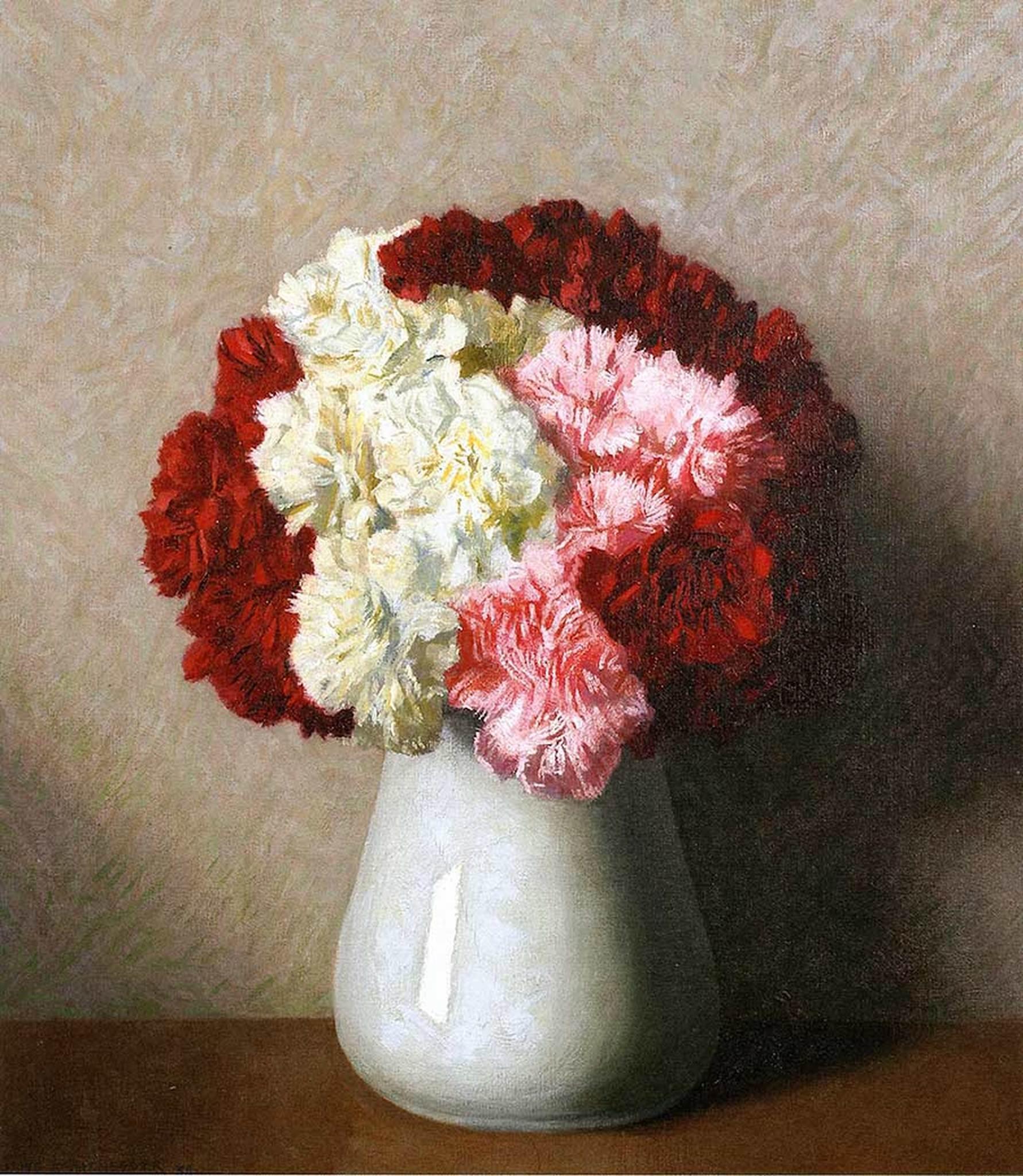
The painting shows a compact bouquet of red, white, and pink carnations arranged in a white vase on a wooden surface. The flowers form an almost circular mass in the upper part of the composition, while the rounded vessel establishes a simple, stable vertical axis. Their curled, scalloped petals create a richly abundant surface: the white flowers occupy the center, the red ones trace the outer edge, and the pink tones reach toward the lower-right foreground. Behind them, a beige, painterly-textured background keeps the scene within an intimate domestic setting. The broad shadow cast by the bouquet and vase falls to the right, revealing the direction of the light and giving the objects physical weight.
As a floral still life, the work focuses on the tangible presence of cut flowers and their relationship to the everyday objects that hold them. The bouquet does not appear isolated in an abstract space: it rests on wood and stands out against a neutral wall, as part of a quiet room. This choice locates beauty on a close, domestic scale, far from ceremonial representation or an open landscape. The carnations bring chromatic variety and a wealth of forms, while the white vase and subdued background contain their exuberance within a scene of serene balance.
The flowers in different colors evoke vitality, natural diversity, and the evanescent beauty characteristic of the still-life tradition. The compact bouquet makes each flower part of a shared whole, even as their hues retain distinct personalities. The white vase offers a visual pause against the intensity of the petals. Meanwhile, the dark shadow extends the flowers’ presence beyond their visible outline: it adds depth and creates a sense of stillness, weight, and transience. The floral abundance is thus linked to an awareness of its fleeting nature.
The formal structure relies on a carefully orchestrated contrast. The bouquet’s almost circular shape draws the eye to the upper area, where red acts as a chromatic border and guides the gaze toward the central whites and the pinks in the foreground. The lighter vase, with its soft lines, breaks up the density of the flowers with a clean base that gives the composition room to breathe. The wood introduces a firm horizontal line, while the beige wall expands the space without competing with the main subject. Side lighting models the petals, separates some clusters of flowers, and casts a diagonal shadow to the right; in this way, a static scene gains depth, direction, and rhythm.
In Roses, Hans Emmenegger turns a domestic subject into a visual meditation on the intensity of color and the fragility of flowers. The work’s appeal arises from the tension between the exuberance of the bouquet and the restraint of its surroundings. Notice how the red edge encloses the composition, how the whites serve as a luminous center, and how the pink flowers bring the bouquet closer to the viewer. The vase, wood, and shadow complete this material order, making the floral beauty feel at once abundant, immediate, and fleeting.
Have questions about our oil painting reproductions? See our frequently asked questions.