

Description
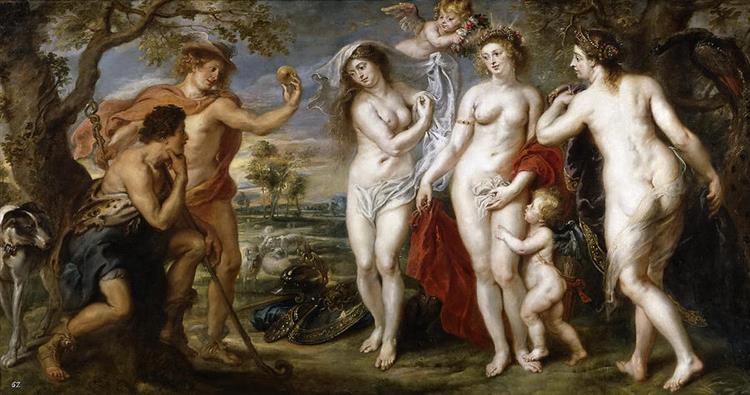
The monumental work "The trial of Paris", created by Peter Paul Rubens in 1636, is erected as a magnificent example of the Baroque mastery of the flamenco painter, known for its ability to instill life and dynamism in their compositions. The painting represents a mythological episode in which Paris, the Trojan Prince, must decide which of the three goddesses - a Minerva and Venus - deserves the famous golden apple that carries the inscription "for the most beautiful". This mythological story is interpreted by Rubens through a rich iconography and an enveloping visual narrative, which provides an emotional and dramatic context.
The use of color in this work is one of its most outstanding aspects; Rubens applies a vibrant and sophisticated palette that evokes luminosity and heat. The golden and warm tones predominate in the clothing of the goddesses and in the skin of humans, which creates a delicious contrast with the darkest funds. This chromatic choice not only establishes a visual and symbolic link between the characters, but also highlights the sensuality of the figures. Venus, the goddess of love, is represented in a triumphant position, with a seductive expression, inviting the viewer to participate in the narrative of choice and desire.
The composition is remarkable for its clear visual hierarchy. In the center, Venus occupies a prominent position, his naked body contrasts with the decorative clothing of Juno and Minerva. The way Rubens organizes the figures in an imaginary triangle emphasizes the tension between the goddesses, all framed by the natural environment that unfolds in the background. This landscape, with its soft hills and exuberant vegetation, serves as a backdrop that complements the main action, providing a sense of space and freedom.
Rubens, recognized for his ability in portrait and visual narration, manages to imbute each figure with an individuality that allows viewers to capture the subtleties of their character. Juno, majestically dressed, radiates authority, while Minerva, with a help and armor, suggests strategy and wisdom. His gestures and looks, loaded with meaning, invite Paris to contemplate his decision, reflecting the complexities of Greek values about beauty and honor.
In addition, sensuality in female representation, typical in Rubens's work, is particularly notable in "the Paris trial." The skin of the goddesses shines with the light, delivering an ideal of classic beauty that is characteristic of the painter's work. This approach in the female body, along with its voluptuous representation, challenges the notion of classical proportions while celebrating humanity in its purest form.
The influence of Renaissance art is palpable in this work, but Rubens goes further, integrating his emotional elevation and personal style that feels the foundations of Baroque art. His ability to capture energy and movement, as well as his talent for the representation of color and light, extend it as a master Insurrent in Western art.
"Paris's judgment" is not only a testimony of Rubens's pictorial ability, but also a milestone that encapsulates a moment of splendor in art history, where narrative, emotion and beauty converge in a celebration of the aesthetic ideal . This work contains within its reflection on the nature of desire, aesthetics and the relationship between the divine and the human, inviting observers to immerse themselves in the rich universe of classical mythology, exploring their links with the eternal emotions that endure to this day.
KUADROS ©, a famous paint on your wall.
Hand-made oil painting reproductions, with the quality of professional artists and the distinctive seal of KUADROS ©.
Reproduction service paintings With a guarantee of satisfaction. If you are not completely satisfied with the replica of your painting, we refund your money 100%.