

Description
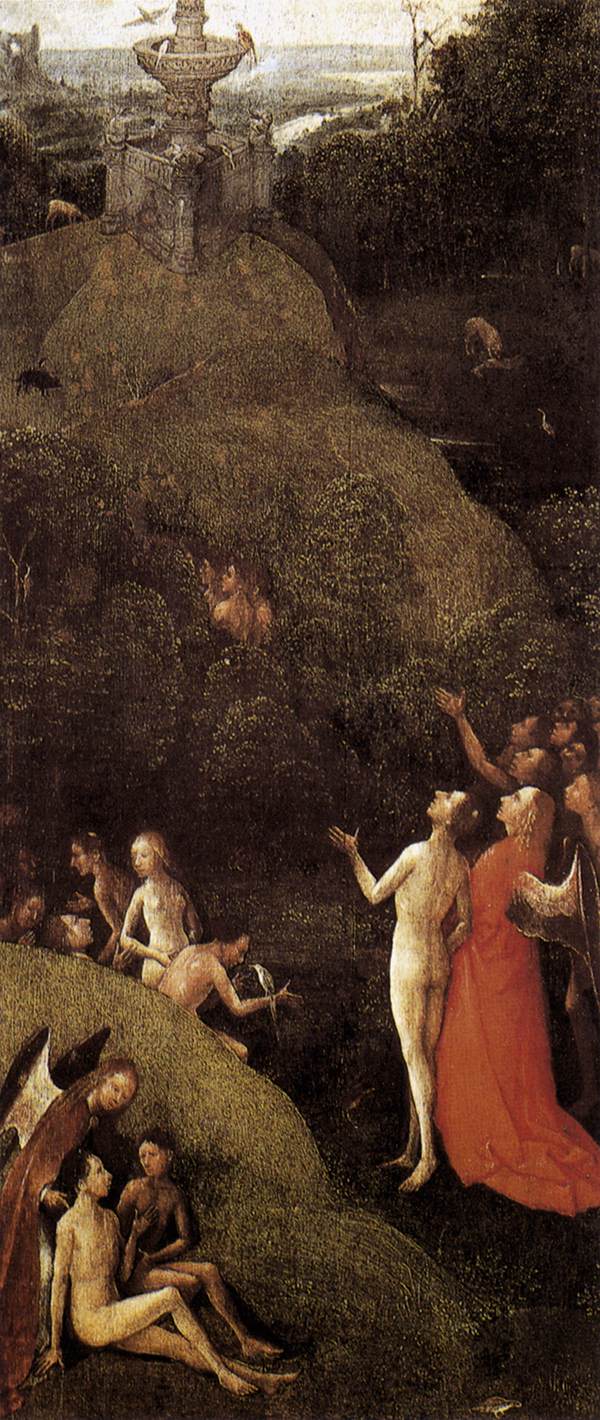
The painting depicts an imagined earthly paradise as a secluded, deep and luxuriant garden. A monumental stone fountain rises in the upper part, with a broad basin and a pedestal that dominates the composition like an architectural axis. Paths and stretches of ground descend from this point among hedges, trees and vegetation-covered slopes. Numerous human figures occupy the space: some appear nude or partially clothed, seated or reclining in the lower area; others gather in the centre and on the right. A pale figure stands with one arm raised beside another, larger figure dressed in red. The variety of poses—resting, conversing, contemplating or gesturing—animates the garden without diminishing its sense of seclusion.
In the Christian tradition, the Garden of Eden represents earthly paradise and humanity’s primordial state. The scene draws on this narrative framework without presenting its figures as identifiable biblical characters: what matters is the vision of fertile nature, where human beings live surrounded by abundance. The fountain reinforces this reading as an image of life, renewal and fertility, while the paths guide the eye through a space that extends towards the open, luminous landscape in the background. This distance creates a suggestive separation between the leafy enclosure and the outside world.
The nudity of several figures evokes a primordial humanity, preceding social conventions, while also introducing a dimension of bodily pleasure and freedom. The red garment stands out among the dark greens, browns, and ochres, adding a note of human intensity to the scene. Against this chromatic presence, the pale bodies act as flashes emerging from the vegetal shadows. The fountain, positioned above them all, evokes abundance and fertility; the paths and profusion of foliage turn the garden into an idealized space, though not one entirely at peace. The dense vegetation and half-light lend the promise of fulfillment a mysterious, allegorical dimension.
The composition is constructed in depth and along a descending diagonal that begins at the fountain and leads the eye toward the groups in the foreground. The contrast in scale is decisive: the monumental architecture establishes the upper frame, while the figures, small and numerous, are arranged like episodes within the landscape. In the lower left, the seated and reclining bodies form a horizontal rhythm that balances the vertical concentration on the right. Light is reserved for the pale surfaces of the skin, the red garment, and the distant background; all around them, masses of vegetation create dark corridors that fragment the view and compel the viewer to explore the painting slowly. Thus, the garden is perceived at once as an ordered setting and as an almost boundless world.
The visual language of the work is consistent with the world widely associated with Hieronymus Bosch: fantastical, densely populated landscapes, allegorical imagination, and groupings of people that turn every area of the painting into a focal point for observation. The scene does not present paradise as a flat image of perfection, but as an ambiguous, theatrical territory full of stimuli. It is worth pausing first at the fountain, then following the leafy slope, and finally returning to the light-toned figures in the foreground: this route reveals how natural abundance, human presence, and chromatic darkness depend on one another. Paradise thus appears as a luminous promise wrapped in mystery, shaped by the fountain and by the contrast between human life and the garden’s dense foliage.
Have questions about our oil painting reproductions? See our frequently asked questions.