

Description
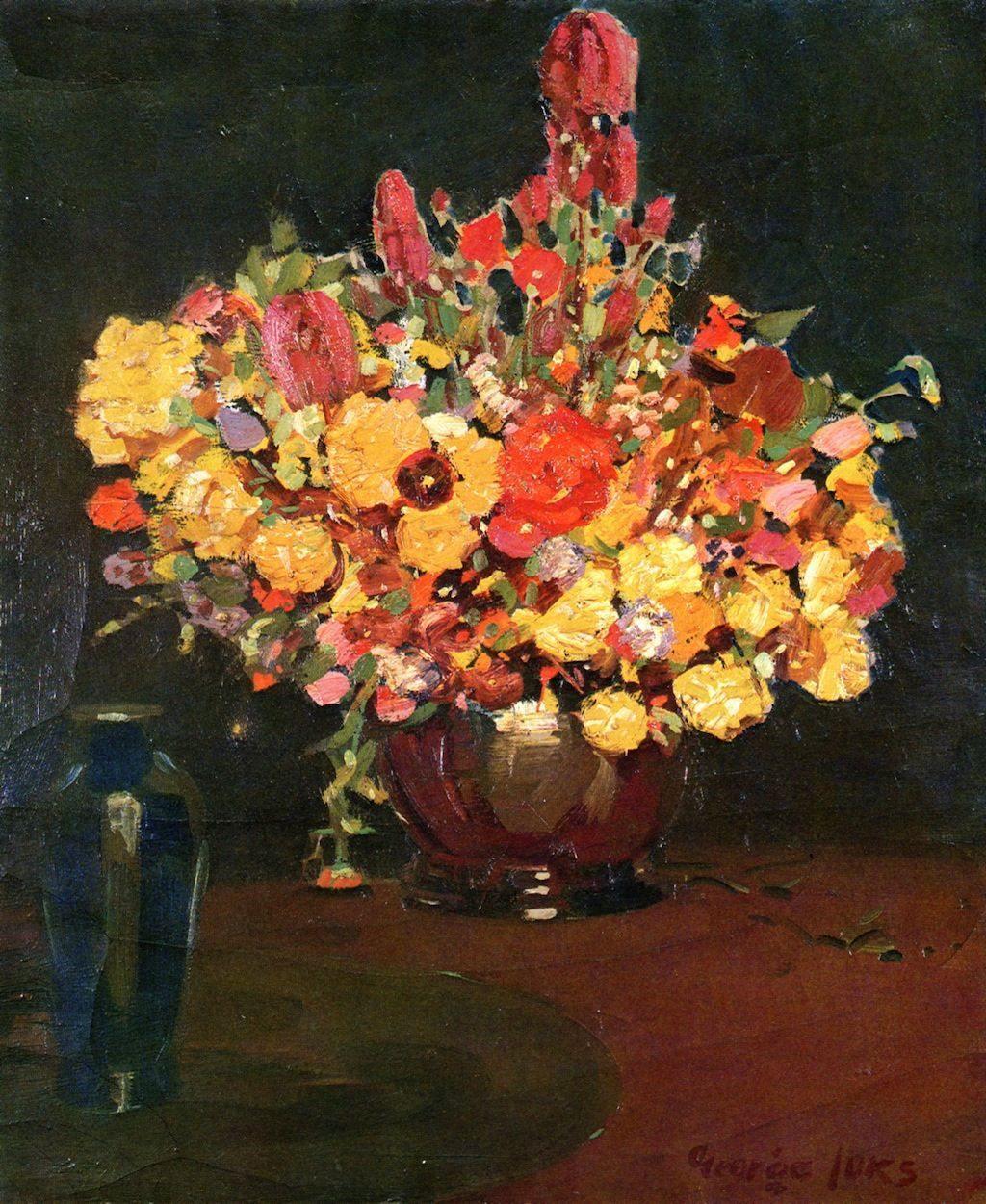
The painting depicts a floral still life with a striking presence and an intimate character. A lavish bouquet brings together yellow, red, orange, pink, and white flowers in a compact mass that spreads out to the sides and rises to fill almost the entire composition. Stems and green leaves intertwine among the petals, while a rounded vase in reddish-brown and muted green tones holds the arrangement on a table in the same warm palette. The very dark interior background allows each flower to stand out as a focal point of color and makes the domestic arrangement the undisputed center of the scene.
October Flowers belongs to the still-life genre, a pictorial tradition devoted to observing objects gathered in a still space and transforming their everyday presence through color, light, and composition. Here, the title’s reference to a particular time of year evokes a season without limiting the interpretation to any specific flower species. The main interest lies in the grouping of forms and hues: the bouquet serves as a visual inventory of diverse flowers, arranged around a stable vessel and a domestic surface that anchors its exuberance.
The profusion of flowers reinforces an image of abundance and vitality. The large yellow forms bring luminosity and act as points of expansion within the bouquet; the reds and oranges introduce intensity, warmth, and visual weight; the pink and white petals create more delicate pauses among the more saturated areas. The shadowy background focuses attention on this chromatic richness and gives the gathered blooms an almost theatrical presence. The vase provides an essential counterpoint: in contrast to the variety and movement of the flowers, its compact volume offers stability and restraint.
The composition is built vertically, with a central axis that begins at the vase and continues up through the stems to the flowers above. Yet the bouquet avoids rigidity: its edges widen irregularly, some flowers lean to the sides, and the leaves interrupt the continuity of the block of color. The eye thus moves across different levels, from the tall, elongated flowers to the rounded clusters in the middle and lower areas. The visible brushstrokes and contrasts between warm colors and greens lend rhythm to the surface, while the reddish table visually extends the body of the vase and reinforces the material unity of the arrangement.
In this work by George Luks, a domestic bouquet becomes an almost theatrical presence: the abundance of flowers and their warm colors emerge from the dark background, while the reddish vase organizes and contains the visual exuberance. The painting’s strength depends not on a complex narrative but on the tension between abundance and structure, between the petals’ organic freedom and the vessel’s solidity. Notice how the yellow and red flowers guide the eye, how the greens articulate the spaces in between, and how the surrounding darkness intensifies each change of color.
Have questions about our oil painting reproductions? See our frequently asked questions.