

Description
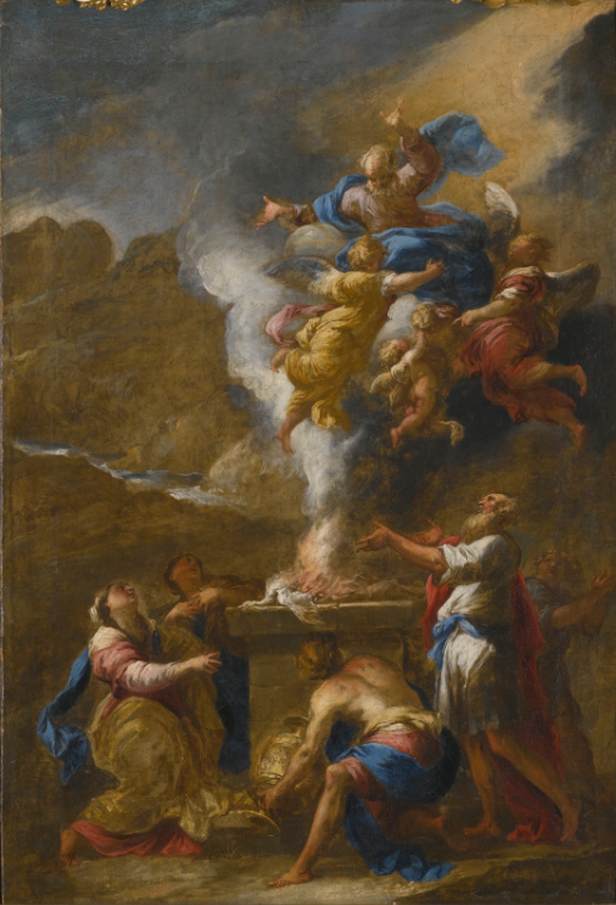
The painting depicts The Sacrifice of Noah as a dramatic, ascending vision. In the foreground, Noah kneels beside a low altar, his arms outstretched in prayer and offering. Beside him, a figure with a bare torso leans toward the ritual’s center, while another standing figure raises both arms, their gestures forming a human arch around the altar. Above them, a luminous column of smoke or fire rises, connecting the earthly scene with a group of figures suspended among the clouds. The landscape opens onto dark mountains, rocks, vegetation and a watercourse, beneath a cloud-laden sky pierced by an opening of light.
The episode comes from the account in Genesis following the Flood. After surviving with his family and the animals, Noah builds an altar and offers sacrifices in thanksgiving for his deliverance. The ritual ushers in a moment of renewal: the catastrophe is over, and a covenant is established between God, Noah and all living creatures. The painting captures this transition in a moment of religious intensity without depicting the Flood itself. The mountainous terrain, water and turbulent sky serve as traces of a transformed world, while the offering expresses a human response of gratitude and reconciliation.
The altar and the luminous plume of smoke form the work’s iconographic core. Rising from the offering, the column transforms the material of the sacrifice into a visual pathway to the divine. Noah’s kneeling posture conveys humility, while his open arms also extend the gesture toward the landscape and the celestial figures. The group among the clouds gives the ceremony a supernatural dimension and establishes a dialogue between the human world and the realm above. The surrounding darkness heightens the symbolic significance of the light: it does not dispel nature’s drama, but transforms it into a promise of renewal.
The composition is organized around a vertical axis that begins at the altar, passes through the smoke, and culminates in the elevated central figure, wearing a blue mantle with arms outstretched. Around this axis, the lower figures form a semicircular base of contrasting gestures: bowing, prayer, and exaltation. The diagonals of the fabrics and bodies guide the eye from one figure to another, preventing the scene from becoming static. Deep blue, red, gold, and white stand out against the browns, grays, and dark greens of the landscape. The luminous opening in the sky draws attention to the upper part, while the mountains and stream enhance the sense of depth and situate the rite in a vast, vulnerable natural setting.
The work of Valerio Castello is in keeping with a Genoese Baroque sensibility, evident in the dynamic composition, the upward movement of the forms, the intense contrasts of light and shadow, and the vivid colors of the garments. The scene transforms an act of gratitude into a visual experience of transition between catastrophe and hope. It is worth noting how the smoke from the altar not only separates the two levels of the composition but also connects them: Noah’s prayer, the movement of the figures, and the celestial light all participate in the same upward current. Thus, the landscape after the flood ceases to be a mere background and becomes the setting for spiritual renewal.
Have questions about our oil painting reproductions? See our frequently asked questions.