

Description
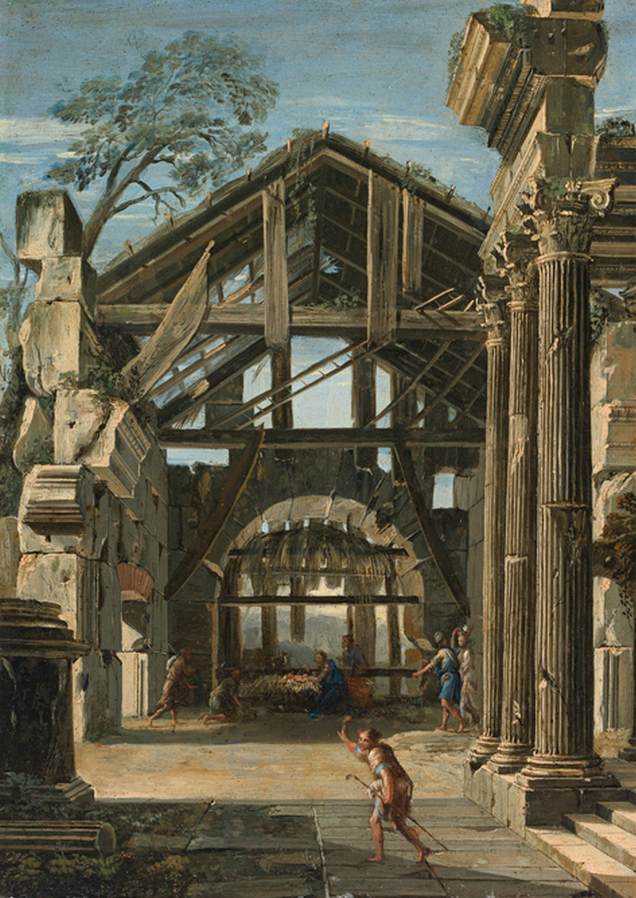
The painting shows the Nativity set within a vast landscape of classical ruins. Beneath the central arch, a small group of figures gathers, drawing the narrative focus, while another figure advances in the foreground with one arm raised and several people occupy the area beside the opening on the right. Fluted columns, fragmented pedestals and remnants of an entablature frame the scene; above, a partially collapsed wooden framework reveals the sky. A leafy tree leans in from the left, while the large paving stones lead the eye into the architectural interior. The ochres of the stone, the browns of the wood and the muted greens stand out against a pale blue sky, creating a sunlit scene in which human activity seems to continue amid the vestiges of an ancient world.
The Nativity represents the birth of Jesus Christ and, in Christian tradition, places Mary and Joseph beside the infant Jesus in a humble setting. Here, that shelter becomes a monumental space: the humble circumstances of the birth are surrounded by columns, arches and deteriorating structures that evoke a vanished civilization. The religious scene is not isolated from everyday life, but incorporated into an open landscape where figures move about, gather and temporarily inhabit the ruins. This combination of a sacred episode and ancient architecture broadens the narrative: the Christian birth is presented as an intimate event set within a much more extensive historical memory.
The architecture serves both as a setting and as a visual symbol. The broken columns and sagging framework prompt reflection on the fragility of human constructions, while the central group conveys a sense of presence and continuity. The small scale of the figures against the monumental ruins heightens the contrast between the humble and the grand: the significance of the event does not depend on its physical size. The arch acts as a threshold, drawing the viewer’s gaze toward the narrative’s focal point; behind it, the opening onto the sky and vegetation prevents the ruin from becoming an enclosed space. Daylight softens the signs of decay and connects the scene of the birth with a sense of renewal.
The vertical composition is structured around a system of lines and diagonals descending from the broken beams toward the arch, the pavement, and the foreground figure. The side columns function as monumental wings and stabilize the sense of depth, while the rectangular paving slabs establish a rhythm of perspective that guides the viewer’s eye. The central arch provides an intermediate focal point: it does not dominate through its size, but through its position and the concentration of figures beneath its shadow. Earthy colors unify the stone and wood, while touches of red and blue in the garments discreetly bring the figures into prominence. The tree introduces an organic mass that balances the architecture’s geometric severity, and the open sky brings light, air, and spaciousness.
In Viviano Codazzi’s work, classical ruins, deep perspectives, and small human figures come together in views with a strikingly theatrical effect. This painting brings these elements together to transform the Nativity into a scene of monumental scale, where the architecture does not overshadow the episode but frames it and gives it resonance. Notice how the eye moves from the figure in the foreground to the group beneath the arch and then toward the sky opening between the ruins. Along this path, the painting sets permanence against transformation: the stones preserve the traces of a powerful past, while the figures and light place the birth in a living present. The result is an image in which the intimacy of the sacred scene gains historical depth without losing its simplicity.
Have questions about our oil painting reproductions? See our frequently asked questions.