

Description
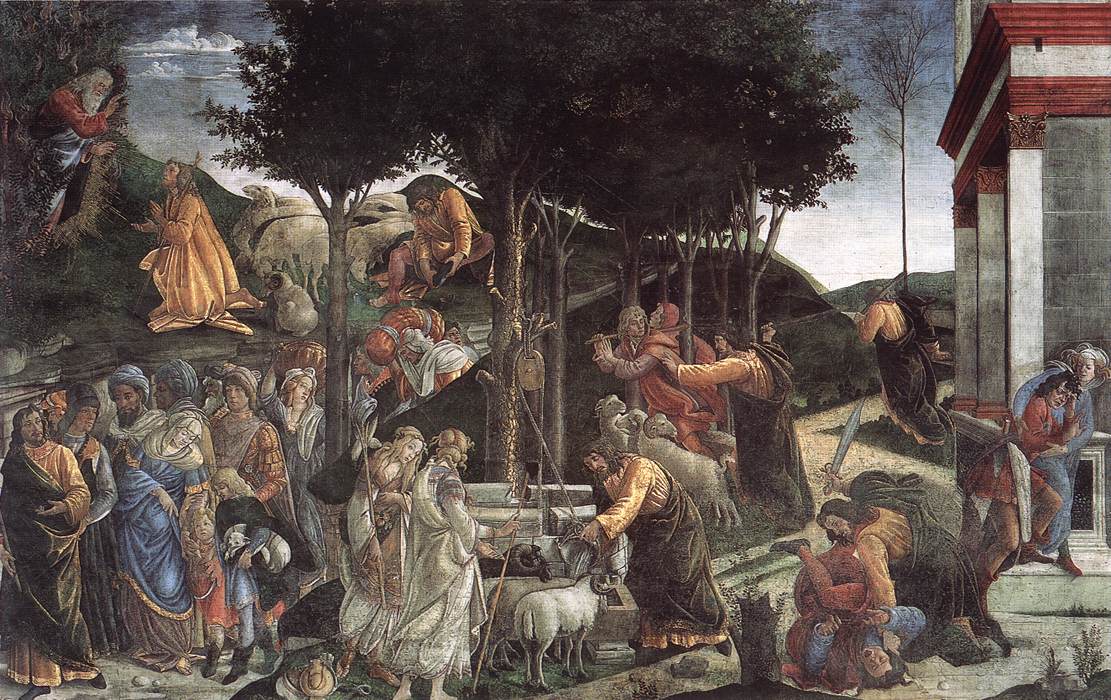
The painting unfolds a narrative populated with episodes from the life of Moses in a theatrical, wooded landscape. In the lower center, a rectangular well or trough organizes the action: several figures in tunics, veils and headdresses gather around it, while a woman leans over the well’s rim and sheep fill the foreground. On the left, a large group of figures gesture, talk or raise their hands; farther back, other groups are scattered among trees, rocks and a path. On the right, a monumental building with columns and a staircase introduces a dominant architectural presence, beside figures caught up in actions marked by movement and tension. The result is a continuous scene, filled with encounters, movement and expressive gestures.
The title, The Trials of Moses, guides the viewer toward several moments from his youth and his divine calling. Biblical tradition presents Moses as a central figure of the Exodus: after fleeing Egypt, he arrives in Midian and encounters the daughters of Jethro beside a well. There, he begins a period associated with pastoral life and the tending of flocks, before God calls him to free the Israelites. The painting brings these episodes together in a single composition, so that the viewer sees not an isolated scene but a narrative sequence in which encounter, trial and transformation unfold within the same landscape.
The well serves as the scene’s visual and iconographic focal point: it is a place of encounter and a point of transition between Moses’s former life and his future destiny. The sheep reinforce the pastoral atmosphere and connect the story with a life of work, travel, and care. The human groups, gathered in a variety of poses, turn hand gestures and bodily postures into signs of dialogue, tension, and recognition. The forest and the path evoke passage between different spaces, while the monumental architecture lends the scene a public and ceremonial dimension. The interplay of nature, human activity, and stone places Moses’s individual experience within a collective history.
The horizontal composition is densely populated, but the central tree acts as an axis that both divides and connects the areas of the scene. The well draws the eye to the middle foreground; from there, the groups spread toward the hills and the building on the right. The vertical architecture balances the mass of vegetation and creates a geometric counterpoint to the organic forms of the trees and bodies. Dark greens, browns, and ochres immerse the landscape in earthy tones, punctuated by muted reds, grayish blues, and creamy whites in the clothing. The bright sky and clouds create depth above the shadowy forest, while the sharply defined contours and succession of poses guide the eye from one episode to the next.
This work by Sandro Botticelli displays features widely associated with his style: elegant linear drawing, crisp profiles, rhythmic drapery, and a narrative structure shaped by expressive gestures. The figures vary in scale, linking the foreground with events in the background, as though each group formed part of a theatrical scene unfolding across the landscape. The well, the flock, and the architecture are not merely incidental details; they organize the narrative and shape its shifts in pace. Following this visual progression, the trials of Moses take concrete form through lines, colors, bodies, and spaces that respond to one another.
Have questions about our oil painting reproductions? See our frequently asked questions.