

Description
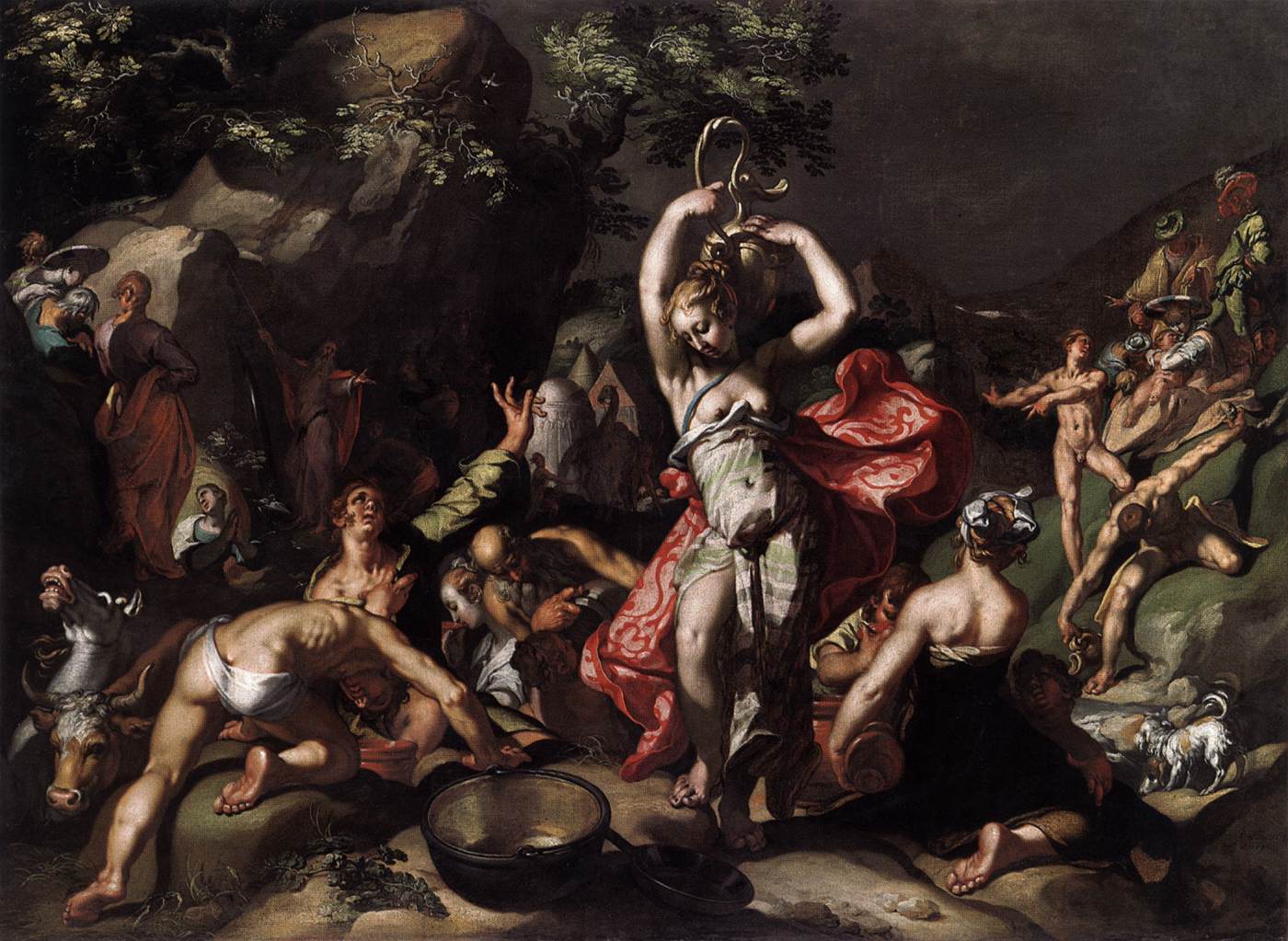
The painting shows Moses striking the rock before the Israelites in a rugged, dark and densely populated landscape. At the center, the prophet’s upright figure raises both arms and lifts above his head the staff associated with the action, while a large red cloth unfurls around him and draws the eye to the right. The scene is inhabited by numerous figures: some are nude or partially covered, others wear robes and headdresses, and several bend over, sit or lie in the foreground. Animals, vessels and belongings mingle with the bodies; prominent among them are the bovine in the lower-left corner and the large metal bowl in the lower center. Trees, rocks and a small structure in the background enclose the space.
The episode refers to the Exodus, when Moses, during the journey through the desert, strikes a rock and water gushes from it to quench the thirst of the people of Israel. The assembled crowd, accompanied by animals and possessions, turns the miracle into a collective experience: it is not merely the action of a leader, but of a community confronting need and sustained by divine provision. The painting concentrates the story in a moment of heightened tension, when Moses’ gesture gives shape to the expectations of everyone around him.
The central figure serves as the narrative and spiritual axis. His upright posture stands out among the bent, reclining or clustered bodies, while the raised staff creates a connection between human action and the rocky landscape. The red cloth brings an intense visual presence amid the greens, ochres, blacks and browns, and heightens the episode’s dramatic energy. The animals and vessels broaden the scale of the event: they evoke the journey of an entire community and make its daily life tangible. The selective lighting on the flesh tones and their contrast with the shadows accentuate the exceptional nature of the moment.
The horizontal composition is organized around an almost pyramidal structure, whose apex is Moses’ gesture. The foreground, crowded with people, animals, and vessels, provides a complex visual base; from there, arms, fabrics, and groupings lead toward the center and rise to the staff. The red cloth acts as a sinuous line, linking separate groups and bringing rhythm to the crowd. The rocky formations and the trees’ irregular crowns create a compact background, with little opening toward the horizon. This limited depth heightens the sense of crowding, while the alternation between illuminated areas and dark masses makes the scene vibrate between revelation and shadow.
In Abraham Bloemaert’s work, this combination of biblical narrative, dynamic figures, dramatic landscape, and contrasting colors is connected with the Dutch Mannerist tradition and its interest in complex compositions. The work turns an episode of divine provision into a choral spectacle: the upright figure of Moses, the expansive red, and the rock form the core of a network of gestures, bodies, and objects. Notice how the eye moves from the bowl and animals in the foreground to the central group and, finally, to the protagonist’s raised gesture; along this path, the formal construction transforms a crowded scene into an image of shared expectation.
Have questions about our oil painting reproductions? See our frequently asked questions.