

Description
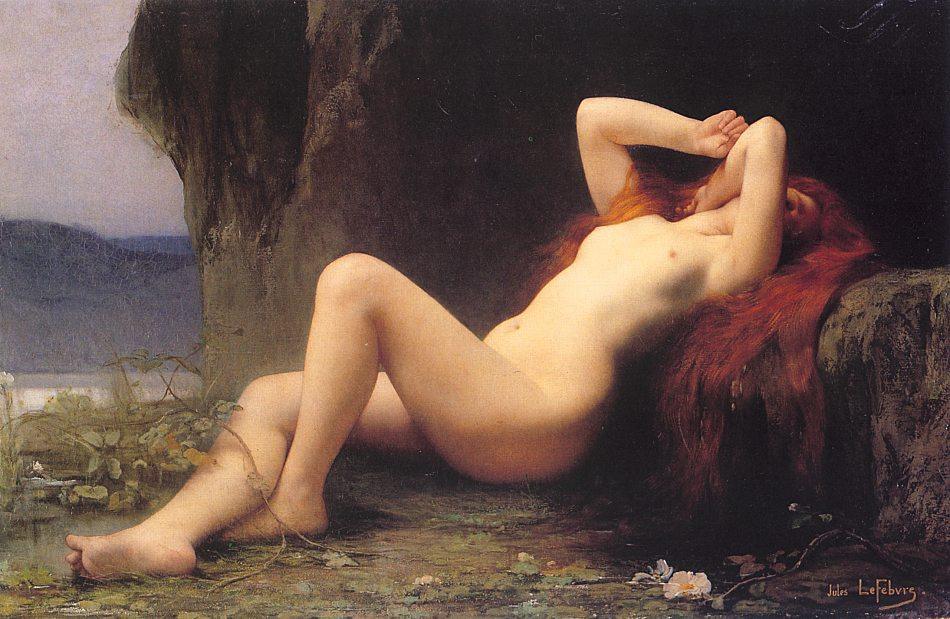
The painting shows Mary Magdalene reclining on the ground beside a large, dark tree trunk and a rocky formation that creates the scene’s natural shelter. Her nude figure stretches diagonally across the composition, with her legs bent and her arms raised behind her head. Her long, copper-colored hair spreads around her body and draws much of the viewer’s attention. In the background, a stretch of water, blue-gray hills and low vegetation can be seen, while branches, leaves and small flowers cover the foreground.
Mary Magdalene holds a prominent place in the Gospels and is associated with the events of Christ’s Passion and Resurrection. Later Christian tradition established her image as a penitent who had withdrawn to a solitary place, far from social life and worldly comforts. The title places the scene within the tradition of the cave as a place of retreat, although the composition is visually structured around the rock, the tree and the open landscape. Here, nature takes the place of any architecture of retreat, making isolation the work’s narrative focus.
In this context, nudity serves as a sign of vulnerability, renunciation and detachment from material things, while retaining its aesthetic dimension. The reddish hair acts as a visual attribute traditionally associated with Mary Magdalene and adds a vivid note against her fair skin. The tree trunk and stone introduce austerity, while the small flowers and vegetation preserve the vitality of the natural world. Penance is not presented as a sterile space, but as a quiet separation in which bodily beauty, mineral roughness and the vitality of the landscape remain in tension.
The horizontal composition is organized around the contrast between the tree trunk’s verticality and the diagonal line of the reclining body. The tree divides the background and provides a firm structure, while the figure leads the eye toward the rock and the flowing hair. Her pale skin emerges against the dark browns, muted greens, and blacks of the ground, becoming the painting’s luminous focal point. In the distance, the gray-blue water and hills open up a restrained sense of depth. The nearby vegetation, rendered as a web of lines and textures, brings the landscape closer to the viewer and heightens the sense of repose.
The work is associated with the refinement of French academic painting linked to Jules-Joseph Lefebvre, particularly in its careful treatment of the human figure, the nude, and the idealized painted surface. The precision of the body coexists with a natural setting constructed from dark masses, earthy tones, and soft light. The reclining body is poised between the serene sensuality of the flesh and the mineral austerity of the refuge; in this way, the landscape ceases to be a mere backdrop and becomes the visible embodiment of solitude, contemplation, and renunciation. The gaze ultimately returns to the contrast between the illuminated skin, the coppery hair, and the tree’s deep shadow.
Have questions about our oil painting reproductions? See our frequently asked questions.