

Description
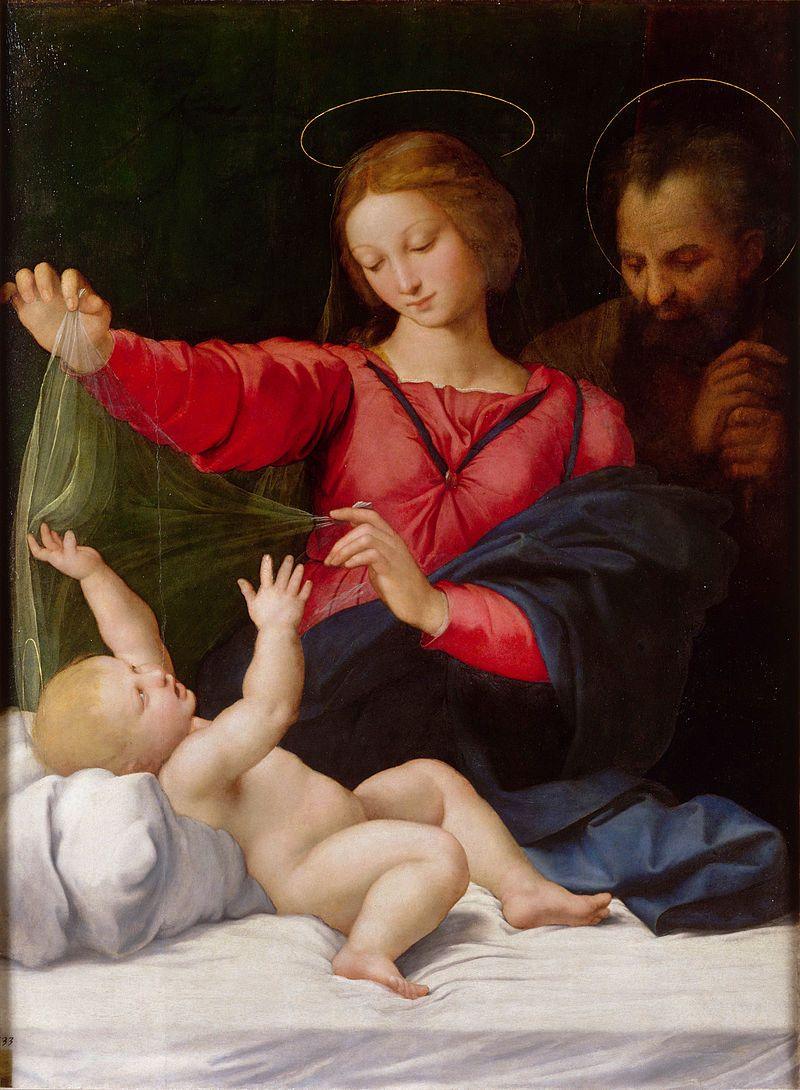
The painting shows the Virgin Mary seated beside the Christ Child, while Saint Joseph leans over them from behind, his hands clasped near his chest. The group is concentrated at the center of the composition: the woman, dressed in red, holds a fine, translucent cloth that extends from the left edge to the child’s body. The little one is shown naked, reclining on white drapery with his arms and legs outstretched. Two circular halos surround the heads of Mary and Joseph, standing out against the dark background, which is barely interrupted by vertical forms. The light draws attention to the faces, hands and child’s body.
The scene belongs to the tradition of Madonnas associated with the Marian cult of Loreto. Here, the Virgin and Child occupy the center of a familiar, devotional image, accompanied by Saint Joseph as a protective figure. Loreto is one of Italy’s major centers of Marian pilgrimage, and its tradition is linked to the Holy House; here, however, the focus is on the figures’ closeness, rather than on an architectural depiction of the shrine. The work thus presents an intimate vision of the Holy Family, suited both to religious contemplation and to meditation on maternal care.
The cloth Mary holds creates a visual and emotional connection between her hands and the Child’s body. Its transparency softens the separation between them and makes the protective gesture the symbolic axis of the scene. The child’s body, illuminated against the light-colored drapery, brings together vulnerability and humanity, while the halos affirm the sacred nature of the adult figures. Joseph’s beard and leaning posture lend him a calm, watchful presence. The contrast between these signs of holiness and the surrounding darkness reinforces the image’s contemplative quality, as though the family’s intimacy were sheltered from the outside world.
The vertical structure guides the eye in a downward movement: first come the faces and halos, then Mary’s hands, and finally the Child’s outstretched body. The Virgin’s arm draws attention to the left, while the translucent fabric creates a diagonal line linking the edge of the painting to the lower center. The crimson reds of her dress and the deep blues of the drapery form an intense core of color around the whites and creams. Light is concentrated on the figures, leaving the background in shadow, enhancing the sense of depth and bringing the figures forward toward the viewer. The abundant folds introduce rhythm and volume without disturbing the overall stillness.
In this work by Raphael, the balanced grouping of the figures, the clarity of the drawing, and the harmonious relationship between the bodies and drapery evoke the Renaissance tradition of devotional imagery. The composition combines idealization with intimacy: the halos indicate the sacred nature of Mary and Joseph, while their gestures and the child’s pose retain a domestic, tangible quality. Notice how the veil visually connects the Virgin with the Child, and how the dark background focuses all attention on this gesture of care. At this point, the formal construction and religious content become inseparable: the family scene is transformed into an image of silent contemplation.
Have questions about our oil painting reproductions? See our frequently asked questions.