

Description
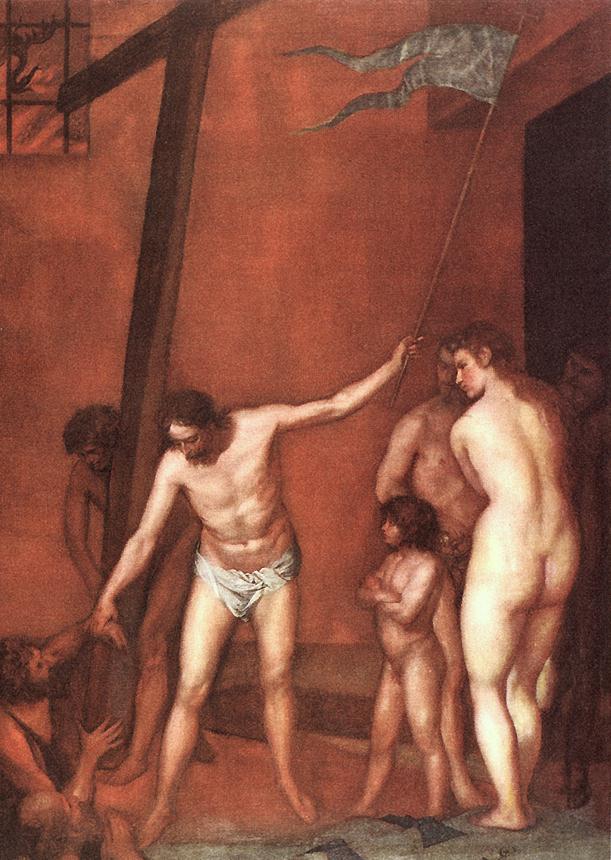
The painting depicts The Descent into Limbo as a compact, dramatic, and deeply theatrical scene. At the center, Christ appears with his torso bare and a light cloth around his waist, extending his arms as he holds a slanting pole that rises toward the upper right. Several human figures are gathered around him: a nude woman seen from behind, a muscular man standing behind her, a childlike figure in the foreground, and another presence partly concealed in the shadows on the left. The scene unfolds in a dark architectural space dominated by beams, posts, and a deep opening in the background.
The episode belongs to the Christian tradition that places Christ’s descent into the realm of the dead between the Crucifixion and the Resurrection. According to traditional doctrine, the righteous who had died before the Redemption awaited him there. The scene does not simply depict an underground space, but the moment when salvation breaks into a kingdom of waiting. The central figure brings the gathering of bodies together and establishes an upward narrative direction: Christ enters the realm of the dead bearing the promise of liberation. The nude or partially clothed figures can be read as the souls awaiting release from this liminal state.
The pole and the grayish banner serve as the composition’s principal iconographic attribute. Their presence introduces a sign of victory into a space dominated by dark red, shadow, and architectural forms. The banner turns Christ’s gesture into a visible proclamation and connects the episode with the Christian idea of triumph over death. The black opening at the far right reinforces the notion of a threshold, while the figures’ physical closeness heightens the collective dimension of the liberation. The light falling on the bodies establishes an expressive contrast between the surrounding darkness and the promise of salvation radiating from the protagonist.
Formally, the work concentrates its visual weight in the lower-right half, where the bodies overlap to form a densely packed group. In contrast to this accumulation, the large vertical beam on the left introduces a stark, almost architectural interruption that divides the pictorial field and heightens the sense of confinement. The pole creates the dominant diagonal: it begins at the center, crosses the space, and leads the eye toward the banner. Reddish and earthy tones unify the setting, while browns, blacks, and grays create depth through areas of shadow. The warm light on the human anatomy makes the bodies emerge as sculptural forms.
In the context of Alonso Cano’s work, the scene is consistent with a Spanish Baroque sensibility: a concentrated composition, figures with a sculptural presence, contrasting light, and a pronounced devotional focus. The painting turns Christ’s Descent into Limbo into a visual confrontation between darkness and salvation, without separating its spiritual content from the physical force of its figures. Notice how the diagonal of the banner connects Christ’s figure with the upper area, while the human group remains confined to the shadowy space. In this tension between ascent and confinement, between illuminated bodies and dark architecture, the work’s most powerful meaning takes shape.
Have questions about our oil painting reproductions? See our frequently asked questions.