

Description
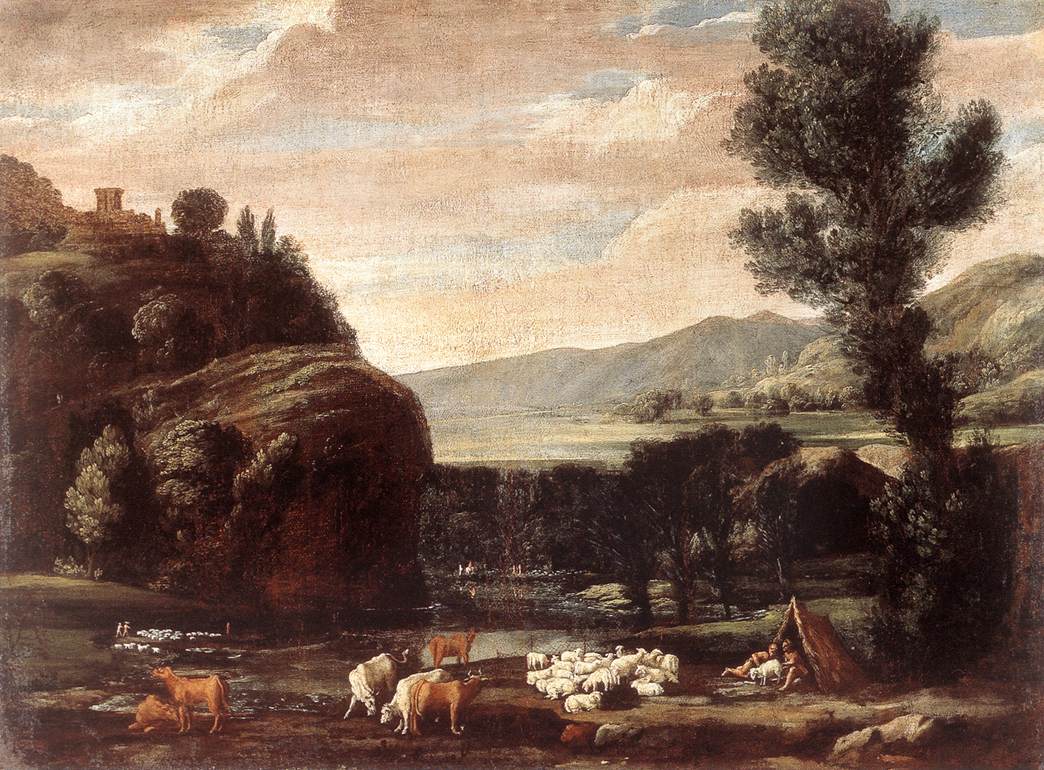
The painting depicts a broad pastoral landscape, with a flock of sheep and several cattle in the foreground, gathered before a valley crossed by water. The human figures, tiny beside the watercourse and a reddish shelter on the right, establish the relationship between the animals and their surroundings. In the distance, hills, wooded areas and a small structure perched on the left slope unfold one after another. The sky, stretching across the entire upper portion, bathes the scene in soft light and enhances its sense of space.
The subject belongs to the pastoral landscape tradition, in which rural life becomes the focus of a serene vision of nature. In Landscape with Shepherds and Sheep, everyday work is integrated into a far vaster setting: the shepherds and livestock do not dominate the land, but inhabit it and help define its scale. The combination of sheep, cattle, water, vegetation and small buildings presents the countryside as a place of coexistence, movement and rest. The scene does not depend on a complex anecdote; its appeal lies in the ordered contemplation of a rural world in balance.
The animals provide the composition’s narrative and symbolic core. The flock of sheep, gathered in the lower section, reinforces the idea of community and care, while the cattle add variety in form, colour and rhythm. The human figures, dwarfed by the landscape, place pastoral activity within a natural world that seems to extend beyond the painting’s boundaries. The water serves as a connecting line between the foreground and the mountains, while the elevated structure on the left adds a trace of human presence amid the vegetation. Together, these elements encourage an idealised, contemplative reading of country life.
The composition is organized in depth. The cattle and sheep form a dense, tactile base, with white, brown, and reddish patches drawing the eye toward the lower area. From there, the watercourse leads the eye toward the center and the horizon, while the bluish hills create layers of depth. A tall, dark tree on the right balances the wooded rise on the left and establishes a strong vertical within the panoramic format. Above this earthly structure opens a sky of light, cream, pink, and blue-gray clouds. The contrast between the dark masses of trees and the atmospheric brightness of the background creates gradual depth, without abrupt breaks, and sustains a measured rhythm between detail and distance.
In Pietro Paolo Bonzi, known as Il Gobbo dei Carracci, this spatial expansiveness and the presence of figures and animals connect with an Italian tradition of warm, populated Baroque landscapes. The work transforms a simple pastoral scene into a far-reaching visual construction: the flock and cattle provide scale, the water guides the eye, and the sky opens the experience to a sense of continuity. It is worth observing how the large tree on the right, the wooded mass on the left, and the hills in the background form a natural frame that focuses attention on the valley. In this way, rural life and the vastness of the landscape support one another, making the whole an image of active serenity and contemplative depth.
Have questions about our oil painting reproductions? See our frequently asked questions.