

Description
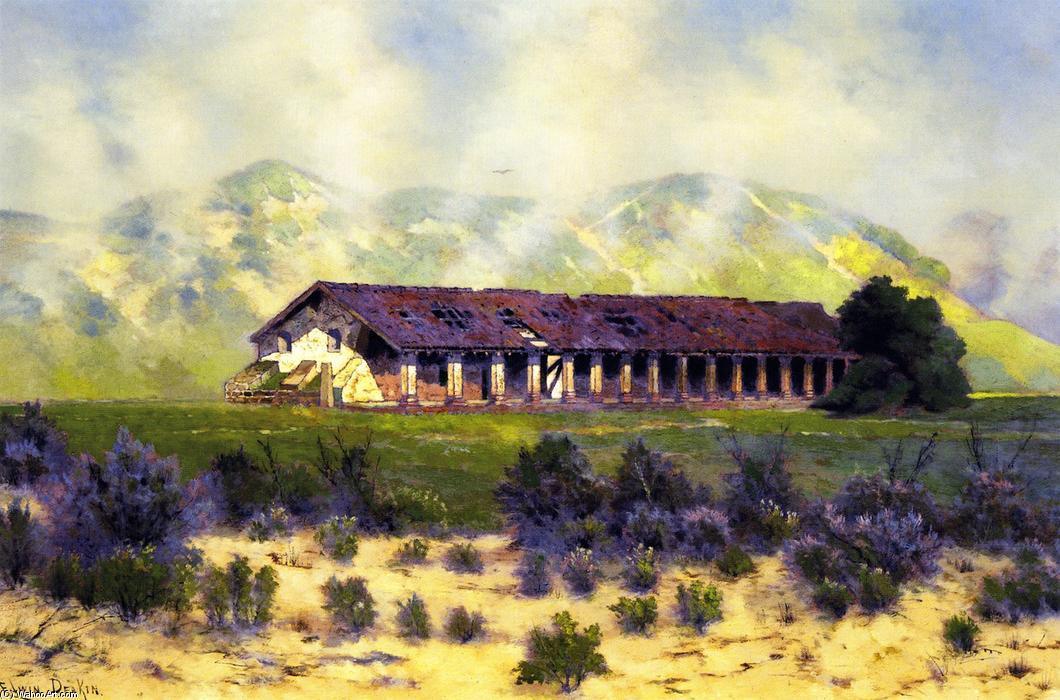
The painting shows Mission La Purísima Concepción serenely integrated into an open landscape. The building extends from left to right in a horizontal band, with a pale façade sheltered by a long porticoed corridor. The repeated columns create a measured rhythm beneath the broad roof of reddish tiles, weathered and marked by slight irregularities. At the far left, a section with a triangular gable rises, while a large dark tree flanks the right side and visually balances the architecture. In front, a green meadow slopes down toward a sandy foreground covered with shrubs and flowers in shades of violet and blue.
The scene presents the mission as a religious and architectural center connected to its surroundings, rather than as a building isolated from its environment. The dedication to the Immaculate Conception refers to a fundamental Marian tradition in Catholicism. In the context of the Spanish missions, the architecture brought religious, residential, and productive functions together within an organized complex. The corridor, pale walls, and tiled roof make this building tradition visible and turn the structure into a legible historical trace within the landscape. The painting avoids any specific narrative episode, focusing instead on the place’s enduring presence and its relationship with the natural world.
The covered walkway serves as more than an architectural detail: its continuity suggests a communal space for passage and gathering, while the building’s horizontal scale presents it as a stable landmark against the expanse of the hills. The foreground vegetation introduces a sense of continuity between the mission and the surrounding landscape. Scattered across the light-colored ground, the violet shrubs add a delicate, lively note to the memory of an old architectural structure. The densely crowned tree at the far right casts a deep shadow that contrasts with the overall brightness and reinforces the sense of shelter.
The composition is arranged in three clearly defined planes. In the foreground, the sandy ground and low vegetation create a tactile, fragmented surface, crossed by a light-colored area resembling a path. The middle ground consists of the meadow and the mission, whose façade line organizes the entire scene with a serene geometry. In the background, the green hills partially dissolve into a luminous, hazy atmosphere, extending the sense of depth without competing with the building. Color also creates this distance: the greens and golden yellows of the landscape contrast with the dark red of the roof, the violet of the flowers, and the grayish blue of the sky. The soft light unifies the surfaces and transforms the wear on the roof into an expressive quality associated with the passage of time.
In Edwin Deakin’s work, as presented here, historic architecture takes on a contemplative presence through the balance between structural precision and expansive landscape. The mission does not dominate its surroundings monumentally; it remains rooted in them, supported by the rhythm of its columns and embraced by luminous nature. Notice how the corridor leads the eye sideways, and how the tree, hills, and clusters of flowers interrupt that regularity with organic forms. The painting’s strength lies in this tension between architecture and landscape: the building becomes at once a memory, a refuge, and a point of orientation within a living landscape.
Have questions about our oil painting reproductions? See our frequently asked questions.