

Description
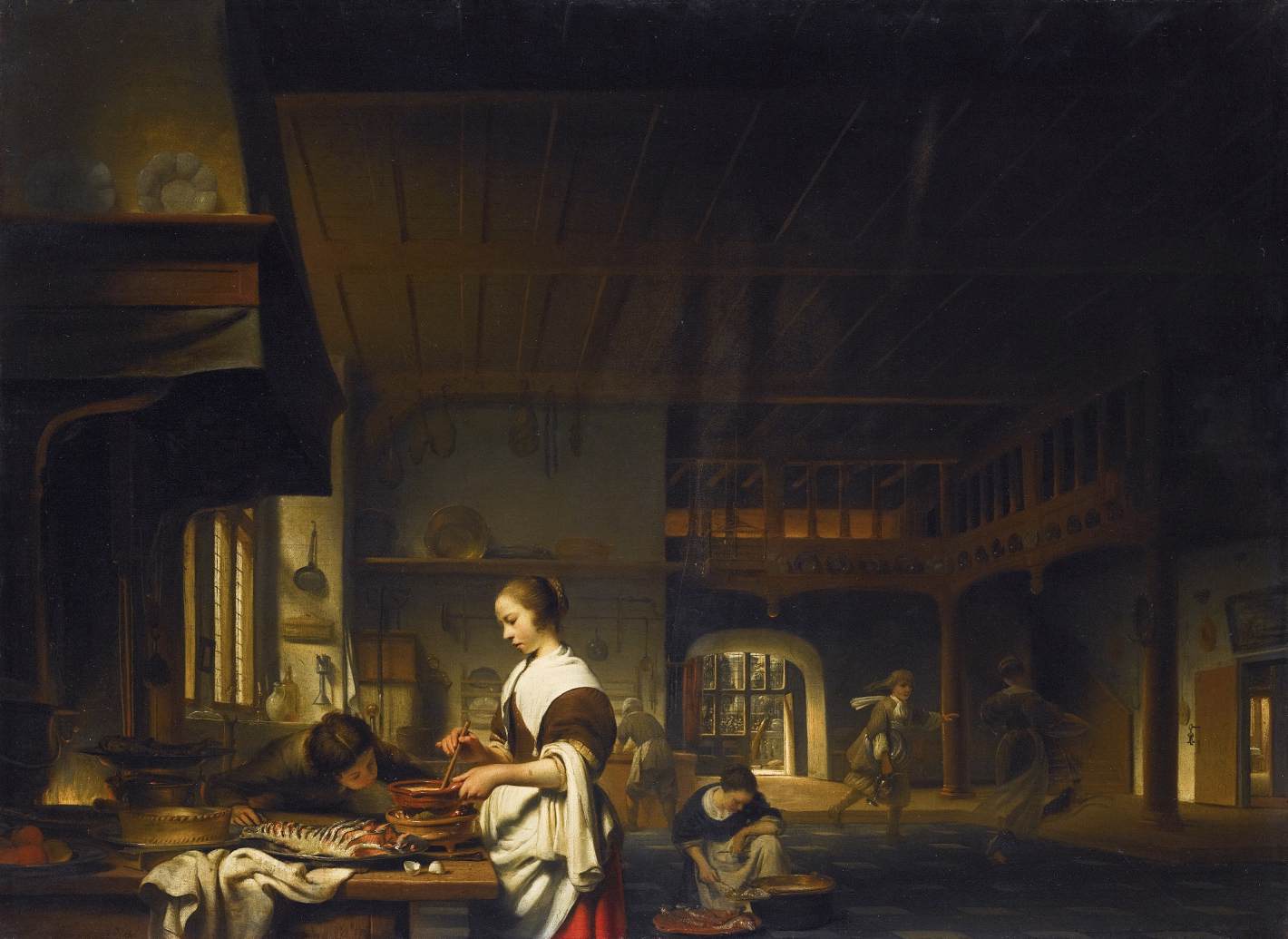
The painting shows a spacious kitchen interior bustling with activity. Several people are gathered around a worktable, focused on preparing food. At the center, a woman in a dark dress and a large white apron holds a utensil over a vessel and visually anchors the scene. On the left, another person leans toward the table; bowls, plates, pots, ladles and light-colored cloths are arranged around them. A large fish, placed on a board or tray in the foreground, provides a tangible focal point for the work being depicted. Farther back, other figures continue their tasks among shelves, vessels and work surfaces. The space extends beneath a ceiling of massive wooden beams, with an elevated gallery and tall windows admitting golden light.
The subject belongs to the genre of everyday life and domestic work. It is not a historical or religious episode, but a kitchen scene in which the activity of the group shapes the narrative. The figures are linked by a sequence of practical gestures involving food and vessels. The spacious room makes an ordinary task worthy of pictorial attention. The traditional architecture, hearth and abundance of utensils place the action in a domestic setting connected with producing and sustaining everyday life. The workspace is not merely a backdrop, but the setting that brings all the figures together and connects them.
The fish plays a decisive role in this interpretation: it is a direct indication of culinary activity and, at the same time, a visually striking object because of its size, scales, and position close to the viewer. The central woman, protected by her white apron, is the focus of the activity and forms an axis between the food in the foreground and the figures in the background. The hearth, pots, and hanging utensils emphasize the kitchen’s artisanal character. Light entering through the windows and the arched opening creates depth, while the half-light preserves the intimacy of the work. In this way, the domestic scene takes on an almost ceremonial quality without ceasing to be concrete and everyday.
The horizontal composition is organized into a succession of planes: the table and fish occupy the foreground; the central figures structure the middle ground; and the gallery, windows, and architectural elements lead the eye toward the background. The beams form strong lines that stabilize the scene, while the arches and openings create vertical and diagonal directions. The palette is built around deep browns, blacks, ochres, and ambers, punctuated by the creamy white of the apron, cloths, and some garments. This contrast makes the central figure an immediate point of reference. Warm light falls on the windows, hearth, and certain objects, leaving other areas in shadow and creating a dense sense of depth.
Without resorting to an extraordinary narrative, Kitchen Interior finds its strength in the coordination of bodies, tools, food and architecture. The scene transforms shared work into a visual choreography: the fish anchors the eye in the material world, the woman in the apron forms the central focus, and the golden light connects the foreground with the deep space beyond. Darkness does not conceal the activity but shapes it, highlighting hands, vessels and work surfaces. In this interplay of shadow and light, of the structural order of the beams and the variety of human gestures, the domestic interior becomes a complete world, filled with contained movement.
Have questions about our oil painting reproductions? See our frequently asked questions.