

Description
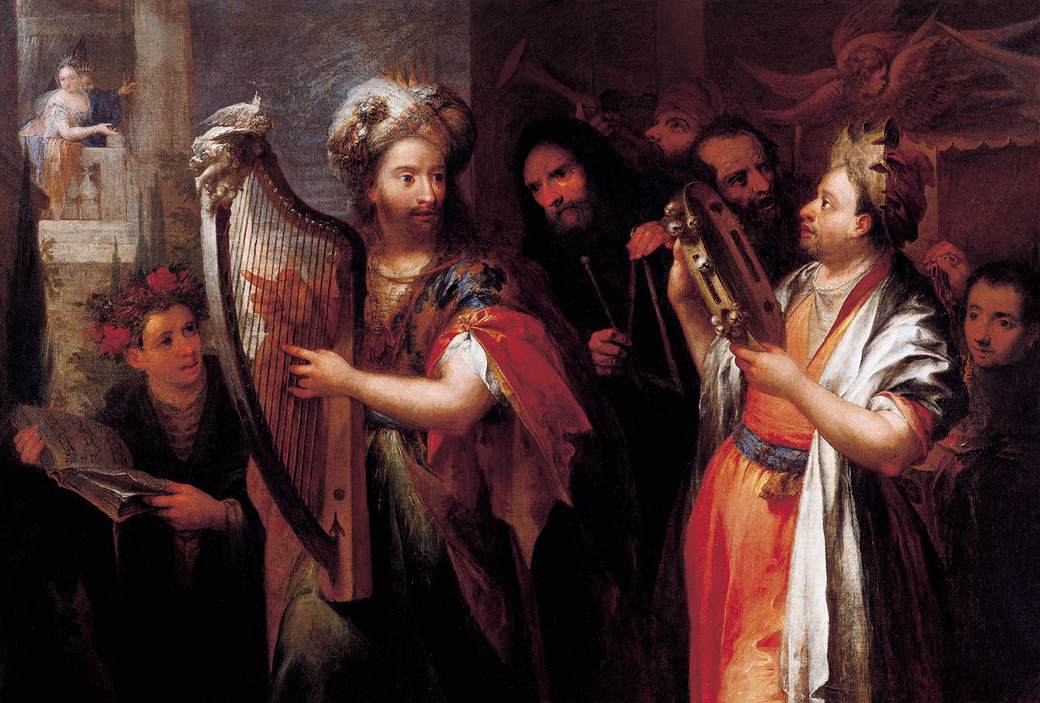
The painting presents David as the central figure in a solemn musical gathering. Standing in the center-left, the king plays a large, upright harp with a curved frame, whose strings structure the composition and draw the eye toward his hands. Musicians and spectators gather around him: in the foreground, a seated man holds an open book; on the right, another figure wears a light-colored shirt with red and blue bands and holds a tambourine. Bearded faces, dark hair and historically evocative clothing complete the scene, while a luminous opening appears in the background amid architectural elements. The dense, shadowy interior contrasts with the light entering from the left.
Biblical tradition presents David as the king of Israel and closely associates him with music, the harp and the psalms. In this work by Andrea Celesti, that association becomes a collective scene: David is not shown in isolation, but surrounded by those who listen, accompany him or take part in the performance. The painting does not need to depict a specific narrative episode to establish its meaning. The monarch appears as a musician and psalmist, an authoritative figure whose spiritual dimension is expressed through singing, reading and ceremonial gathering.
The harp serves as the attribute that defines David’s identity and establishes the scene’s symbolic axis. The open book introduces a dimension of memory, reading and textual transmission, closely connected with the idea of the psalms without reducing it to a specific liturgical object. The tambourine broadens the meaning of the solo instrument to encompass shared musical practice. The contrast between the dark interior and the illuminated opening is also significant: the light in the background creates a sense of depth while also serving as a counterpoint to the concentration of the musicians. The ornate headdress and the performer’s prominent position reinforce his regal presence.
The horizontal composition brings the figures together in an irregular semicircle around the harp. The diagonals formed by the instrument, the book and the arms holding the tambourine create a visual rhythm that links the different planes. Darkness dominates the lower area and the center, allowing the faces, hands, strings and light-colored fabrics to emerge as carefully placed accents. Browns, blacks, crimson reds and ochres build a warm, rich palette, interrupted by ivory whites and a muted blue. The contrast between light and shadow models the faces and heightens the theatricality of the gestures, while the partially overlapping figures create a sense of a compact group and interior depth.
The work transforms David into the focal point of a collective musical scene, in which the harp, book and tambourine convey authority, psalmic memory and Baroque theatricality. Rather than simply contemplating the central figure, it is worth following the gaze from the book in the foreground to the hands on the strings, and then to the tambourine and the faces that complete the visual chorus. Along this path, we can see how the composition turns a musical activity into an image of gathering, transmission and royal presence within a space steeped in shadow and light.
Have questions about our oil painting reproductions? See our frequently asked questions.