

Description
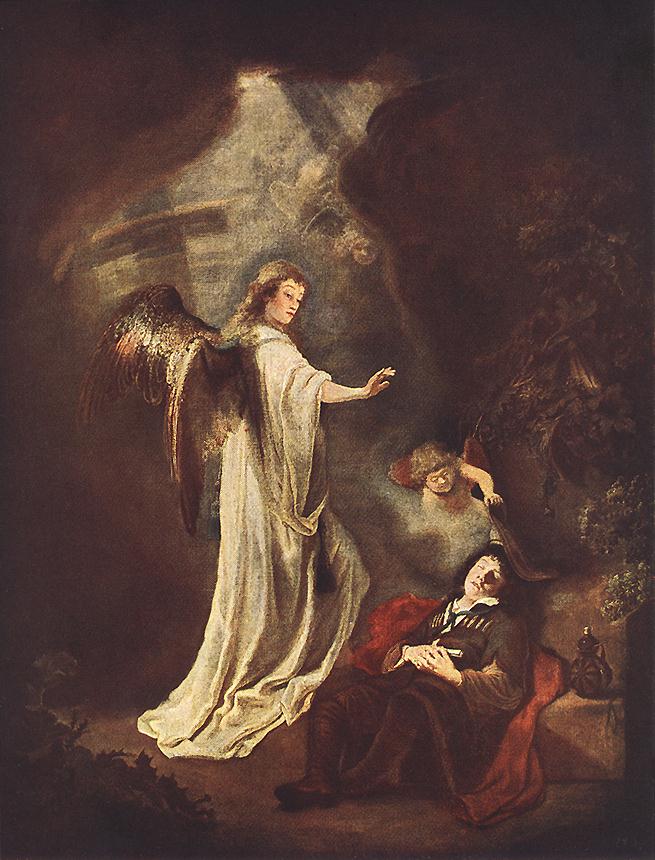
The painting depicts Jacob asleep in a nighttime setting, lying in the foreground with his face turned upward, while a winged figure leans over him from the center of the composition. The celestial figure wears a light-colored tunic and extends an arm to the right, a gesture that establishes a direct connection with the sleeper. A second, smaller winged presence can be seen behind, surrounded by drapery and feathery forms. The scene unfolds amid rocky ground, low vegetation, and dense woodland occupying the right side. Jacob’s red mantle introduces a deep note of color among the browns, blacks, and ochres, while the glow of the wings and garments sets the figures apart against the gloom.
The episode refers to the account in Genesis in which Jacob falls asleep during his journey and receives a vision connecting earth and heaven. In it, angels ascend and descend between the two realms, and God addresses the patriarch, reaffirming the promises made to Abraham and his descendants. The work focuses this experience of revelation in an intimate encounter: the traveler lies motionless on the ground, but his dream opens onto a supernatural realm. The secluded vegetation and dark landscape reinforce the sense of a suspended moment, far from the passage of everyday life and close to mystery.
The central winged figure can be read as the messenger of that communication between the human and the divine. Its dominant scale and inclined position make the apparition seem to descend toward Jacob, while the secondary presence broadens the celestial scope of the scene. The sleeping figure’s posture, with his face turned upward, presents him as the recipient of an experience that transcends wakefulness. The contrast between the luminous tunic, the dark wings with golden highlights, and the red mantle creates a network of visual meanings: light and shadow, protection and vulnerability, promise and isolation. The misty background transforms the natural setting into a visionary threshold.
The composition is structured around a diagonal that begins with the wings and the bright figure in the upper-left area, descends along the outstretched arm, and leads the eye to Jacob, positioned at the lower right. This path connects the apparition with the sleeping body and makes the gesture the painting’s narrative axis. The vertical mass of trees acts as a counterweight, enclosing the space and concentrating the scene in an intimate setting. The dark surfaces absorb much of the surroundings, allowing the creamy whites, golds, and deep red to take on focal intensity. The alternation between clearly defined contours and vaporous glows sustains the tension between the real landscape and the inner vision.
In Jacob’s Dream, Ferdinand Bol presents the biblical story as a theatrical, immersive apparition, constructed around the contrast between nocturnal darkness and supernatural light. The painting does not need to depict every element of the vision literally to make its meaning perceptible: the spatial relationship between the angel, the smaller figure, and the patriarch is enough to suggest communication between different realms. Notice how the outstretched arm and the direction of the wings guide the eye toward Jacob’s face; along this path, the landscape ceases to be a mere backdrop and becomes the very space of revelation.
Have questions about our oil painting reproductions? See our frequently asked questions.