

Description
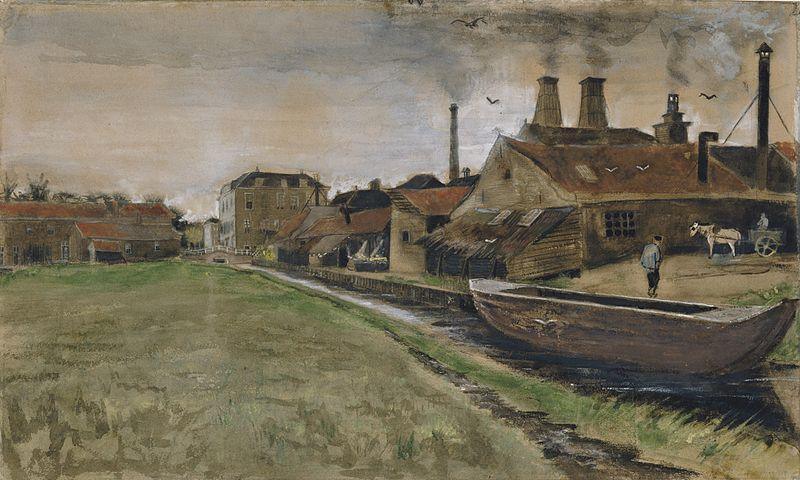
The painting depicts an industrial riverside landscape in The Hague, arranged around a canal that cuts diagonally across the scene. In the foreground, a large barge with a dark hull occupies the lower right, its solid presence set against the open field stretching away to the left. Behind the vessel, a solitary figure walks beside the water near a low fence. Houses, factory buildings and a large iron mill line the background, defined by their sloping roofs, tall chimneys, ducts and vertical structures. A light-colored horse appears at the far right, while several birds cross the broad, grayish sky.
The subject brings together 2 essential dimensions of the Dutch landscape: the open space along the shore and the productive activity concentrated on the urban horizon. Here, The Hague provides a setting of canals, homes and the movement of goods, while the industrial complex introduces factory work into an environment that is still partly rural. Mills and ironworks relied on chimneys, ducts and loading or transport areas; the barge visually connects these facilities to the network of waterways. The work does not present an anecdotal scene, but rather an observation of how work, infrastructure and everyday life share the same territory.
The chimneys and pipes function as signs of production and combustion, but also form a pattern of vertical lines that cuts across the horizon. In front of them, the barge suggests the movement of raw materials or goods and adds a heavy, close-set horizontal element. The figure walking alongside the canal introduces a human scale into a landscape dominated by buildings and industrial facilities. The horse and birds broaden the scene’s meaning to encompass the continuity of everyday and natural life. The open field, low vegetation, and spacious sky soften the harshness of industry: the mill appears integrated into a landscape where the productive and rural elements remain in tension.
The horizontal composition distributes visual weight between the field in the left foreground, the diagonal of the water, and the dark mass of the barge. That diagonal leads the eye toward the center and then to the band of buildings, where the chimneys create an irregular rhythm of vertical accents. The low houses and industrial facilities form a continuous line, while the sky fills a generous expanse, allowing the scene to breathe. The palette of brownish gray, ochre, muted green, dark brown, and bluish gray creates a soft, misty light. Contrasts arise from the opposition between earthy surfaces, dark reflections, and the lighter areas of the sky and the horse.
This work by Vincent van Gogh reflects the attention he paid during his Hague period to everyday settings, workers, and the Dutch landscape. The earthy palette and direct observation turn an industrial area into an atmospheric experience, without artificially separating human activity from the surrounding countryside. The painting’s appeal lies in how each element shapes the way we read the others: the barge makes transport tangible, the chimneys define the industrial horizon, and the solitary figure lends an intimate scale to the panorama. Following the canal’s diagonal course toward the chimneys reveals how Van Gogh transforms a place of work into a balanced composition of industry, water, and silence.
Have questions about our oil painting reproductions? See our frequently asked questions.