

Description
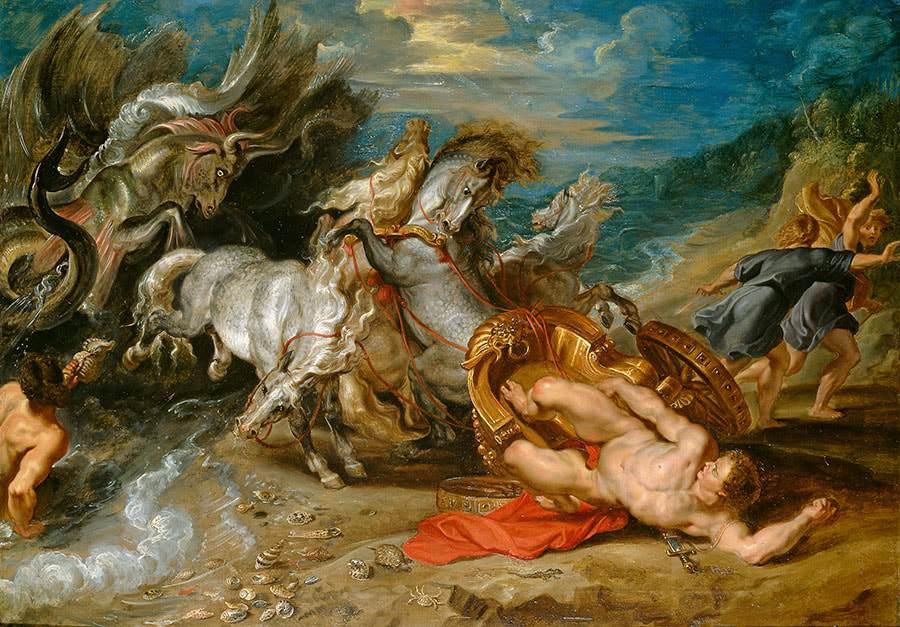
The painting depicts The Death of Hippolytus as a catastrophe unfolding between sea and land. At the center, several white and gray horses surge forward, their harnesses taut and their heads tossing. On the left, a dark, winged, serpentine creature emerges beside the water; on the right, an overturned golden chariot draws the eye toward the naked body of Hippolytus, lying on a red cloth in the foreground. A darkly dressed figure bends or runs along the rocky rise, while other figures are woven among the animals and harnesses. The overcast sky, foam, rocks and shells extend the violence of the accident across the entire landscape.
The episode comes from Greek mythology and recounts the tragic fate of Hippolytus, son of Theseus, traditionally associated with chastity and devotion to Artemis. After Phaedra’s accusation, Theseus calls upon Poseidon to intervene. As Hippolytus drives his chariot along the coast, a sea monster terrifies the horses; the vehicle overturns, and the young man dies in the catastrophe. The painting focuses on this outcome without depicting the entire story: the fallen chariot, the prostrate body and the monstrous apparition are enough to make the decisive moment clear.
The creature beside the water serves as the visible manifestation of a supernatural force, while the rearing horses express panic and loss of control. The golden chariot, associated with movement and mastery, appears overturned and vulnerable, transformed into a sign of downfall and fate fulfilled. The red cloth beneath the body heightens the tragic nature of the episode and contrasts with the cool tones of the sea and sky. The coastal landscape is not merely a backdrop: its rocks, foam and turbulent waters make nature an extension of the catastrophe.
The composition is organized around diagonals that cross the space from the creature on the left to the overturned chariot and the body lying on the right. The horses form a dynamic mass surging toward the viewer, with overlapping bodies, legs in motion, and red reins introducing taut lines between the figures. In contrast to this commotion, Hippolytus’s body creates a horizontal pause in the foreground, a point of stillness that makes the outcome clear. The whites and grays of the animals stand out against the blue-green of the sky and water; the golden ochres of the chariot and the reds of the harness draw attention to the heart of the accident. The light breaking through the clouds adds depth and makes the scene seem to expand beyond its boundaries.
In the work of Peter Paul Rubens, mythological narrative becomes an experience of movement, volume, and theatricality. The energy of the bodies, the color contrasts, and the diagonal composition bring hero, animals, monster, and landscape together in a single visual thrust. The drama depends not only on the fallen body but also on the chain of forces surrounding it: the turbulent water, the terrified horses, the taut reins, and the heavy sky. As you look at the work, follow the trajectory from the sea creature to the chariot, then pause at Hippolytus; along this path, Rubens transforms a mythical episode into a compact image of panic, downfall, and fate.
Have questions about our oil painting reproductions? See our frequently asked questions.