


Description
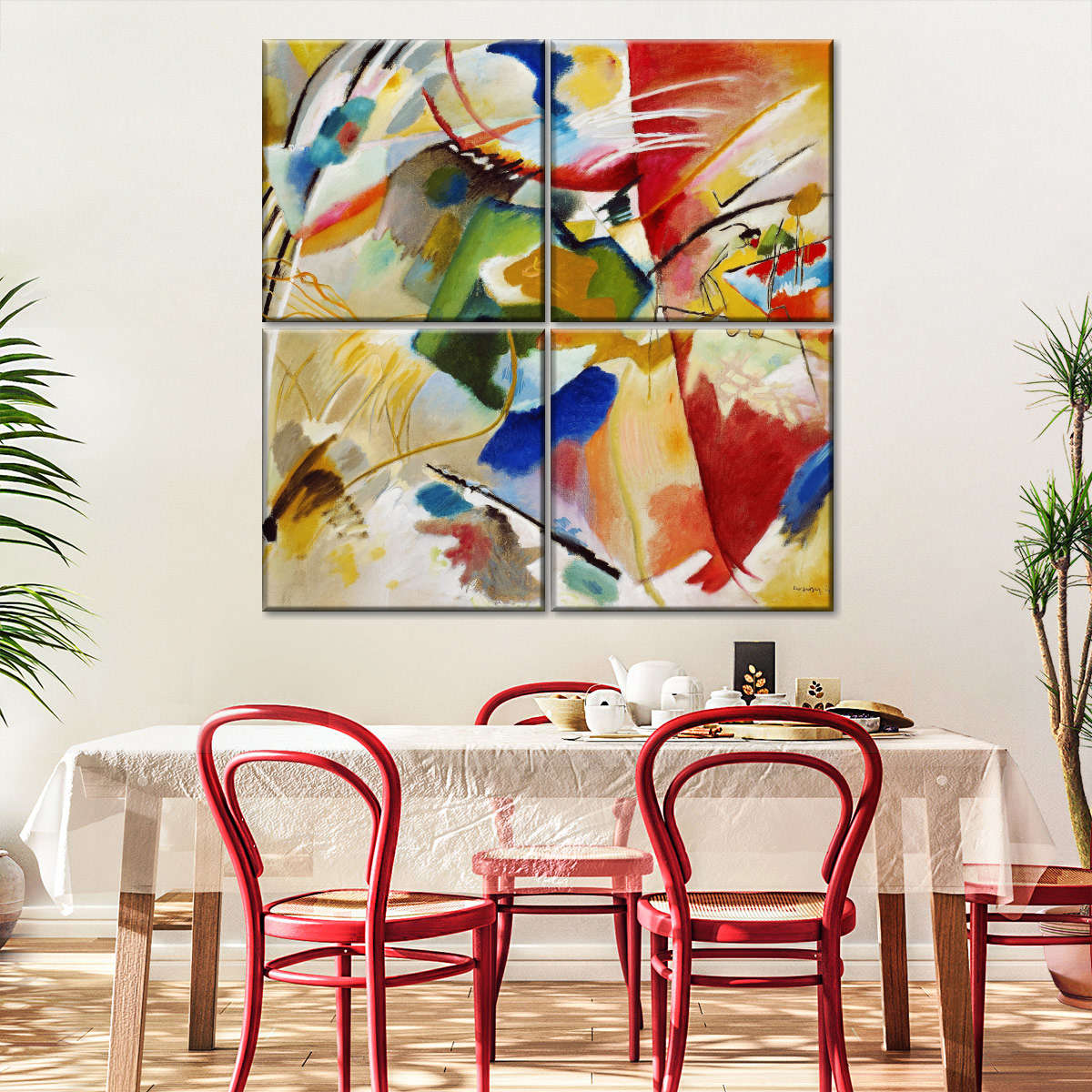
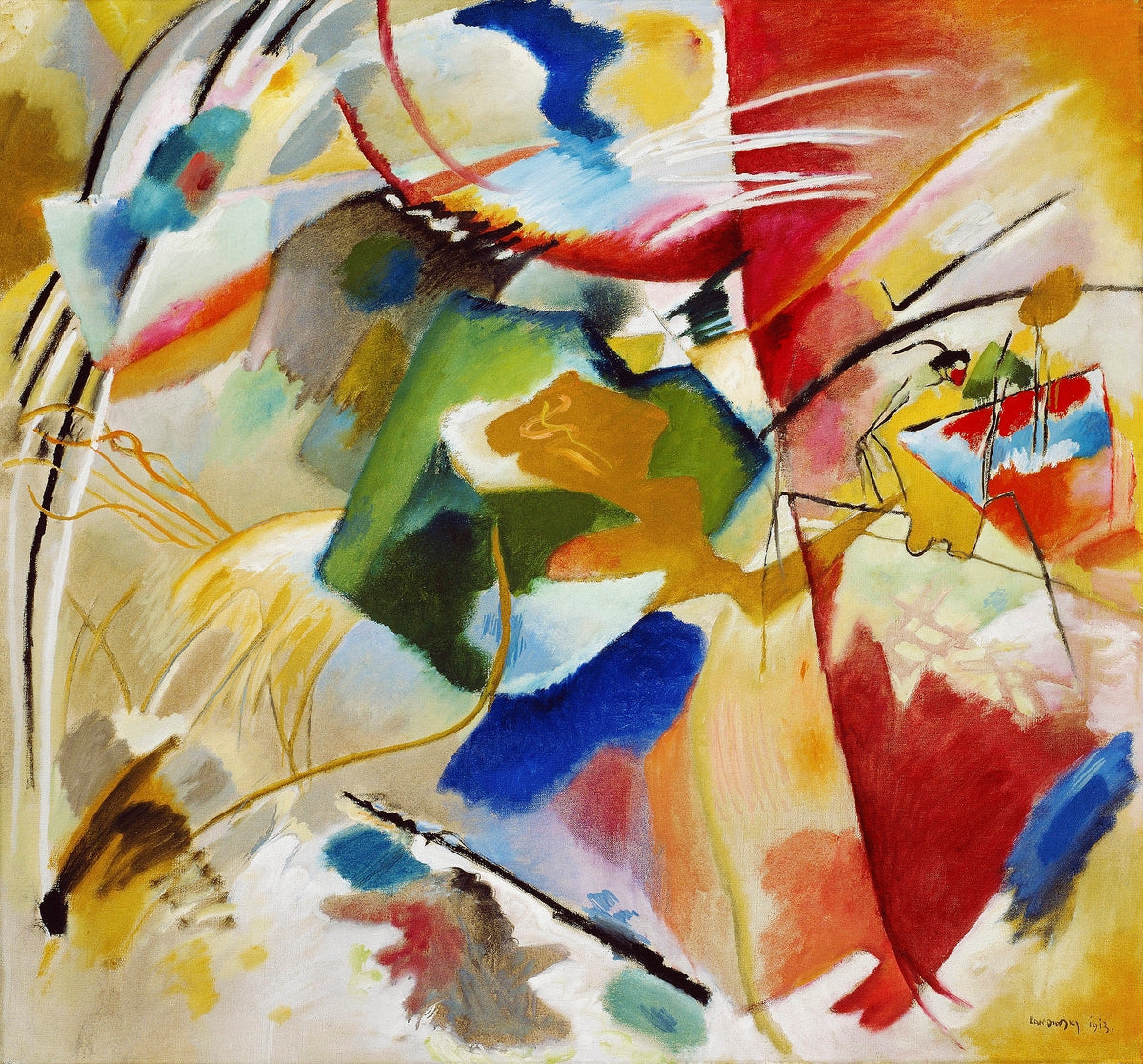
The painting presents a horizontal abstract composition in which an irregular core of dark green, olive and turquoise occupies the central area, slightly shifted to the left. Large fields of carmine red, ochre yellow, cobalt blue, orange, white and black are arranged around it, overlapping in planes with shifting contours. The forms combine angular profiles with organic patches, while a network of curved lines and fine strokes crosses the surface. In the upper right, several parallel white lines interrupt the field of color; in the lower-right corner, a small handwritten inscription completes the work visually.
As an abstract painting, the work abandons the representation of recognizable figures, objects or landscapes and focuses instead on the relationships between color, form and movement. Its interest does not depend on a figurative narrative, but on the way the masses of color confront one another, balance each other and extend over one another. The green center serves as a point of reference within an expansive visual structure: it provides orientation amid the abundance of stimuli while also keeping the interpretation of the composition open. Its association with Wassily Kandinsky places this work within a horizon of abstraction in which color and line acquire expressive autonomy.
The central green shape serves formally as the center of gravity and a point of stability, but its irregular outline keeps the composition from becoming static. The surrounding reds and yellows lend intensity and warmth, while the blue below introduces chromatic depth that draws the eye toward the lower part of the painting. The dark lines can be read as vectors of energy connecting separate areas and guiding the eye around the composition. By contrast, the parallel white strokes in the upper-right area act as a luminous pause, a rhythmic interruption amid the denser fields. The whole suggests tension and balance at the same time.
The asymmetrical structure guides the eye through diagonals, curves and overlapping forms. The viewer's gaze often enters through the yellows on the left, moves toward the green core and continues to the large red shape on the right, before descending through the blue and the black-and-brown band in the lower section. Jagged edges, soft brushstrokes and small accents of turquoise, pink and light blue enrich the surface with shifts in scale and visual texture. There is no single point of rest: each area of color leads to another, giving the painting a sustained sense of movement.
The work is consistent with an abstract approach associated with Wassily Kandinsky, based on the expressive autonomy of color, the coexistence of geometric and organic forms, and a dynamic composition guided by lines and chromatic relationships. Here, the title directs the viewer's experience toward the green center, but that core gains its full impact through its contrast with the surrounding fields of red, yellow and blue. Notice how the lines pass through the patches of color without dissolving them: they are what turn an array of intense colors into a unified, vibrant structure in constant motion.
Have questions about our oil painting reproductions? See our frequently asked questions.