

Description
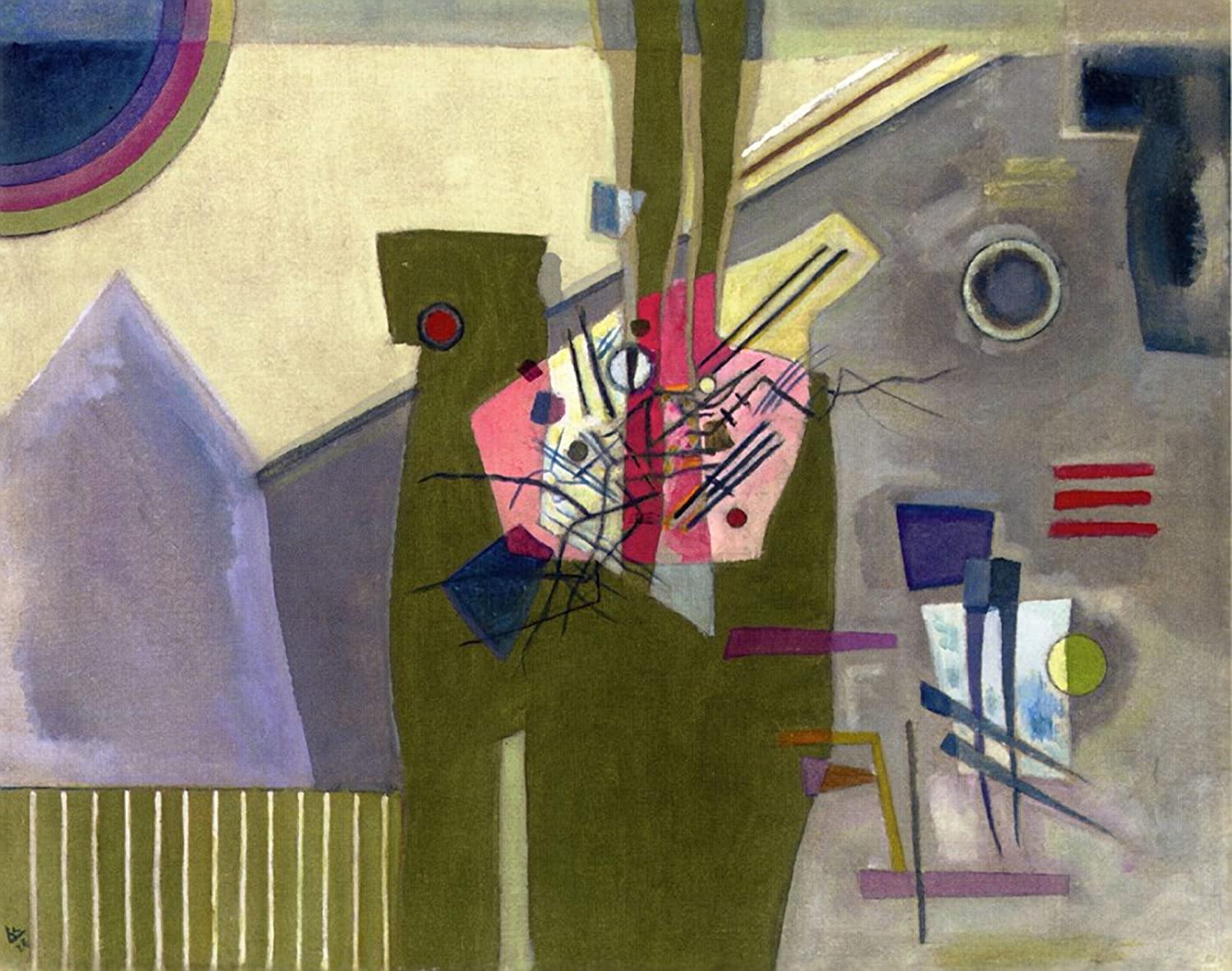
The painting shows a geometric abstract composition built from overlapping planes, bands, circles, diagonals, and dark lines. At the center, a pink rectangle stands out, partially concealed by white and cream shapes, while a broad purplish-gray field extends to the right and envelops much of the background. A vertical olive-green plane structures the central axis, accompanied by a lavender triangle on the left and a cluster of blue, yellow, purple, and white shapes in the lower-right area. The multicolored concentric arc in the upper-left corner, the light-colored ring in the upper-right area, and the three red side bands introduce accents that travel across the surface like visual signals.
“Pink in Gray” belongs to the realm of abstraction, where the work presents neither a narrative scene nor recognizable figures, but rather an autonomous arrangement of color, line, and space. The title directs the viewer’s gaze to the relationship between two fields of color: pink, concentrated at the heart of the composition, and gray, spread out as an enveloping mass. Within this framework, the elements need not represent specific objects to create a visual experience; they function as parts of a pictorial language based on tensions, pauses, and correspondences. The work is associated with the geometric and lyrical abstraction linked to Wassily Kandinsky, particularly through the dynamic interplay of circles, diagonals, planes, and colors.
The contrast between the pink rectangle and the purplish-gray field creates a study in balance and chromatic depth. Pink takes on a presence precisely because it is contained among angular structures, black lines, and surfaces in more muted tones. Around it, the small red, blue, yellow, and dark circles act as rhythmic counterpoints to the large masses of color. The black diagonals heighten a sense of movement and structural tension, while the arcs and circular forms introduce a different, more enveloping cadence. In this way, the composition alternates compact visual weights with small elements that keep the eye engaged.
Formally, the work is organized through a continuous superimposition of planes. The olive-green block provides vertical stability; the lavender triangle opens the structure to the left, and the large gray field anchors the right side as an area of relative rest. Against this base, the fine intersecting lines form a network that densifies the center and draws the eye toward the lower part of the composition. The light vertical bands along the lower-left edge balance the geometric arrangement in the opposite quadrant, while the three red bands create a horizontal pause amid the predominance of diagonals and polygons. Depth does not depend on traditional perspective, but on the partial concealment of forms, their changes in scale, and the friction between straight contours, curves, and open spaces.
In keeping with the abstraction associated with Kandinsky, Pink in Gray turns color into structure and rhythm into a visual journey. The composition is not taken in all at once: first the central pink draws the eye, then attention shifts to the upper-left arch, the pale ring, and the red bands, before finally revealing the complexity of the lower planes. Its strength lies in this constant movement between muted masses and vivid accents, between orderly geometry and lines that seem to spill beyond it. Notice how the pink is not isolated but gains intensity through its contrast with the gray and as it is crossed by a network of forms; this is where the tension that unifies the entire painting is concentrated.
Have questions about our oil painting reproductions? See our frequently asked questions.