




Description
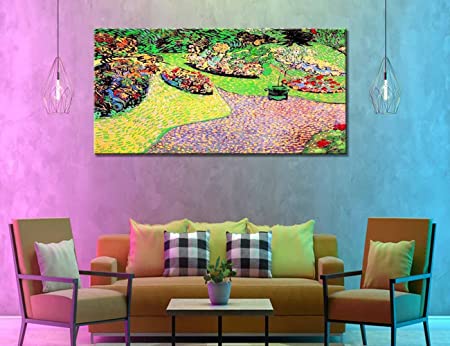
The painting Garden at Auvers presents a wide, curving path that opens from the lower part of the scene and leads the eye toward the center and right of the composition. Dense flower beds stretch out on either side, covered with red, orange, yellow, pink, blue, and white flowers. Low-growing vegetation borders the path, while a darker mass of shrubs and foliage frames the upper part and left side. Beside the path, to the right of center, a green garden feature offers a subtle sign of care and everyday work in this exuberant space.
The title connects this cultivated landscape with Auvers-sur-Oise, a French town closely associated with the final period of Vincent van Gogh’s life and work. Rather than focusing on a detailed topographical view, the painting centers on the experience of the garden: an intimate space organized by paths and flower beds, where nature is transformed through human labor. In the tradition of modern landscape painting, the garden is not merely a decorative backdrop, but a setting in which color, plant growth, and the viewer’s gaze play a central role.
The path serves as an entrance and route through the scene. Its curve softens the structure of the composition and suggests a leisurely movement inward, while the flower beds create a sense of abundance and vitality. The flowers’ range of colors turns each bed into a concentration of visual energy. The green feature beside the path reinforces the sense of a cultivated and tended place, linking the splendor of the vegetation with the human activity that sustains it. At the same time, the dark foliage acts as a frame that makes the brighter areas stand out.
The composition is organized through diagonals and curves rather than a rigidly geometric perspective. The path divides and connects the different fields of color, guiding the eye from the brushstrokes in the foreground toward the floral groupings at the center. The short, dense, clearly visible brushstrokes break up the surface into small bursts of green, violet, lilac, yellow, red, and orange. This technique creates rhythm and movement even in the seemingly still areas of the garden. The contrasts between the dark vegetation and the bright flower beds intensify the depth and keep the eye engaged.
In Garden at Auvers, Vincent van Gogh is associated with a distinctive approach characterized by intense color, directional brushwork, and a construction of the landscape based on the expressive rhythm of its surfaces. The garden thus becomes a vibrant experience: the path organizes the journey, the flower beds multiply points of interest, and the foliage provides the necessary counterpoint for each color to stand out. The curve of the path transforms a cultivated scene into an almost musical composition, in which the abundance of vegetation is conveyed both by what it depicts and by the cadence of its brushstrokes.
Have questions about our oil painting reproductions? See our frequently asked questions.