

Description
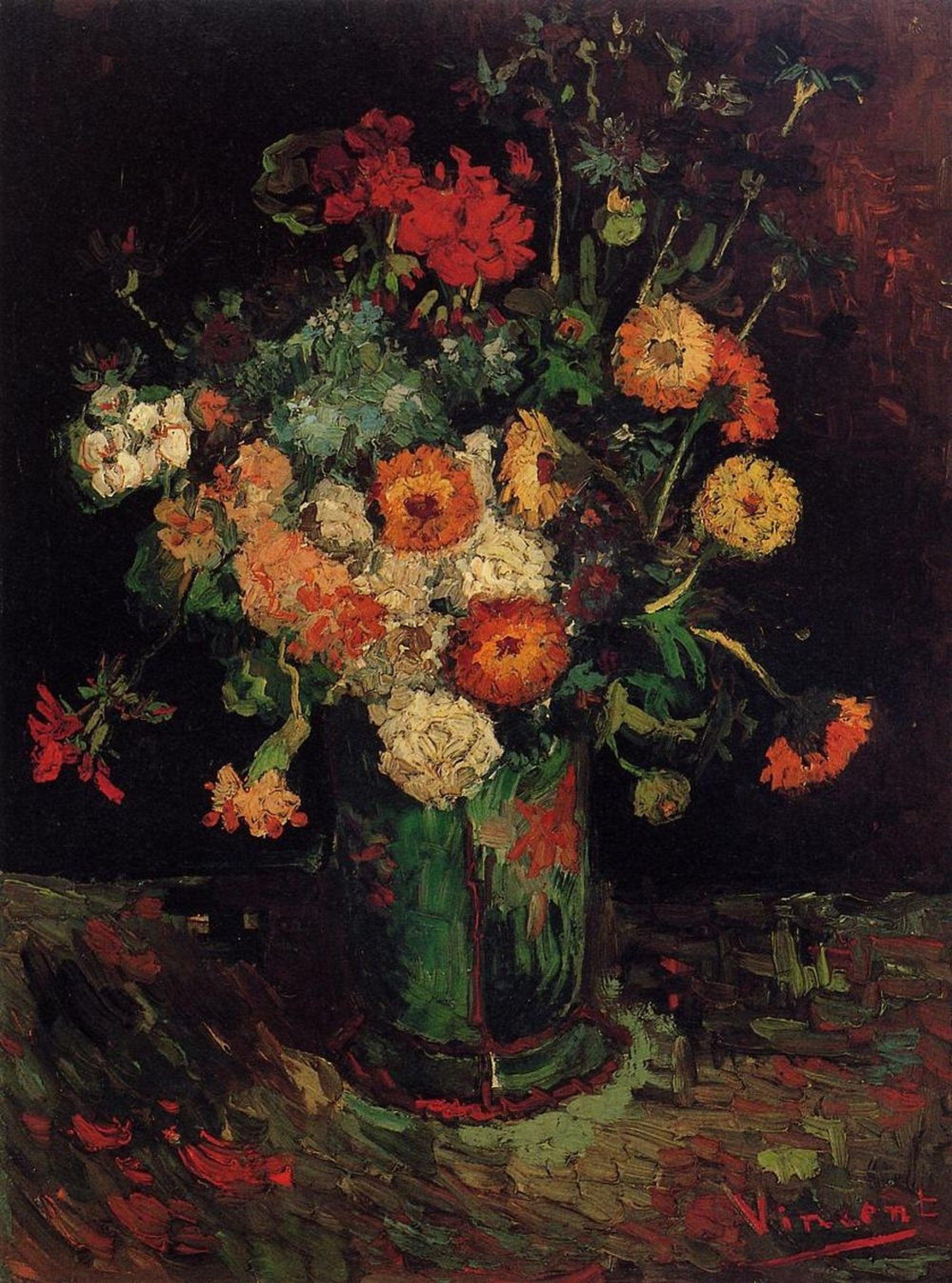
The painting shows an abundant bouquet of zinnias and geraniums arranged in a green vase on a dark wooden table. The flowers fill the center and upper part of the composition, forming a compact, expansive mass: intense reds, oranges, yellows, creamy whites, pinks, and salmon hues alternate among green leaves and stems rising in different directions. The tall, narrow vase is partially concealed by the foliage and visually supports the entire arrangement. Behind it, an almost black background draws attention to the bouquet’s exuberant colors, while the tabletop provides a solid, horizontal base with a slight incline.
Rather than a narrative scene, the work belongs to the genre of floral still life: a study of natural forms gathered in a domestic setting and carefully arranged. Its interest lies not in an action or in figures, but in the relationship between the abundance of flowers, the vase’s structuring presence, and the stillness of the dark background. In this genre, an everyday subject can become an opportunity to observe nature’s variety and painting’s ability to organize its rhythms, colors, and volumes within a confined space.
The profusion of flowers lends the painting an association with vitality, diversity, and natural abundance. Each cluster of petals retains its own character, yet all contribute to a larger whole, as if the bouquet brought together many accents in a single visual breath. The dark background heightens this impression: the flowers seem to emerge toward the surface with a luminous energy that contrasts with the surrounding space. The green of the vase and leaves extends the bouquet vertically, creating a bridge between the contained matter and the stems’ organic growth.
The composition is carefully balanced around a central axis. The triangular mass of flowers fans out across the upper area, while the vase’s neck gathers and narrows the movement before guiding it toward the table. Warm colors are distributed across the entire surface, keeping the eye from settling on any single point; the reds and oranges serve as points of intensity, while the whites and yellows introduce flashes among the denser areas. The leaves fill the gaps and connect the clusters of flowers. Visible brushwork and variations in color give the petals, stems, and wood a tactile presence, making the bouquet seem to vibrate even in its stillness.
In Vase with Zinnias and Geraniums, Vincent Van Gogh turns the still life into an expressive architecture of color. The chromatic intensity, visible brushwork, and dynamic construction of forms are consistent with his treatment of floral subjects, in which nature remains recognizable while taking on an energy of its own through paint. It is worth noting how the bouquet does not simply fill the space: its expansion is contained by the vase, the table, and the background, creating a tension between exuberance and structure. This relationship is the key to the work: the more closely the eye focuses on the variety of flowers, the more evident the order that holds the whole composition together becomes.
Have questions about our oil painting reproductions? See our frequently asked questions.