

Description
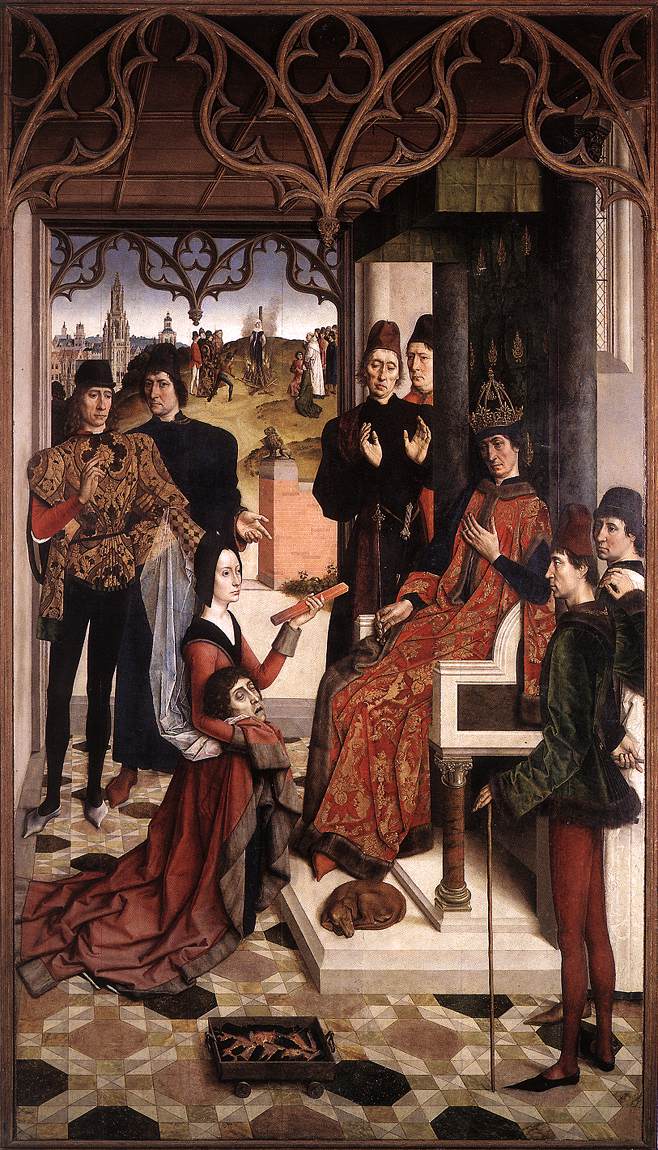
The painting presents a ceremonial scene of The Ordeal by Fire, arranged around a crowned figure seated on an elevated chair on the right. Before this figure, a kneeling woman holds an elongated, reddish object, while a bearded male head appears beside her lap. A religious figure, dressed in a dark robe and holding his hands raised before his chest, accompanies the moment; courtiers and witnesses gather around him. Two men in elaborate garments balance the composition on the left. A brown dog rests on the throne steps, and a dark box or basket occupies the foreground. Gothic architecture frames the scene, while a road leads toward a city of towers and a small group of figures in the distance.
The title places the episode within the context of the medieval ordeal: a judicial practice in which a test involving fire or red-hot iron was believed, according to the beliefs of the time, to reveal innocence or guilt through divine judgment. The enthroned authority presides over the hearing, the religious figure reinforces its moral and ritual dimension, and the spectators turn the procedure into a public event. The scene thus connects political justice with a sacred conception of the verdict, within a community that observes and participates in the act.
The reddish object concentrates the narrative tension and draws attention to the woman’s hands, while her kneeling posture conveys the gravity of the ritual. Opposite her, the crowned figure embodies power and stability, elevated on steps that visually separate the authority from those awaiting its decision. The religious figure links these two spheres, while the sleeping dog provides a quiet counterpoint to the solemnity of the ceremony. The city in the background broadens the meaning of the episode: the trial does not take place in isolation, but within an urban, social and religious order.
The vertical composition is held together by a network of architectural lines that guides the eye from the tracery above to the geometric paving in the foreground. The white steps of the throne form a diagonal toward the kneeling woman, while the figures on the left balance the visual weight of the group on the right. The crimson reds of the enthroned figure’s garment and the object she holds stand out against the blacks, browns, and dark greens of the interior. The bright courtyard and distant city create depth, while the polygonal paving stones extend the precise order of Gothic architecture horizontally.
The work’s strength lies in transforming a scene of justice into a visual arrangement of pauses, hierarchies, and restrained gazes. The enthroned figure dominates through her elevated position, the woman concentrates the tension through her gesture, and the religious figure connects the institutional dimension with the spiritual one. The Gothic setting is not mere decoration: it encloses the ceremony and at the same time extends it toward the city and the community gathered in the background. The visual journey, from the reddish object to the authority, the motionless dog, and the urban landscape, transforms an individual ordeal into a solemn spectacle of public judgment.
Have questions about our oil painting reproductions? See our frequently asked questions.