

Description
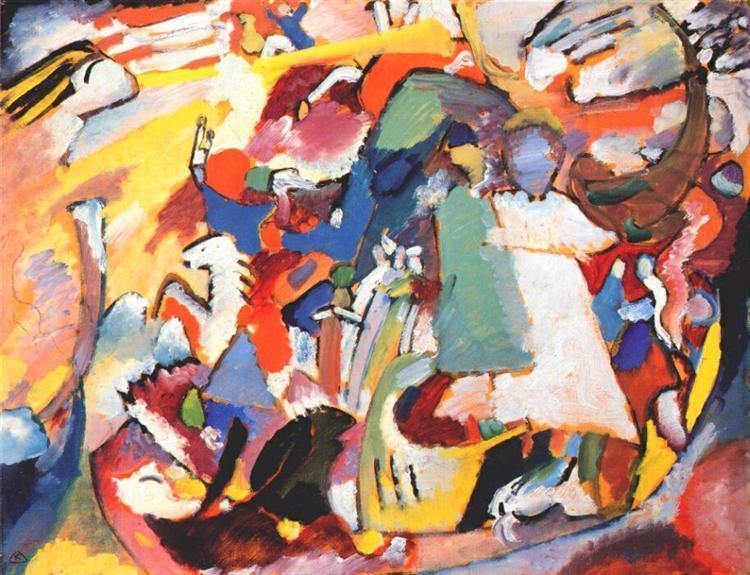
The painting presents a highly intense horizontal abstract composition, brought together under the title Angel of the Last Judgment. The surface is arranged through yellow and white masses in the upper-left area, a central core of reds, blues, and violets, and a broad blue-green block extending toward the center-right. In the lower-right quadrant, a light white and pink form introduces a luminous pause among the overlapping strokes, while the lower bands concentrate accents of black, dark blue, and red. There is no recognizable setting or developed figurative narrative: the work creates its presence through layers of color, irregular contours, and brushstrokes that cross the surface in multiple directions.
The Last Judgment belongs to the core of Christian eschatology and refers to the moment of final judgment upon humanity. Within this religious framework, the angel acts as a messenger or intermediary of a divine event. Here, the reference shifts away from narrative representation toward an experience of chromatic energy. The title lends the painting a spiritual and apocalyptic resonance, but the work conveys it without resorting to wings, trumpets, human figures, or identifiable celestial settings. The solemnity of the subject is thus transformed into an open visual tension, in which forms accumulate, intersect, and advance like forces in conflict.
The contrast between warm and cool colors underpins the symbolic reading. Yellows, oranges, and reds introduce impulses of expansion and alarm, while blues and greens create areas of resistance, depth, and counterpoint. The whites and pinks on the right act as a fragmented clarity, surrounded by broken edges and active brushstrokes. The accumulation of masses evokes passage, confrontation, and spiritual transformation; rather than depicting a specific episode, it turns the religious theme into an atmosphere of opposing forces. Meaning emerges from the relationships between the colors and the pressure they exert on one another.
Formally, the work is built around a densely worked surface and a rhythm of diagonals, interruptions, and overlaps. The eye enters through the yellow and white area in the upper left, descends toward the red and blue core at the center, and continues to the large green block at center-right. From there, light strokes lead toward the lower-right area, while black and dark blue accents draw attention back to the edges. The absence of a uniform background prevents any one form from dominating completely: each plane seems to emerge and recede at the same time. The visible brushwork preserves the gesture of its execution and makes the movement both chromatic and material.
The work broadly belongs to an abstract approach associated with Wassily Kandinsky, based on color, gesture, compositional tension, and the autonomy of forms. Its appeal lies in transforming the title’s eschatological solemnity into an experience of color and movement, without relying on an explicit figurative scene. The central green mass balances the force of the reds and blues, while the pink brightness at the far right adds another area of vibration rather than calming the composition. The theme is thus concentrated in a structure of tensions: spiritual in its framework, abstract in its construction, and dynamic in the pulse of its brushstrokes.
Have questions about our oil painting reproductions? See our frequently asked questions.