

Description
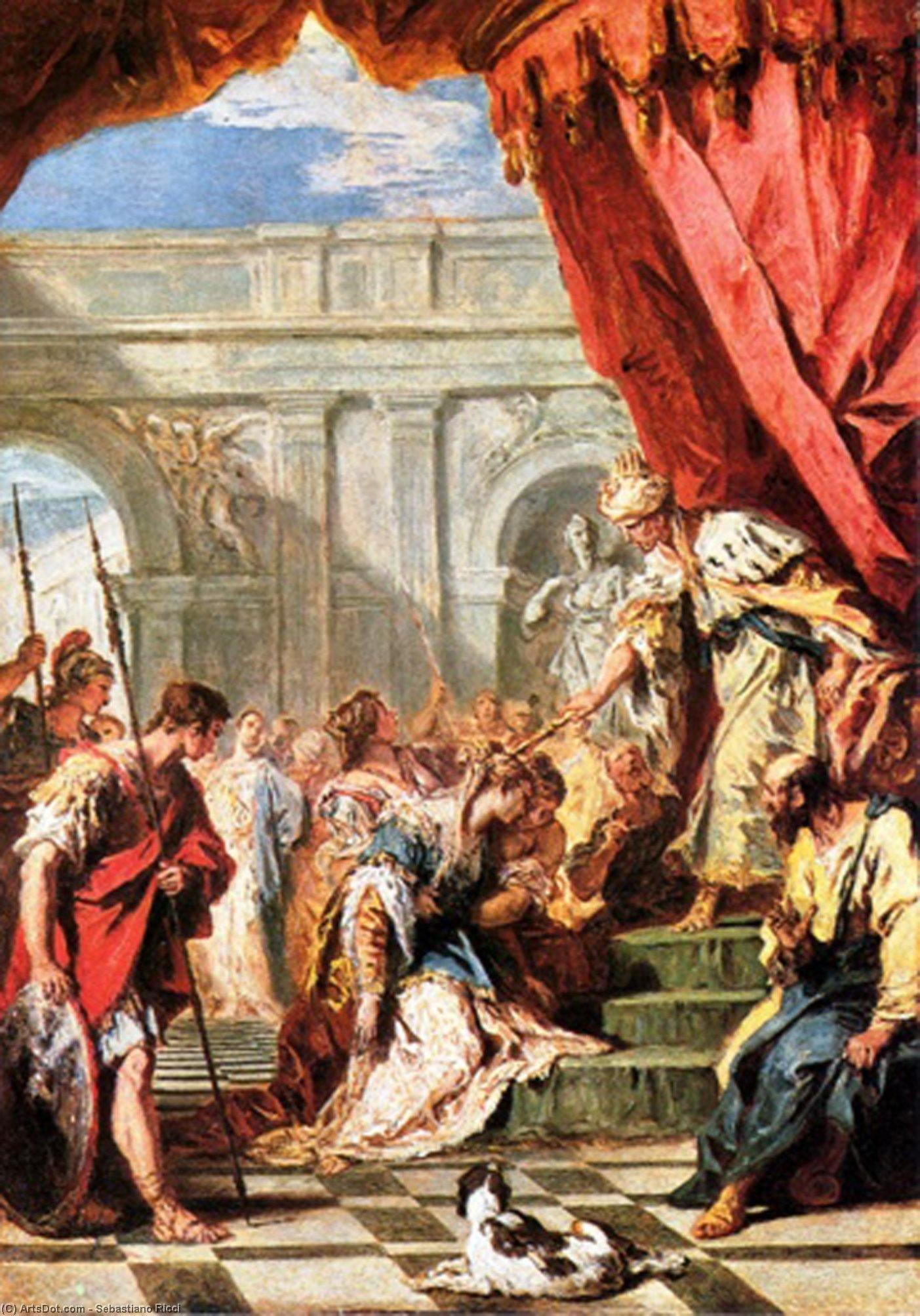
The painting shows Esther before Ahasuerus inside a monumental palace space. At the lower center, the female figure bends or kneels in a light-colored dress enlivened with blue details, while the king occupies an elevated position on the steps, richly dressed and distinguished by a headdress or crown and a staff of authority. A court of figures seated, kneeling, or gathered at different levels surrounds them. Two figures with spears flank the left side, and a black-and-white bird appears in the foreground on the checkered pavement. Columns, arches, stone moldings, and a fragment of open sky complete the setting, while the large crimson curtain on the right theatrically frames the audience.
The episode comes from the Book of Esther and is set at the court of the Persian Empire. Esther, a Jewish woman who becomes the queen of Ahasuerus, appears before the monarch to intercede for her people, who are threatened by Haman’s plan. The action carries a particular tension because appearing before the king without being summoned could entail grave danger. This circumstance sheds light on the protagonist’s gesture: her bow is not merely a courtly formality, but a visual expression of a perilous plea before the highest authority.
The iconography conveys meaning through contrasts in rank and demeanor. Esther appears lower and more vulnerable, close to the ground, while Ahasuerus dominates the scene from the stepped platform. The headdress, ornate mantle, and staff serve as conventional symbols of sovereignty; the spears on the left introduce the watchful presence of the guards and reinforce the court’s control. The red curtain lends magnificence and drama, as if raising the curtain on a scene of power. The bird in the foreground adds a naturalistic, anecdotal note that balances the solemnity of the encounter without displacing its narrative core.
The composition is built around an ascending diagonal that guides the eye from the guards at the far left toward the kneeling figure and then up to the elevated king. The checkered floor forms a geometric grid that organizes the crowd and accentuates the depth, while the steps visually separate the different levels of authority. The crimson tones of the curtains stand out against the gray stone, golden ochres, and blues of the garments. The opening to the sky in the background brings light and air into a densely populated scene, while the contrast between the architectural surfaces and the movement of the drapery keeps the visual rhythm lively.
In the work of Sebastiano Ricci, a Venetian Baroque painter, this combination of vivid color, dynamic figures, and theatrical staging reflects a taste for biblical stories presented as grand visual dramas. The painting transforms a plea into a court spectacle of visible hierarchies: every secondary figure, every step, and every fold of the curtains helps measure the distance between the one who pleads and the one who can grant the request. Pay particular attention to the path connecting Esther’s bowed posture to the elevated Ahasuerus; this is where the tension between vulnerability, authority, and hope is concentrated.
Have questions about our oil painting reproductions? See our frequently asked questions.