

Description
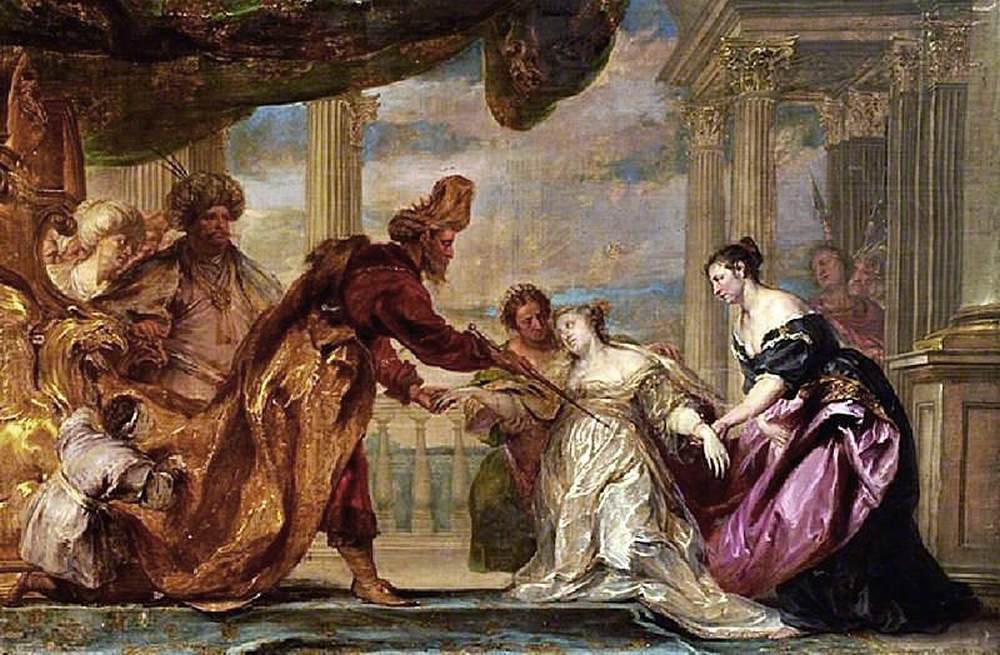
The painting Esther before Ahasuerus, by Jan Van Boeckhorst, presents a highly theatrical biblical scene. At the center of the action, Esther appears in a brilliant white dress, leaning backward with one arm extended, immediately drawing the viewer’s attention. Opposite her, a man in a voluminous golden-brown cloak gestures toward her and occupies a dominant position within the group, consistent with an interpretation of him as King Ahasuerus. On the right, a woman dressed in black, violet, and light tones holds Esther’s hand, while several figures cluster behind them and watch the episode. Fluted columns, entablatures, and monumental structures frame the scene, which opens onto a blue sky and a distant landscape.
The subject is drawn from the Book of Esther. Esther, a Jewish woman who becomes queen of Persia, appears before Ahasuerus without having been summoned, in order to intercede for her people. Her appearance before him carries a decisive risk: she must approach the sovereign and ask for help in the face of the threat hanging over her community. The king’s favorable reception transforms this moment of danger into an opportunity to be heard and protected. The painting captures this transition, placing the encounter between Esther’s plea and royal authority before a group that lends the episode a public and solemn dimension.
Esther’s bowed gesture makes her body the emotional centre of the composition. Her posture brings together fear, exhaustion and hope, while her outstretched arm towards the king keeps the connection between vulnerability and petition open. The hand of the woman on the right, supporting her, adds a note of human solidarity within the public ceremony. Ahasuerus’s ample cloak and the classical architecture serve as visual signs of power and solemnity: royal authority is inscribed in a monumental, shared space. The gathering of witnesses reinforces the collective dimension of the episode and gives the sovereign’s decision consequences extending beyond those of a private encounter.
The horizontal structure arranges the movement from the group on the left towards the figure in white and then to the woman in a black bodice and violet skirt. The vertical columns introduce pauses and divisions into this flow, ordering the human agitation within a ceremonial setting. The browns and golds of the cloaks lend density and warmth; Esther’s white garment sets off her silhouette and makes her the immediate focus of the viewer’s gaze. The black and violet of the figure on the right extend the contrast, while the blue of the sky opens up depth between the architectural masses. The warm light on the figures, set against the atmospheric space of the background, heightens the sense of a suspended moment.
These devices are consistent with the language of the Flemish Baroque associated with Jan Van Boeckhorst: historical compositions on a theatrical scale, dynamic figures, expressive gestures, and a rich palette. The work does not present the story as a distant scene, but as a sequence of movements that directs the viewer’s gaze toward the central decision of the encounter. Esther’s white clothing, the hand supporting her, and the king’s gesture form an axis of tension, while the columns transform this emotion into a courtly event. In this way, the architecture of power and the protagonist’s vulnerability are brought together in a single narrative image, whose drama is concentrated in the instant when an individual plea takes on collective significance.
Have questions about our oil painting reproductions? See our frequently asked questions.