

Description
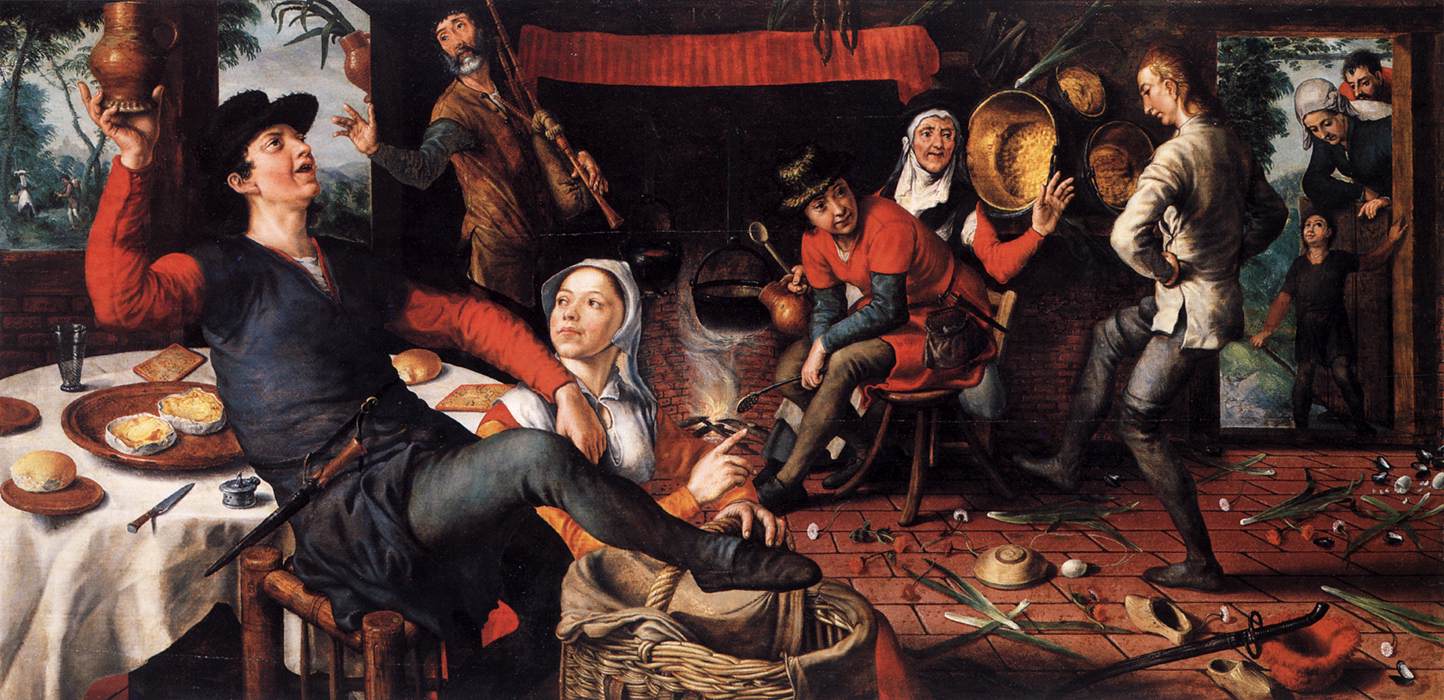
The painting depicts The Egg Dance as a kitchen scene and popular celebration, populated by nine figures gathered around a laden table, a lit hearth and a collection of utensils. In the foreground, a seated man raises a large ceramic jug above his head, while another figure stands behind him holding a rod or long utensil. A woman wearing a white headdress leans beside the table, and in the center, a young man holds a ladle in front of the fire. On the right, several figures work among large trays, pans and copper vessels; a woman leans near an opening that reveals trees and a landscape. Loaves of bread, vegetables, plates, a goblet, a wicker basket and metal objects fill the floor and table, making the interior a place of constant activity.
The title places this gathering within the context of a traditional festive pastime: the egg dance, a game in which participants must move around an egg without touching or breaking it. The work can thus be read as a depiction of a shared celebration, connected both to play and to food and domestic work. The gathering is not an intimate, silent scene but a bustling convivial occasion in which every gesture contributes to the overall spectacle. This kind of setting is associated with Pieter Aertsen’s genre painting, particularly his kitchens and markets filled with food, vessels and figures.
Abundance dominates the visual meaning of the composition. The bread, vegetables, plates, and metal vessels turn everyday provisions into a tangible, almost sensory subject. The central fire brings the various activities together and serves as the hub of work, warmth, and sociability. In front of it, the figures, ladles, and saucepans create a rhythm of intersecting gestures that suggests cooperation and amusement. The openings at the sides, with trees and daylight outside, provide a spatial pause against the dense darkness of the interior: the open world recedes into the background, while the kitchen concentrates human energy, food, and the material brilliance of domestic life.
Formally, Aertsen organizes the scene as a densely populated panoramic band. The diagonal beginning at the table in the left foreground, rising toward the figure with the jug and continuing to the hearth and the openings on the right, guides the eye through a succession of activities. The contrast between charcoal black, deep browns, and brick red sets off the red shirts, creamy whites, and golden reflections on the copper. The basket at the bottom, the table, and the utensils bring the scene closer to the viewer, while the overlapping figures create depth without losing the sense of crowding. The light is not distributed evenly: it gathers on food, hands, fabrics, and metals, transforming everyday objects into visual focal points.
This accumulation of figures, food, and objects is a feature widely associated with Pieter Aertsen: his interiors and markets take on an almost monumental scale through the density of the subject matter and the strength of the contrasts. In The Egg Dance, the kitchen ceases to be a mere backdrop and becomes the entire setting for the action. It is worth noting how the large jug, the fire, and the copper vessels connect the different groups of people: the festive title is conveyed not through a single, isolated gesture, but through the collective animation of the whole room, where abundance, work, and play form a single visual experience.
Have questions about our oil painting reproductions? See our frequently asked questions.