


Description
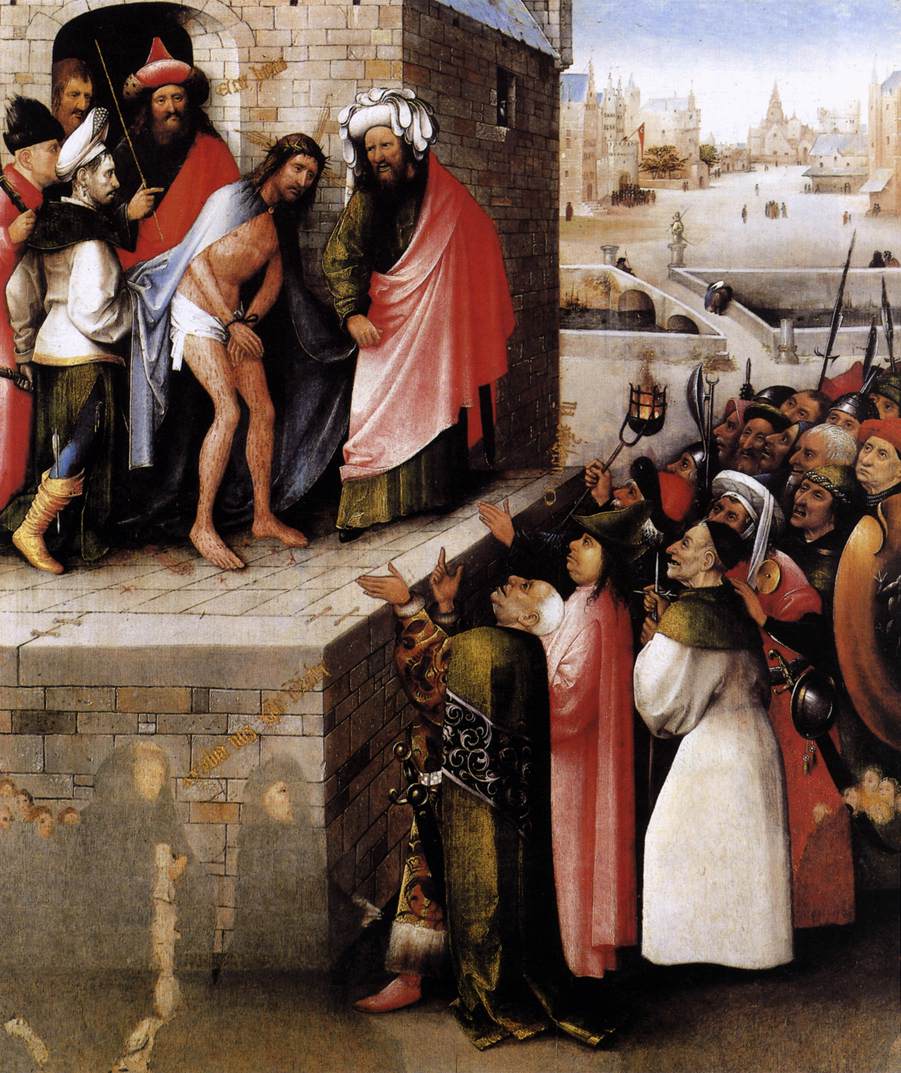
The painting presents Christ as Ecce Homo, standing with his hands bound on an elevated stone platform. His half-naked body, covered only by a white cloth, is surrounded by men dressed in cloaks, tunics, and a variety of headdresses. Some lean toward him; others hold staffs, while a crowd gathers at the foot of the platform, arms raised and gazes fixed on the condemned man. A stone wall and an arch frame the scene, which then opens onto an urban square with buildings, towers, a bridge, and a pale expanse that extends the space to the horizon.
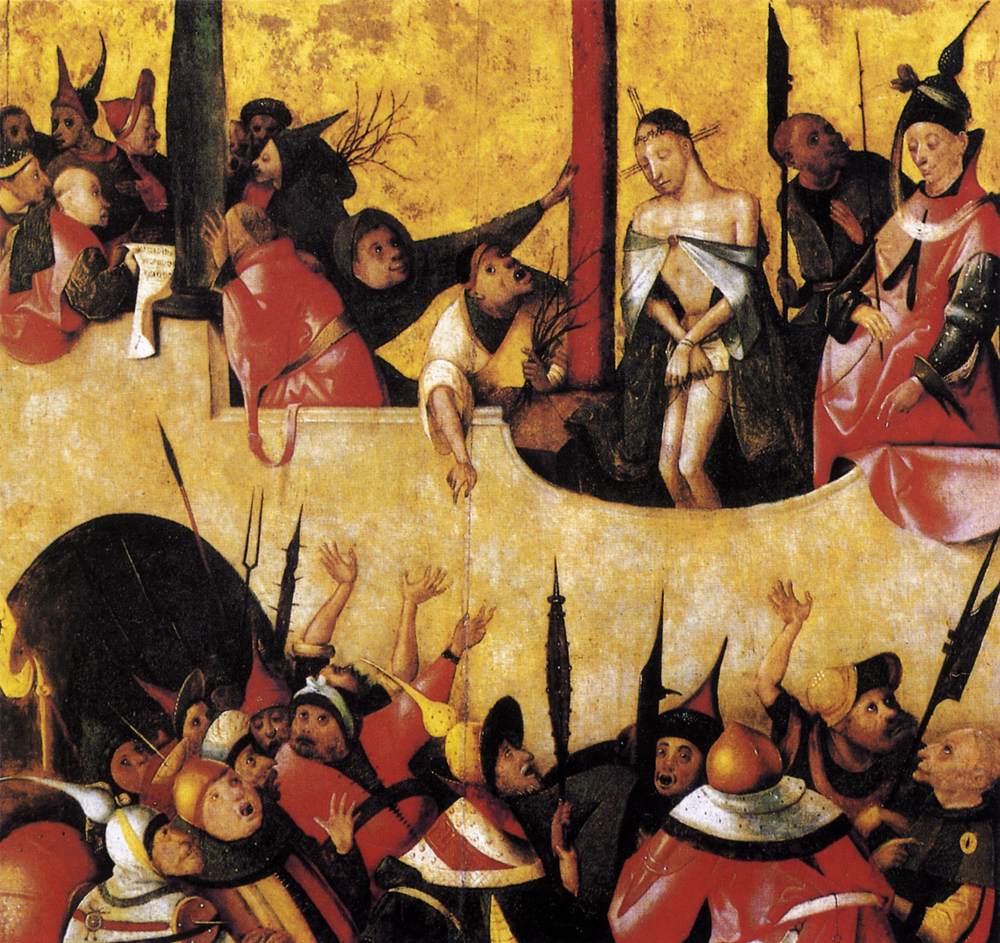
The title refers to the moment in the Passion when Jesus is presented before the crowd after being mistreated, before the Crucifixion. The Latin phrase “Ecce Homo,” traditionally translated as “Behold the man,” makes the public display the narrative center of the work. Christ stands apart from the throng, subjected to its gaze, while the figures around him embody the pressure of authority, expectation, and collective judgment. The scene does not merely depict a religious episode: it constructs a public situation in which the vulnerability of a single figure contrasts with the strength of the crowd.
The elevated platform functions as a stage for this public display and creates a physical distance between Christ and those watching him. Raised arms, spear shafts, and weapons intensify the tumultuous nature of the moment, making visible a violence expressed both in gestures and in the crush of people. The red, black, white, and green garments create a web of contrasts around the central figure, whose nakedness makes him all the more vulnerable. The architecture, with its walls and arches, reinforces a sense of confinement, while the square in the background extends the episode into a civic and collective dimension.
The composition guides the eye with a strong diagonal: the platform rises from the foreground toward the main group, then leads on to the cityscape. The dark wall dividing the scene acts as a vertical axis, setting the dramatic concentration on the left against the open light of the background on the right. The nearby figures are depicted with great intensity of gesture and color, while the tiny people in the square establish depth and scale. The visual rhythm emerges from the accumulation of heads, arms, fabrics, and weapons; against this movement, Christ’s bound body forms a quiet, stable focal point.
This work by Hieronymus Bosch displays features associated with his artistic imagination: a densely populated religious narrative, highly expressive figures, meticulous details, and a complex interplay between architecture, city, and landscape. The tension depends not only on the subject but also on the way each human group participates in the scene and draws attention toward the center. Notice how the isolated figure on the stone is caught between the crowd nearby and the distant city: this arrangement transforms Ecce Homo into a visual meditation on exposure, judgment, and vulnerability under the collective gaze.
Have questions about our oil painting reproductions? See our frequently asked questions.