

Description
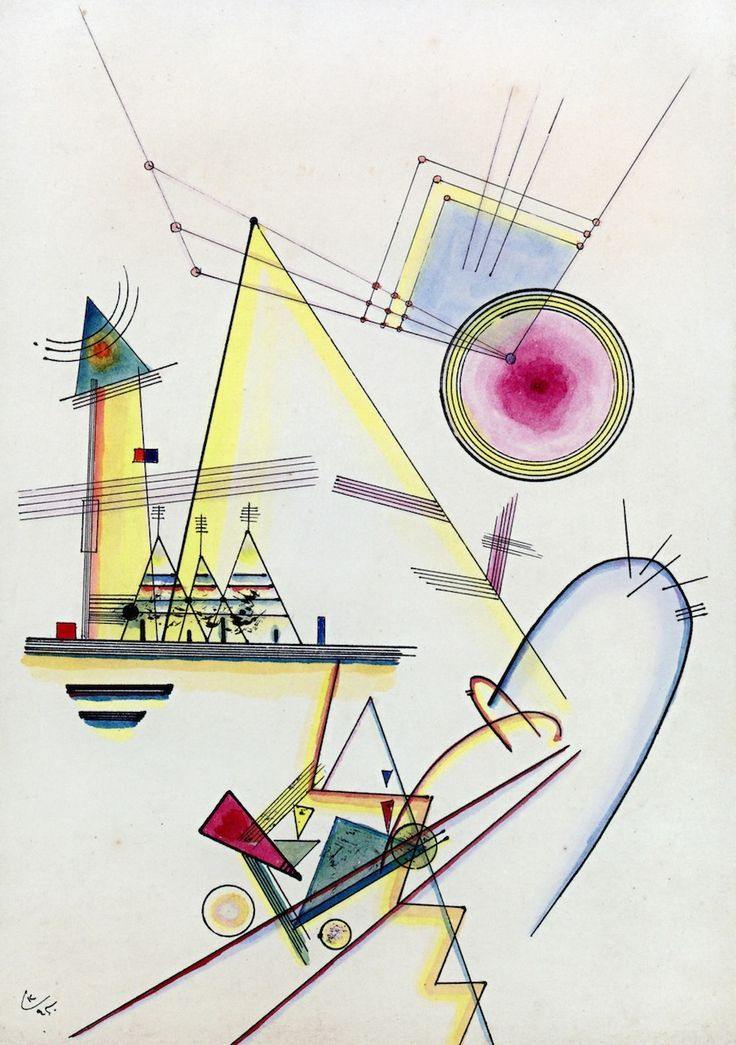
The painting Delicate Soul presents a geometric abstract composition set against a light background, where triangles, circles, lines and small polygons are arranged in a vertical, asymmetrical balance. A large yellow triangle rises from the lower area toward the center, becoming the work’s visual axis. In the upper right, a circle of concentric pink and magenta rings introduces a vibrant, rounded focal point, while on the left, a structure of yellow, blue and red bands rises, crossed by horizontal lines. The composition extends downward through linear bases, overlapping forms and a diagonal group of multicolored polygons. A pale blue curve runs along the right side, softening the tension of the angles. There are no human figures or recognizable setting: the painting grounds its subject in the relationship between color, rhythm and form.
As an abstract work, Delicate Soul does not develop a figurative narrative or depict a specific historical or religious episode. Its context belongs to a modern tradition that makes visual elements autonomous protagonists. The title suggests a sensitive reading of this construction: delicacy does not appear as a character, but as a quality that can be perceived in the fine lines, curved contours, soft color fields and open spaces of the background. This quality coexists with an energetic, almost architectural arrangement, in which each form seems to take part in a larger network. Wassily Kandinsky’s presence places the work within the horizon of an abstract exploration based on the expressive relationships between color, line and geometry, without relying on the representation of recognizable objects.
The large yellow triangle functions formally as an upward impulse and concentrates the composition’s main tension. Opposite it, the concentric circle in the upper-right area acts as a focus of chromatic attraction and as a counterpoint to the angular structure. The network of lines, nodes and small figures distributed across the surface creates a sense of connection and visual circulation: the eye jumps from one intersection to another, from a red rectangle to a small circle, from a diagonal to a horizontal band. The pale blue curve on the right introduces a more organic transition within a system dominated by straight lines, triangles and angles. Taken together, these elements can be read as an image of inner sensitivity, organized through tensions, pauses and chromatic resonances.
The composition guides the eye in layers. First, the central yellow and the magenta circle stand out, establishing two poles of intensity; then the lateral structures and more delicate lines emerge, broadening the visual field and connecting its areas. The asymmetry keeps the work from becoming static: the vertical weight on the left is balanced by the blue curve and circular focus on the right, while the lower diagonal arrangement introduces an oblique direction that activates the space. The saturated colors—yellow, red, blue and teal—alternate with transparencies, grays and blurred surfaces. The black and colored lines add precision, but also fragment and articulate the fields of color, as if the painting were simultaneously a diagram, a score and an organism in motion.
In this synthesis associated with Wassily Kandinsky, geometry does not cool the experience; it becomes a language capable of suggesting rhythm, energy and moods. The work connects the structural clarity of the triangle and parallel lines with the softness of the blue arc and the gradations of the upper circle. Thus, the title Delicate Soul finds its strength in a visual paradox: a subtle sensitivity is expressed through an intense chromatic architecture. Notice how the eye moves from the yellow axis to the magenta circle and, from there, follows the lines toward the small nodes and lower polygons. This journey reveals that the painting’s delicacy does not lie in the absence of tension, but in the precise and dynamic way its forms sustain it.
Have questions about our oil painting reproductions? See our frequently asked questions.