



Description
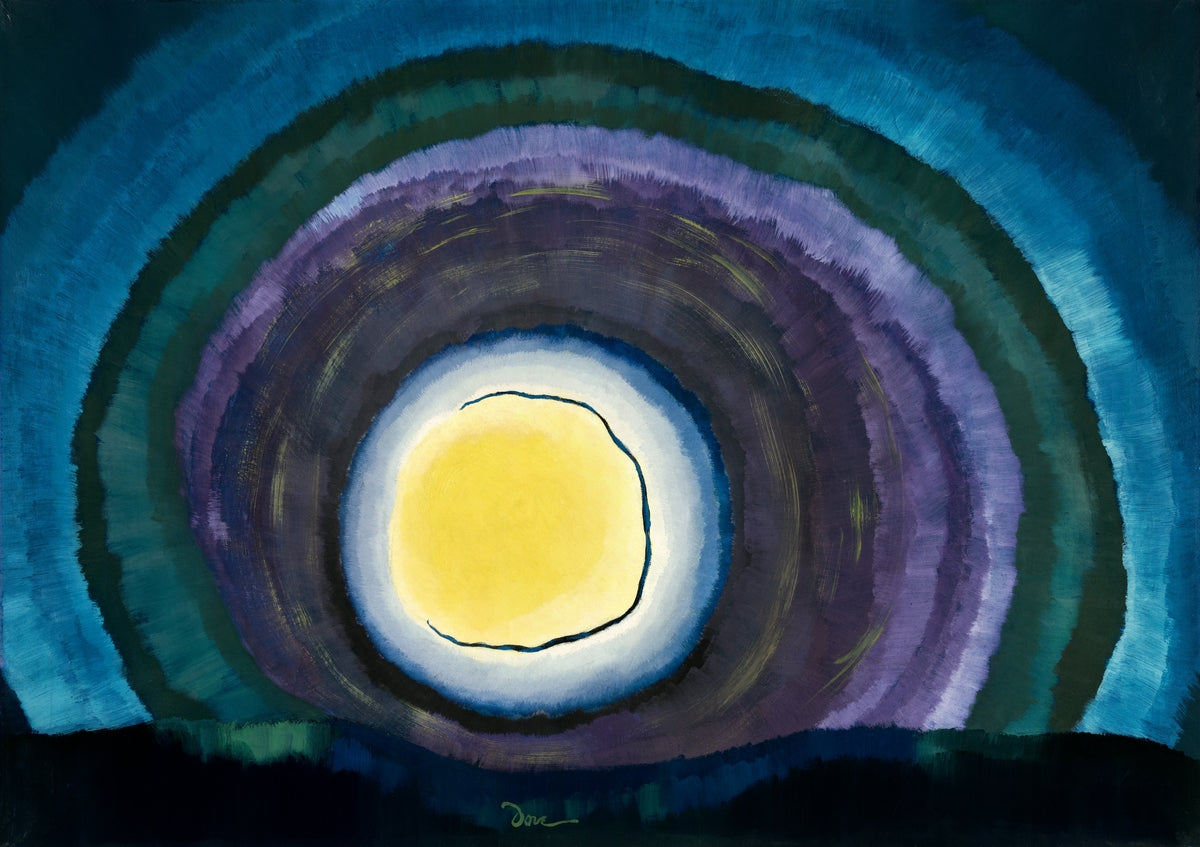
The painting Sunrise III presents an abstract, radial composition organized around an irregularly outlined yellow core. This luminous shape occupies the center and is surrounded by a white halo tinged with pale blue, as if an intense brightness were breaking through a cooler field of color. Around it, curved bands of dark blue, violet, purple, green, and turquoise unfold. The upper edge and the sides are enveloped in deep blues and cyans, while a horizontal band of navy and black introduces a dark visual weight in the lower area. The visible brushstrokes retain a curving movement that makes the rings seem to vibrate and keeps the image from reading as rigid geometry.
The title places the work within the realm of an abstract evocation of dawn. There is no literal horizon or recognizable landscape: the transition from night to day is transformed here into an experience of color, expansion, and emergence. The yellow center acts as a source of rising light, while the pale halo marks the first area of radiance. In general, dawn is associated with the passage from darkness to light and the beginning of a new daily cycle; the painting turns this temporal idea into a visual structure that can be experienced immediately.
The concentric rings create an immersive effect. The violet and blue bands seem to surround and protect the central focus while also expanding it, like atmospheric layers or waves of light spreading from a point of origin. Green and turquoise broaden the palette, suggesting an organic quality associated with nature without depicting it figuratively. Against this chromatic openness, the dark band along the lower edge acts as a counterpoint: it preserves a trace of night and, by contrast, sustains the brightness at the center. The image thus gains a simple yet effective tension between what remains dark and what is beginning to radiate.
The radial structure guides the eye progressively. First, the central yellow draws attention; then the gaze moves to the bluish-white halo and from there to the rings of broader brushstrokes. The rhythm of the curves creates a sense of continual expansion, although the lower band partially interrupts the circular flow and anchors the composition. Cool tones dominate the space, but the yellow concentrates the greatest perceptual intensity. The contrast depends not only on color, but also on the relationship between the small, luminous focal point and the extensive bands surrounding it. The visible brushwork gives physical energy to an image that might seem static because of its centered organization.
In this sense, Sunrise III relates to Arthur Dove’s contribution to American abstraction: translating experiences of nature, light, and rhythm into nonfigurative forms and intense color relationships. The work does not depict a sunrise; it constructs one through layers of color that make its emergence perceptible. It is worth observing that the yellow is not isolated, but activated by the light halo, the cool rings, and the darkness below. In this interaction, subject and form become inseparable: light appears as an event that reorganizes the entire pictorial space.
Have questions about our oil painting reproductions? See our frequently asked questions.