

Description
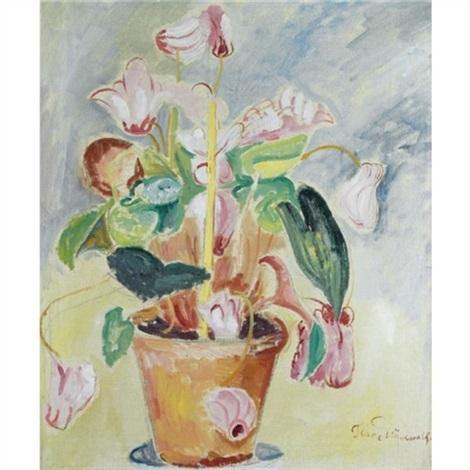
The painting shows a lush bouquet of cyclamens in a rounded terracotta pot. The pink, white, and reddish flowers rise in different directions, some open toward the viewer and others tilted or drooping among the foliage. A network of green, yellowish, and reddish stems structures the arrangement from its base, while the elongated leaves curve toward the sides, leaving the pale background unobstructed. The pot occupies the lower center and serves as a warm anchor for the bouquet’s vertical expansion. Beneath it, a bluish-gray shadow separates it from the background and reinforces its sense of space.
As a floral still life, Cyclamen focuses on the relationship between objects, colors, and vegetal rhythms, without relying on an external narrative. The bouquet transforms a domestic scene into a carefully organized composition: the pot provides stability, while the flowers and leaves draw the eye upward and toward the edges. The choice of a flowering plant brings delicacy and vitality together in a single motif. The viewer thus contemplates a fragment of nature brought into pictorial space, where the arrangement as a whole matters as much as the botanical identity of its flowers.
The pink and white flowers evoke beauty, lightness, and renewal, while the foliage introduces a denser, more changeable energy. The terracotta provides a warm, material base that contrasts with the greens and the luminous petals. This contrast makes the bouquet seem to emerge from a simple container and unfold into an almost ornamental dimension. The bluish shadow beneath the pot also serves an expressive purpose: it not only indicates support and volume, but also cools the lower area and balances the warmth of the fired clay. Meaning here arises from the interplay of floral fragility, materiality, and growth.
The composition is almost square in format, with an open, asymmetrical structure that rises upward. The stems act as fine lines, guiding the eye from the pot toward the flowers, while the diagonal leaves interrupt the verticality and create a gentle sense of movement. The petals, rendered with patches of color and visible brushstrokes, form small points of light against the blue-green background. The flowers are not arranged in a rigidly uniform way: some overlap, others are partly hidden, and one droops toward the lower right, creating variations in scale, direction, and visual weight. The gestural background avoids an overly pronounced illusion of depth, turning the space into an active, light, and vibrant surface.
In this work, Isaac Grünewald is associated with an expressive, modernist strand of Swedish painting, characterized by an intense use of color, visible brushwork, and a decorative sensibility. This framework can be seen in the freedom with which the bouquet fills the pictorial field and in the way the contours yield to the rhythm of color. The painting does not present the flowers as a botanical inventory, but as a living form built through relationships of color and movement. It is especially worth noting how the still pot supports an arrangement that seems to expand: between the terracotta base, the linear stems, and the luminous petals, this everyday motif takes on an almost musical energy.
Have questions about our oil painting reproductions? See our frequently asked questions.