

Description
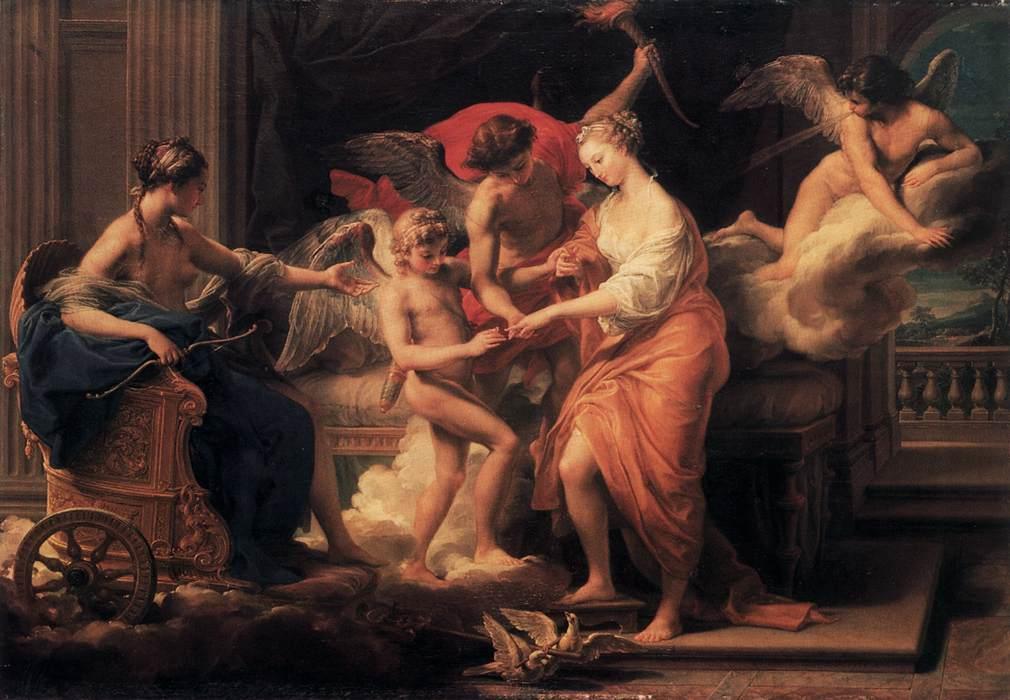
The painting depicts The Marriage of Cupid and Psyche as a mythological celebration unfolding in a palatial setting. In the lower center, a winged child moves energetically and draws the viewer’s attention. Beside him, a female figure in a light-colored dress with a pink skirt leans toward him, while a winged male figure appears from above, raising an object over the group. On the left, a seated woman holds a bow beside a richly ornamented ceremonial seat or chariot. At the far right, a winged couple embraces on a cloud, extending the scene into a celestial realm. Columns, dark draperies, a balustrade and a mountainous landscape complete the setting, while two small birds enliven the foreground.
The episode comes from the myth of Cupid and Psyche, one of the best-known love stories in the classical tradition. Cupid, the Roman personification of love, often appears as a winged figure associated with a bow; Psyche is the mortal maiden whose bond with him culminates in marriage. According to the story, Psyche attains immortality and joins the realm of the gods. The composition thus brings together the moment of love and its symbolic elevation: the human realm is shown integrated into a divine sphere of clouds, wings and ceremonial architecture.
The mythological attributes guide the reading of the work. The bow immediately introduces the world of Cupid, although it is held by an adult figure taking part in the collective ceremony. The winged child embodies the vitality of love, while the woman leaning toward him establishes a visual bond of closeness and union. The couple on the right echoes the central marriage: their intertwined bodies turn the cloud into a realm of elevated intimacy. The object raised above the group heightens the ritual character of the scene, and the wings link the loving gesture to a transcendent dimension. The contrast between the dark landscape and the illuminated figures transforms the background into a transition between the earthly and divine worlds.
The horizontal composition allows the eye to travel from the ornate seat on the left to the couple suspended on the right. The diagonals formed by the arms, wings, and drapery repeatedly lead toward the child and the central female figure, where the action is focused. The warm light models the bodies and fabrics with particular intensity against the deep browns, blacks, and greens of the surroundings. The pinks, creams, golds, and reds introduce luminous accents that shape the eye’s journey. The architecture lends vertical stability through columns and balustrades, but the clouds, leaning gestures, and wings dissolve that structure into an ascending, theatrical movement.
The work is consistent with Pompeo Batoni’s late Baroque refinement and classicist tendencies: polished drawing, idealized figures, theatrical composition, and warm lighting against a contrasting background. Rather than isolating the protagonists, the scene brings them together in a complex visual ceremony in which every figure, attribute, and spatial plane contributes to the same narrative. The arch and wings link love with the divine, while the light gradually shifts attention from the shadowy architecture to the lively center of the composition. The marriage thus emerges as an image of ascent, union, and concord between love and the soul; the couple embracing on the cloud provides the visual culmination of this journey.
Have questions about our oil painting reproductions? See our frequently asked questions.