

Description
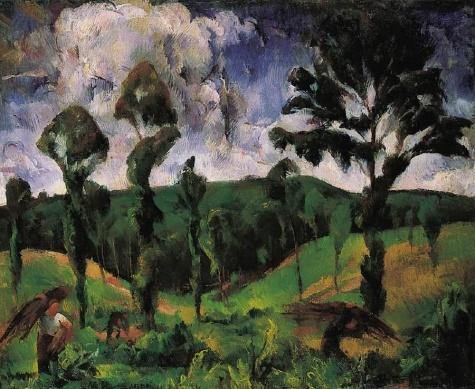
The painting shows an open, dynamic, wooded rural landscape, with trees scattered across a field of green hills. In the left third, a tree with a rounded crown and dark foliage rises; toward the center, other masses of vegetation gather, while a taller, more vigorous tree dominates the right side and extends its branches toward the sky. Shrubs, grasses and plants of varying heights cover the foreground, interrupted by ochre bands that cross the terrain like patches of earth, paths or dry vegetation. The title, Gathering Wood, connects this setting with a rural task integrated into nature. In this way, Vilmos Aba-Novák’s work turns an everyday place into a scene with a strong visual presence.
The landscape is associated with a simple idea of rural work: gathering wood as an activity connected with the countryside, the trees and paths across the land. It is not presented as a detailed narrative scene, but as an environment that retains traces of human activity, suggested only by the title. The stepped hills and abundant vegetation create a habitable yet demanding landscape, where moving around and working mean passing through dense nature. The focus shifts from the specific anecdote to the relationship between the rural community and its surroundings, between the resources of the landscape and the effort required to obtain them.
Trees carry much of the composition’s meaning: they are natural elements, but also the implicit material of the activity named in the title. Their repeated presence creates continuity between the forest, the fields, and the paths. Ochre patches introduce a sense of movement and labor amid the green, while pale clouds open up the space above the dark foliage. This contrast between density and brightness gives the landscape an almost theatrical quality. Nature is not presented as a neutral backdrop, but as a structure that shapes the action while also making it possible. The title suggests everyday work, while the painting transforms it into a broader experience of contact with the earth.
The horizontal composition is arranged in several layers of depth. The foreground, dense with shrubs and interwoven brushstrokes, offers a tactile, immediate surface; behind it, the trunks and treetops structure the middle ground; in the distance, green hills form a low line that allows the sky to take prominence. The large tree on the right counterbalances the cluster of forms in the center and on the left. Dark greens lend weight and stability, while the purplish blues of the sky and the grayish whites of the clouds introduce a more open vibrancy. The clouds, with their rounded edges and visible brushwork, concentrate the light in the upper part of the painting and lead the eye back toward the field.
Within the expressive style of painting generally associated with Vilmos Aba-Novák, intense color, vigorous forms, and a commanding compositional structure stand out. The trees are not treated as isolated botanical details, but as masses that give rhythm, direction, and character to the landscape. The contrast between their dark silhouettes, the green hills, and the luminous sky transforms a rural scene into a tense, poetic pictorial structure. As you look at it, follow the path from the nearby vegetation to the clouds: this progression reveals how the work suggested by the title is integrated into a nature that is at once fertile, dense, and dominant.
Have questions about our oil painting reproductions? See our frequently asked questions.