

Description
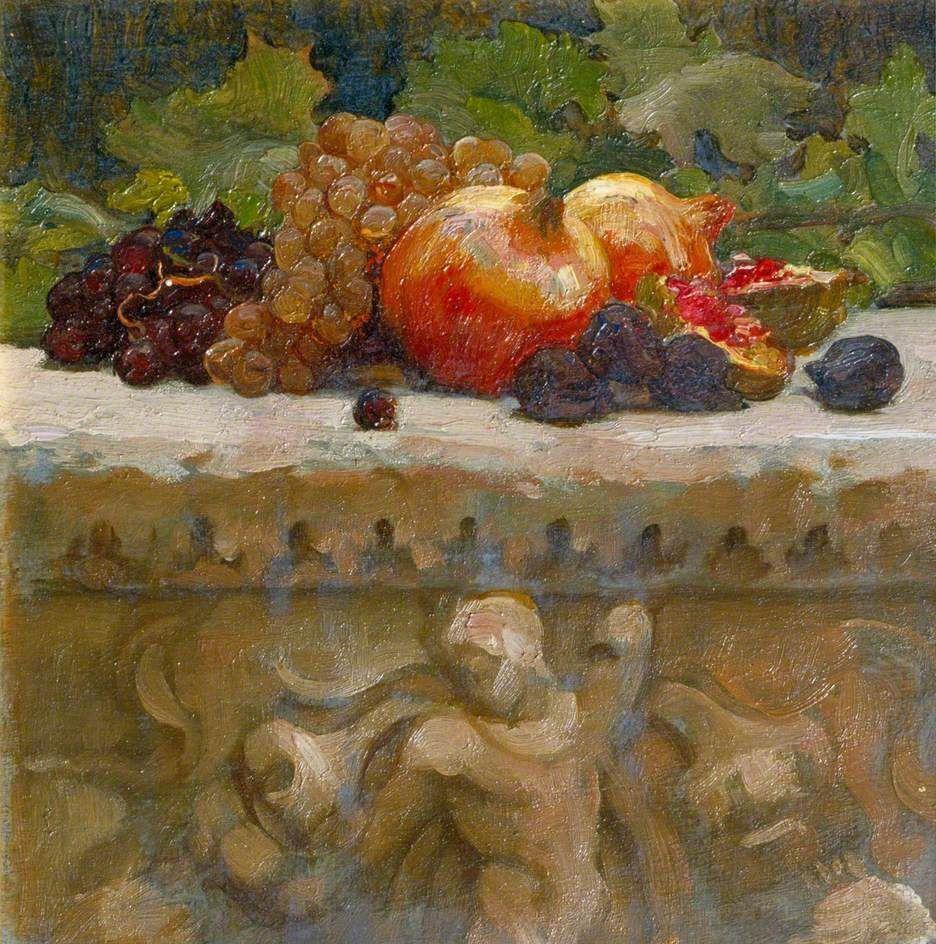
The painting presents a sumptuous still life of fruit arranged on a light-colored table, with a red pomegranate at the center as the focal point. Around it are clusters of dark and green grapes, yellow and orange fruit, another opened pomegranate, and a grouping of bluish or purplish fruit in the lower right. The deep green foliage in the background envelops the composition like a dense garden. Beneath the table’s ornamental edge is a darker band, where several nude or partially nude human figures are integrated among folds and undulating forms. The scene is arranged in two registers: the luminous, tactile abundance of vegetation above, and a faint, narrative presence of figures below.
The title alludes to Clytie, a figure from Greco-Roman mythology who was in love with Apollo. According to classical tradition, her persistent contemplation of the sun leads to a transformation into a plant, commonly associated with heliotrope or the sunflower. This mythological framework guides the interpretation of the figurative area below, although the work gives particularly strong emphasis to the still life. Rather than literally depicting an isolated episode, the composition links the lush natural world with an evocation of the classical figure, as if the narrative were partly submerged beneath the sensuous richness of the fruit and leaves.
Grapes, pomegranates, and assorted fruits evoke fertility, abundance, and fullness, but they also serve as visual subject matter: their skins, seeds, and surfaces draw the eye to tangible details. The opened pomegranate reveals a luminous red interior that echoes the whole fruit at the center, while the grapes establish a rhythm of rounded, clustered forms. The foliage turns the background into an enveloping, garden-like setting. In contrast, the barely illuminated figures beneath the table introduce a classical, enigmatic note. The separation between the two bands heightens the tension between the sensory exuberance of the natural world and a darker narrative dimension, in which the reference to Clytie takes on symbolic resonance.
The horizontal composition lends stability to the scene and allows each group of fruits to be read as a variation in color, weight, and texture. The dark grapes balance the left side, while the central pomegranate anchors the compositional axis, and the opened, shadowy fruits lead the eye to the right. The olive and bluish greens of the foliage set off the garnet reds, oranges, and golds, casting a soft light across the fruit. The table’s light-colored edge acts as a decisive dividing line: it organizes the still life while partially concealing the scene below. The sharp definition of the fruit, contrasted with the softer treatment of the figures, creates depth and keeps the eye moving between the decorative and the narrative.
In Frederic Leighton’s work, this combination is consistent with an interest in classical tradition, the idealized figure, and richly colored decorative compositions. Here, ornamental refinement does not eliminate the human dimension; instead, it shifts it into the background, allowing it to coexist with the opulence of nature. The central pomegranate functions simultaneously as fruit, a focal point of color, and a threshold between the work’s two registers. As viewers move across the surface, from the grapes and foliage to the figures beneath the table, they perceive a composition in which mythology is integrated into a sensual vision of vegetal abundance.
Have questions about our oil painting reproductions? See our frequently asked questions.