

Description
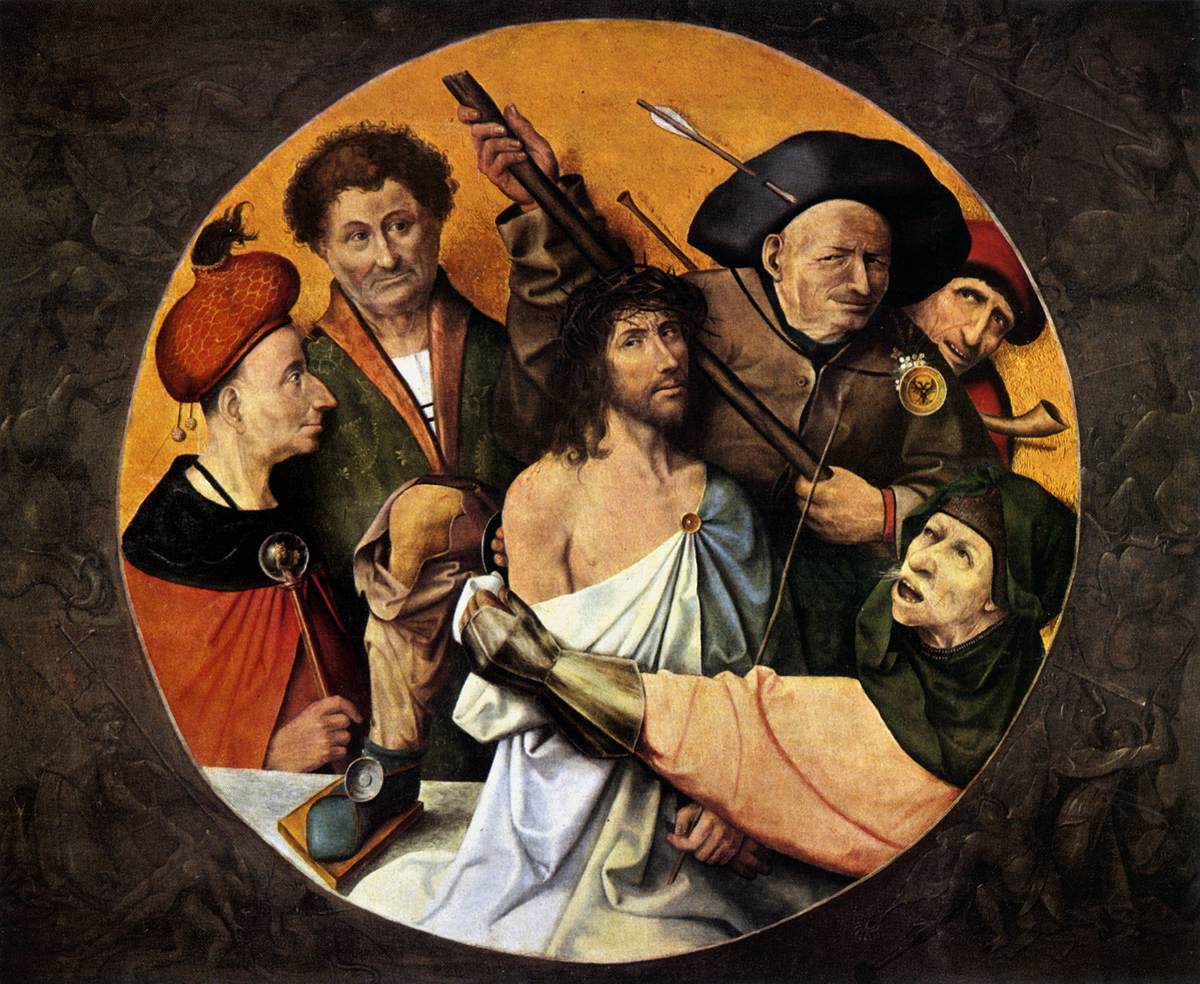
The painting shows Christ Crowned with Thorns at the center of a circular composition, his torso bare and partially wrapped in a white and blue cloth. His bearded, upright figure is surrounded by a compact group of figures who lean in, reach out their arms, or raise rods and weapons. The individualized faces, red and black headwear, green, brown, and flesh-toned cloaks, and large cream and pink cloth crossing the lower area build a scene of harassment focused around the central figure. Behind the group, a golden disk appears, bordered by a dark, ornamented edge that encloses the action like a solemn stage.
The scene belongs to the cycle of the Passion of Christ and depicts Jesus subjected to the humiliation and violence of his tormentors before the Crucifixion. The crown of thorns, placed on his head as an act of mockery during his torment, turns physical suffering into a form of public derision. In this episode, Christ is exposed and isolated as those around him create human and visual pressure on his body. The work does not present the Passion as a distant story: it brings the faces, hands, and instruments close to the viewer, making the cruelty of the moment and the sacrificial dimension of the central figure tangible.
The iconography is shaped by the contrast between Christ’s dignity and the agitation of those besieging him. The rods, weapons, and tense gestures serve as signs of coercion and violence, while the cloth crossing the foreground connects several bodies and heightens the sense of encirclement. The golden area behind the group focuses attention on Christ and sets him apart from the dark surroundings; more than a simple background, it acts as a luminous field that sustains his devotional presence. The dark band around his head and the insistent gazes of those around him intensify the reading of the crowning as an act of humiliation and suffering.
Formally, the painting directs the viewer’s gaze through a radial, densely clustered composition. The central figure establishes a vertical axis, while the diagonals formed by the rods, the arrow, the arms, and the cloth below introduce a constant movement that repeatedly draws the eye back to his face and torso. The contrast between the ochre gold and the charcoal of the outer edge enhances the sense of depth without resorting to an open space: everything takes place within a compressed field. The reds, greens, and browns of the garments break up the mass of figures, while the highlights on the central cloth create luminous pauses amid the shadows and taut gestures.
In relation to Hieronymus Bosch’s work, this painting reflects an interest in religious images of dramatic intensity, carefully differentiated faces, and human groupings charged with moral and expressive tension. Here, this concentration of features and accessories transforms the sacred episode into an immediate visual experience: each figure contributes to the clamour, pressure, and violence surrounding Christ. Note how the golden circle and dark frame turn the scene into a visual enclosure; against this contrast, the suffering figure remains a point of relative stillness amid a crowd dominated by movement.
Have questions about our oil painting reproductions? See our frequently asked questions.