



Description
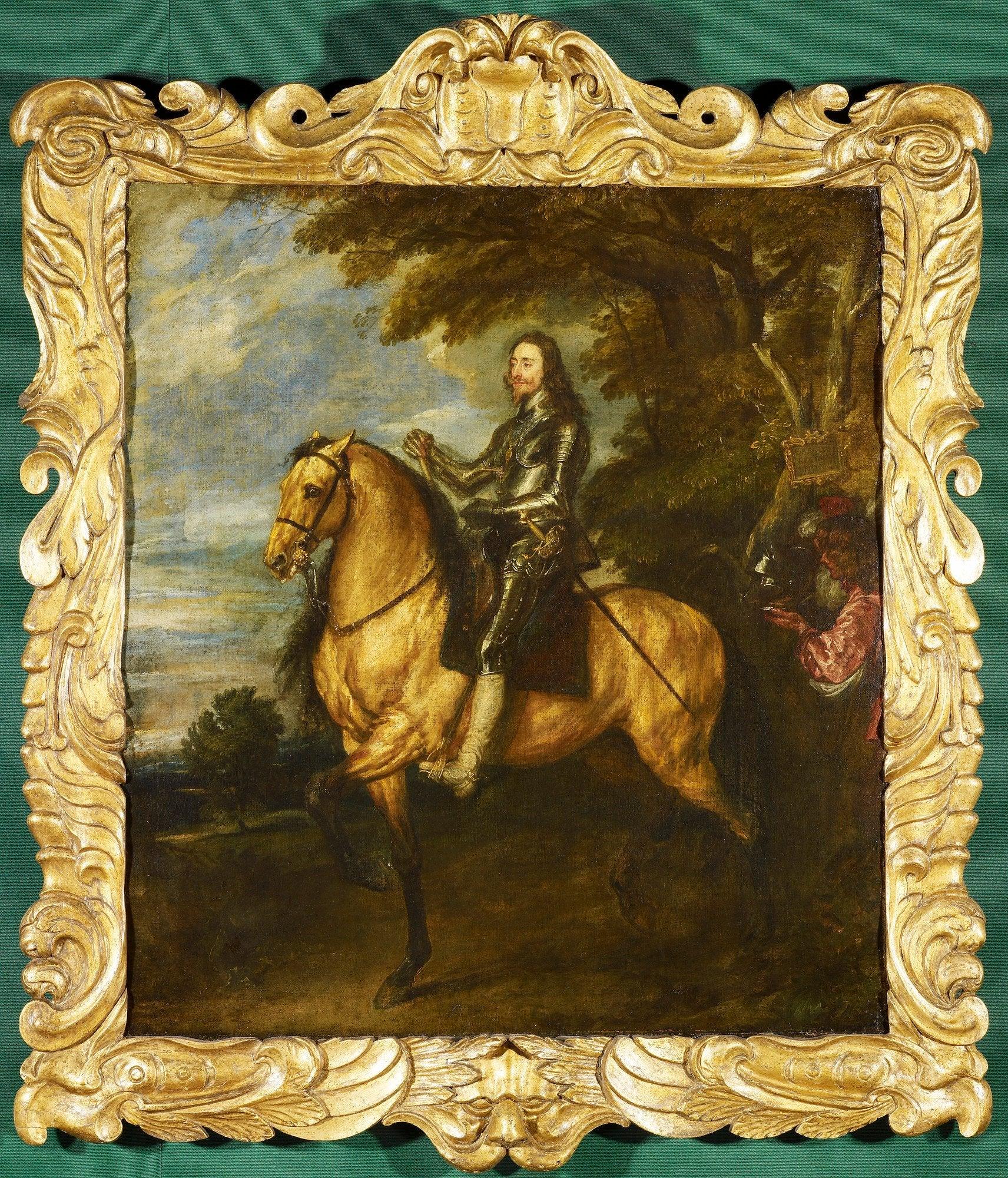
The painting depicts Charles I riding a golden chestnut horse moving to the left, with one foreleg raised. The monarch occupies the center of the composition and wears dark armor, tall boots, and a reddish garment beneath the saddle. He holds the reins, while the harness, bridle, and straps form diagonals connecting his hands to the animal’s head. A wooded landscape opens around him: large branches and dense foliage fill the upper and right portions, while the left side reveals a grayish-blue sky, pale clouds, and an open horizon. Secondary figures appear among the vegetation, expanding the scene and suggesting the presence of attendants.
As a portrait of a monarch, the work belongs to a tradition intended to associate the ruler with authority, rank, and the ability to command. Charles I was king of England, Scotland, and Ireland, and here he is depicted not in a private space but as part of a public, aristocratic tableau. The armor connects his image with military duty and political authority, while the horse conveys nobility, energy, and control. The landscape turns the portrait into a broader vision of sovereignty: the figure dominates the foreground, but his presence extends across the surrounding territory.
Equestrian iconography is grounded in the relationship between rider and animal. The horse’s movement introduces dynamism, although the monarch’s pose maintains a calculated stability; together, these elements convey restrained power rather than agitation. The armor serves as a visible surface of authority, its dark plates standing out against the sky and the horse’s light coat. Lush vegetation frames the sovereign and creates a kind of natural stage, while the figures in the background can be read as attendants or a retinue. The contrast between the luminous sky and the shaded forest reinforces the theatrical quality of the depiction and visually separates the royal figure from the distant world.
The vertical composition focuses attention on an ascending diagonal that begins with the horse’s body and leads to the rider. The animal’s head, turned to the left, balances the visual weight of the trees on the right, while the open space in the background keeps the scene from feeling enclosed. Dark brown, golden ochre, olive green, and black form an earthy, solemn palette, interrupted by the grayish blue of the sky and muted touches of red. The light is distributed in contrasting areas: it illuminates the distant landscape and parts of the horse, while leaving the grove in deep shadow. The eye thus moves from the horse’s motion to the armor, then ventures into the depth of the landscape.
In Charles I on Horseback, Sir Anthony Van Dyck connects aristocratic elegance with a monumental sense of scale. The figure retains refinement and dignity, while the armor, horse, and landscape give him a public, almost ceremonial presence. The work belongs to Van Dyck’s tradition of portraying royalty through authoritative poses, carefully balanced spatial relationships, and natural backgrounds that heighten the importance of the sitter. Notice how the open sky and dark forest are not mere backdrops: they create a framework of contrasts that brings the horse forward, emphasizes the monarch’s silhouette, and transforms the portrait into a theatrical image of sovereignty.
Have questions about our oil painting reproductions? See our frequently asked questions.