

Description
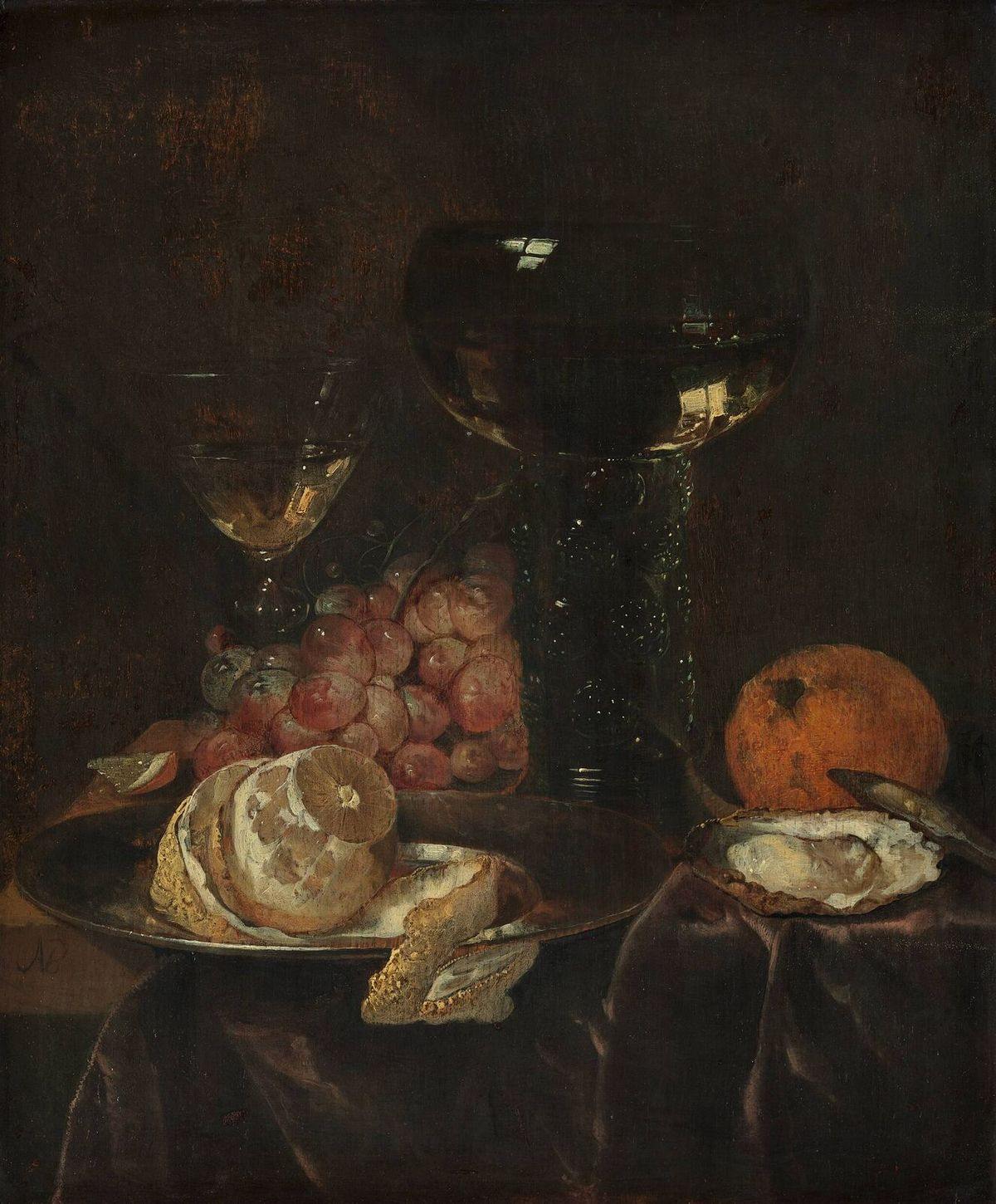
The painting depicts a still life of fruit, glasses and food arranged on a dark table. In the upper half, 2 glass vessels rise above the table: a large goblet containing a deep-colored liquid with golden reflections, and a smaller one, partly absorbed into the shadow. Below them, the table’s abundance gathers: a cluster of reddish and violet grapes, a cut lemon beside other wedges, a whole orange and several pieces of baked food on dark trays and plates. Each object retains its individual presence, yet they all belong to the same intimate, silent and richly material scene.
As a Baroque still life, the work turns everyday objects into a study of appearance, texture and light. The genre focuses on fruit, food and vessels because these elements allow us to observe very different surfaces: the smooth skin of the orange, the moist flesh of the citrus fruit, the delicate skin of the grapes, the crust of the baked goods and the broken transparency of the glass. This gathering also evokes a rich, sensuous table, where the variety of shapes and colors suggests abundance and domestic pleasure. Without the need for a narrative scene, the composition builds a complete world from what is presented to the eye.
The fruit brings together color and volume and conveys a sense of plenitude, while its freshness also evokes an awareness of the perishable nature of food. Grouped at the center, the grapes form an organic core connecting the objects above with the trays below. The cut lemon and the orange create a contrast between inside and outside, between the protective surface and the exposed flesh. The goblets, in turn, add a dimension of domestic luxury and refinement: their reflections reveal not only the vessels themselves, but also the way light acts on the space. The surrounding darkness focuses attention on this tactile richness.
The vertical structure organizes the gaze into two levels. First come the goblets, silhouetted against the almost-black background; then the eye descends toward the grapes and follows the gentle diagonals leading to the citrus fruits, the foods and the orange. Selective lighting shapes the volumes without fully revealing the table: the glints of the glass, the ochre and golden tones, and the accents of red, violet and orange gradually emerge from the gloom. This contrast creates depth and rhythm, while the dark trays steady the accumulation of forms. The brushwork serves the surfaces, distinguishing what is translucent, juicy, rough and baked.
The composition is connected to the sumptuous character of the Baroque still lifes associated with Abraham Van Beyeren, in which fruit, goblets and food are arranged through contrasts of light, color and texture. Here, richness depends not on the number of objects, but on the intensity with which each occupies its place within the chiaroscuro. Notice how the goblets raise the scene, while the bunch of grapes, citrus fruits and food bring it back to the surface of the table: between these two movements, the entire visual tension takes shape. The result is a restrained celebration of matter, in which looking becomes a journey across a silent table and a savoring of its reflections.
Have questions about our oil painting reproductions? See our frequently asked questions.