

Description
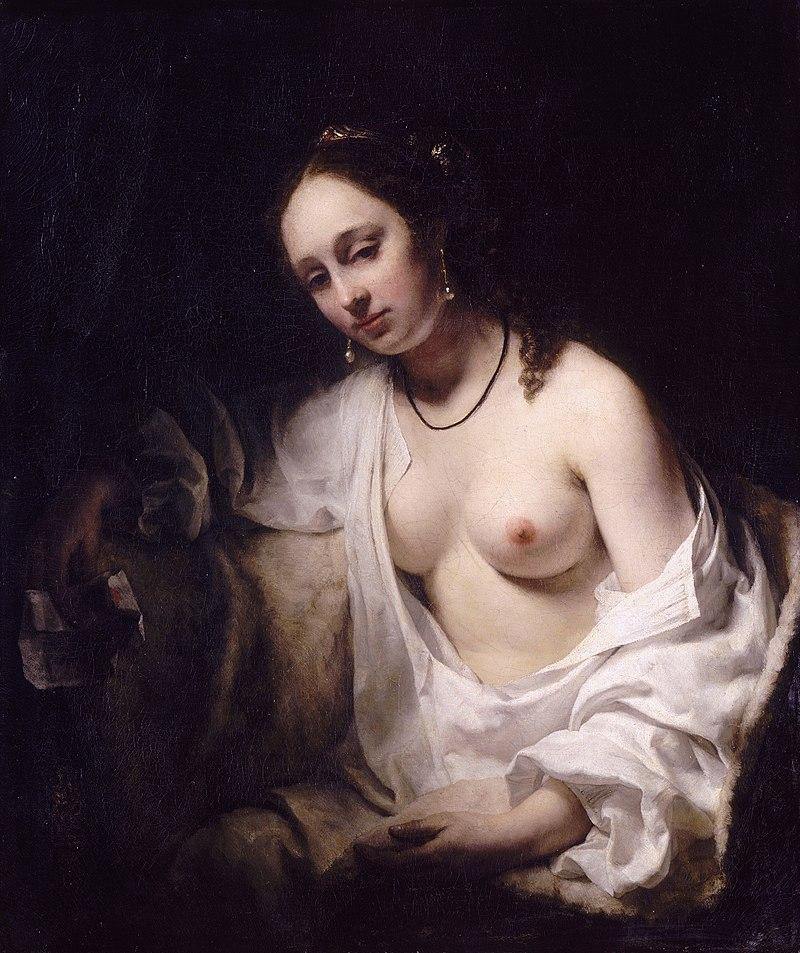
The painting presents Bathsheba as the central figure, seated or reclining in a space enveloped in darkness. Her body occupies the central and right-hand areas of the composition; she tilts her head to the left and looks straight ahead, establishing silent contact with the viewer. A wide, fine, crumpled piece of white fabric partially covers her shoulders, encircles her torso, and extends toward the lower part of the painting. Her earrings and the dark cord around her neck stand out against her fair skin and the luminous fabric. Beside her, an animal with brown fur remains partially hidden in the lower-left area, blending into the half-light surrounding the protagonist.
The title places the scene in the biblical episode of Bathsheba and King David. Bathsheba was Uriah’s wife and was summoned by David after he saw her; she later became pregnant by the king. To conceal the consequences of the relationship, David arranged for Uriah to be exposed to danger in battle, which led to his death. The letter mentioned in the title serves as a narrative link between private desire and public tragedy. The painting condenses this complex story into a moment of suspended intimacy, before its consequences have fully reached everyone involved.
The exposure of the body, softened by the white fabric, brings together vulnerability, luxury, and intimacy. The fabric envelops Bathsheba like a luminous surface that makes her presence visible while also separating her from the dark background. Her tilted head and direct gaze invite an introspective reading, as if the protagonist were paused under the weight of a message and a decision. The animal introduces a domestic, earthly note that contrasts with the episode’s moral gravity; its presence brings the scene closer to everyday life without assigning it a specific symbolism. In this way, the composition weaves desire, exposure, and tragic fate around an isolated figure.
The vertical composition is anchored by a diagonal path of light that begins in the upper left, illuminates the face, and descends across the torso and fabric. The fair skin, ivory white, and pinkish tones stand out vividly against the surrounding browns and blacks. This contrast draws attention to Bathsheba, leaving the animal and the surrounding space in gradually deepening shadow. The almost-black background minimizes spatial references and turns the figure into a concentrated focal point. The curves of the body and the folds of the fabric introduce a sense of rhythm, while the direct gaze stills that movement and draws the viewer back to the emotional center of the scene.
Willem Drost’s work belongs to the 17th-century Dutch tradition associated with dramatic lighting, a dark palette, and an intense focus on expression and the physical presence of the figure. Drost was a pupil of Rembrandt, and here chiaroscuro serves both a formal and a narrative purpose: it shapes the body, heightens the intimacy, and turns darkness into a silent pressure surrounding the protagonist. The enveloping whiteness of the fabric brings sensuality and restraint together, while the letter, the animal, and Bathsheba’s gaze shape a scene in which desire, vulnerability, and fate remain inseparable. The result invites us to consider how an apparently motionless figure can concentrate all the tension of a biblical story.
Have questions about our oil painting reproductions? See our frequently asked questions.