

Description
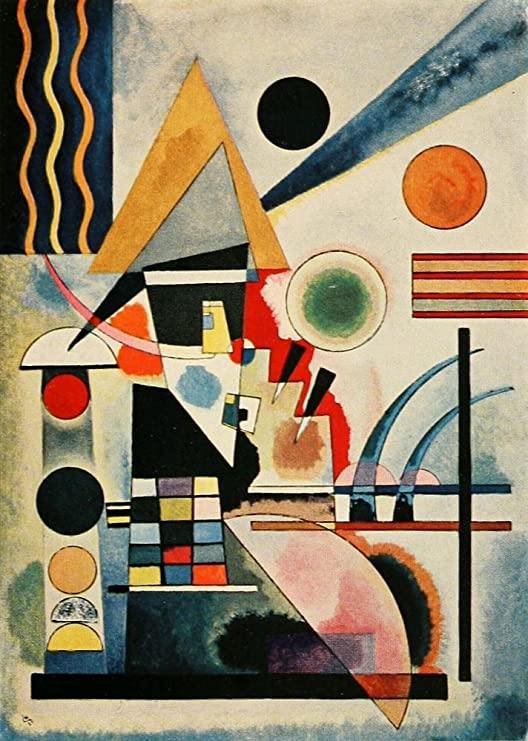
The painting shows a vertical abstract composition in which circles, triangles, polygons, curved bands and lines are arranged against a light background with an irregular texture. A large yellow triangle with a gray interior dominates the upper-left area, while a black circle and a diagonal blue band animate the upper part of the composition. Higher up, an orange circle adds a warm accent, contrasting with the black strip crossed by yellow lines along the left edge. In the center, black, white and red shapes overlap, alongside a circle with a green center and a rectangle of dark and reddish stripes. The composition continues downward with solid circles, columns of semicircular shapes, small multicolored blocks and a large structure of arches in the lower-right area.
As an abstract work, “Swinging” does not unfold a figurative narrative or depict a recognizable event. Its subject lies in the relationships between the forms and in the way visual weight shifts from one group to another. The title suggests reading the surface as a system in motion: each circle, diagonal or block seems to take part in a constant process of balancing. The painting thus belongs to a modern tradition that gives color, line and geometry expressive autonomy, without relying on figures, landscapes or literary scenes to create meaning.
The circles and polygons function as units of tension, stability, and counterpoint. Some appear in isolation, such as the black and red discs, while others are integrated into more complex groupings, creating pauses and responses within the whole. The diagonal and curved bands introduce a sense of movement that keeps the structure from becoming rigid. In contrast, the grid of vertical and horizontal lines provides a visual anchor. The light background, traversed by blue, green, gray, red, and brown patches, brings the elements together on a shared painted surface and softens the distinction between geometric form and background material.
The eye enters through the contrasts of yellow, black, and red in the upper and central areas, but is soon led toward the lower groups by diagonals, extended lines, and changes in scale. The large forms establish the main rhythm; the small rectangles in the lower left add an almost modular cadence, while the concentric arcs on the right extend the movement toward the edge. Color alternates between flat areas and textured zones, so the work combines graphic precision with a more tactile, irregular surface. Depth does not depend on traditional perspective, but on overlapping, contour, and color contrast.
In relation to Wassily Kandinsky, the work can be broadly associated with his interest in abstraction, the expressive autonomy of color, and the dynamic arrangement of geometric forms and lines. “Swinging” turns these elements into a visual choreography: straight axes support the structure, curves set it in motion, and circles act as pauses of varying intensity. Notice how the compositional weight shifts from the center toward the two lower areas, and how each accent of color alters the balance of the whole. The true subject emerges in this continual adjustment between stability and movement.
Have questions about our oil painting reproductions? See our frequently asked questions.