

Description
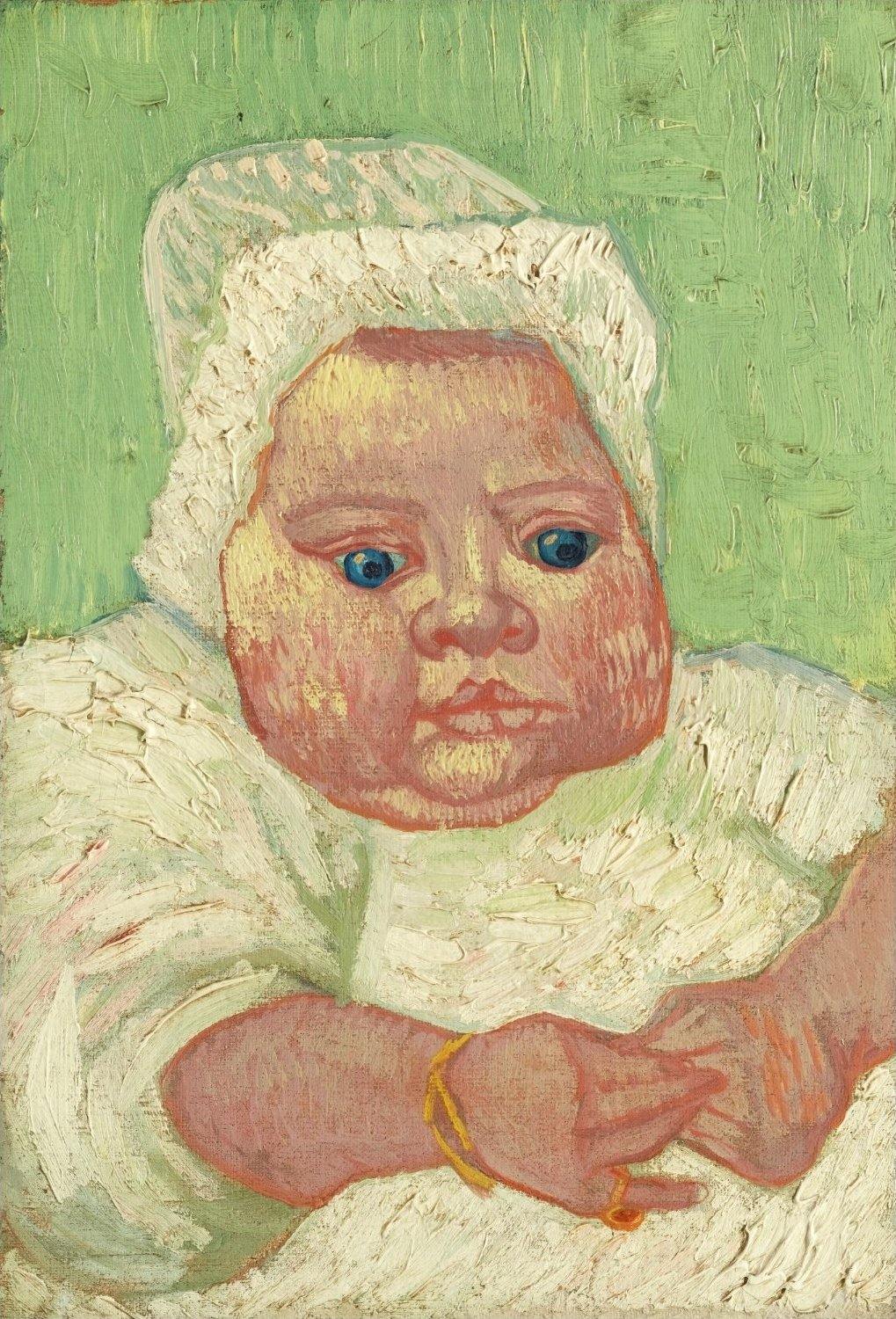
The painting shows Baby Marcelle Roulin in a frontal portrait, depicted from the chest to the top of her head. The girl occupies the center of the composition and looks toward the viewer with her blue eyes and a serene, almost motionless expression. Her light, curly hair forms an irregular outline around her face, while a loose garment in cream and ivory tones surrounds her shoulders and frames her head. A red area appears beneath it, and a yellow ribbon across her chest adds a bright accent. Behind the figure stretches a green background of vertical brushstrokes, with no secondary narrative elements to distract from the sitter.
The portrait depicts Marcelle Roulin, daughter of Joseph Roulin, the postman also portrayed by Vincent van Gogh. The work is thus connected to the group of portraits devoted to members of the Roulin family, a context in which everyday observation takes on a particularly intimate intensity. This is neither an anecdotal scene nor a depiction full of action: the interest lies in the girl’s individual presence, in the way her face creates a direct encounter with the viewer, and in the quiet dignity of a child’s figure within the genre of portraiture.
The frontal pose makes the gaze the main point of contact. The blue eyes, positioned along the central axis of the face, make Marcelle’s presence feel immediate and close. The green background and red garment create a contrast that heightens the silhouette and brings chromatic energy to a restrained scene. At the same time, the light-colored clothing acts as a soft frame around the head: its volume softens the outline and makes the face stand out more clearly. The yellow ribbon adds a small, warm note, enough to visually link the red of the clothing with the surrounding green palette.
The composition is built around an almost absolute frontality. The head dominates the upper area, while the torso fills the lower part without opening up conventional spatial depth; the uniform background keeps all the focus on the figure. The vertical green brushstrokes create a calm rhythm that contrasts with the more broken texture of the hair and the broad folds of the clothing. On the face, the visible strokes model the cheeks, nose, and mouth without concealing the materiality of the surface. Color guides the eye: first toward the eyes and features, then to the red of the garment, and finally to the yellow and light accents that define the torso.
In this work, Vincent van Gogh combines chromatic intensity with visible, tactile brushwork, features widely associated with his painterly style. Color does more than describe the clothing or background: it creates the portrait’s emotional atmosphere and makes the surface around the figure vibrate. Marcelle’s serenity thus becomes inseparable from the energy of the greens, reds, and yellows surrounding her. Notice how the face remains steady at the center while everything else—the hair, clothing, and background—seems to move with the rhythm of the brushstrokes; the work’s power lies in this tension between childlike stillness and a vibrant surface.
Have questions about our oil painting reproductions? See our frequently asked questions.