


Description
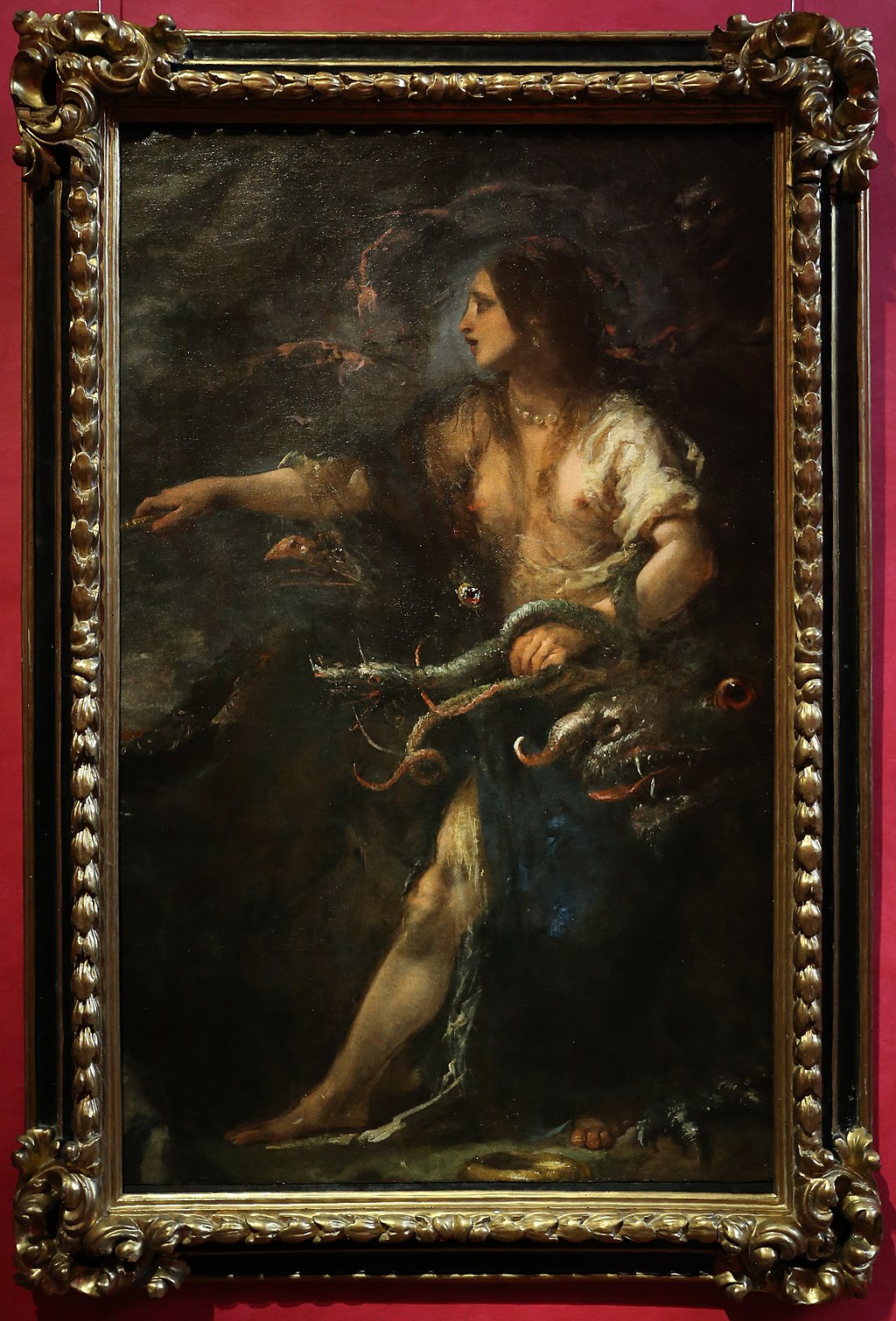
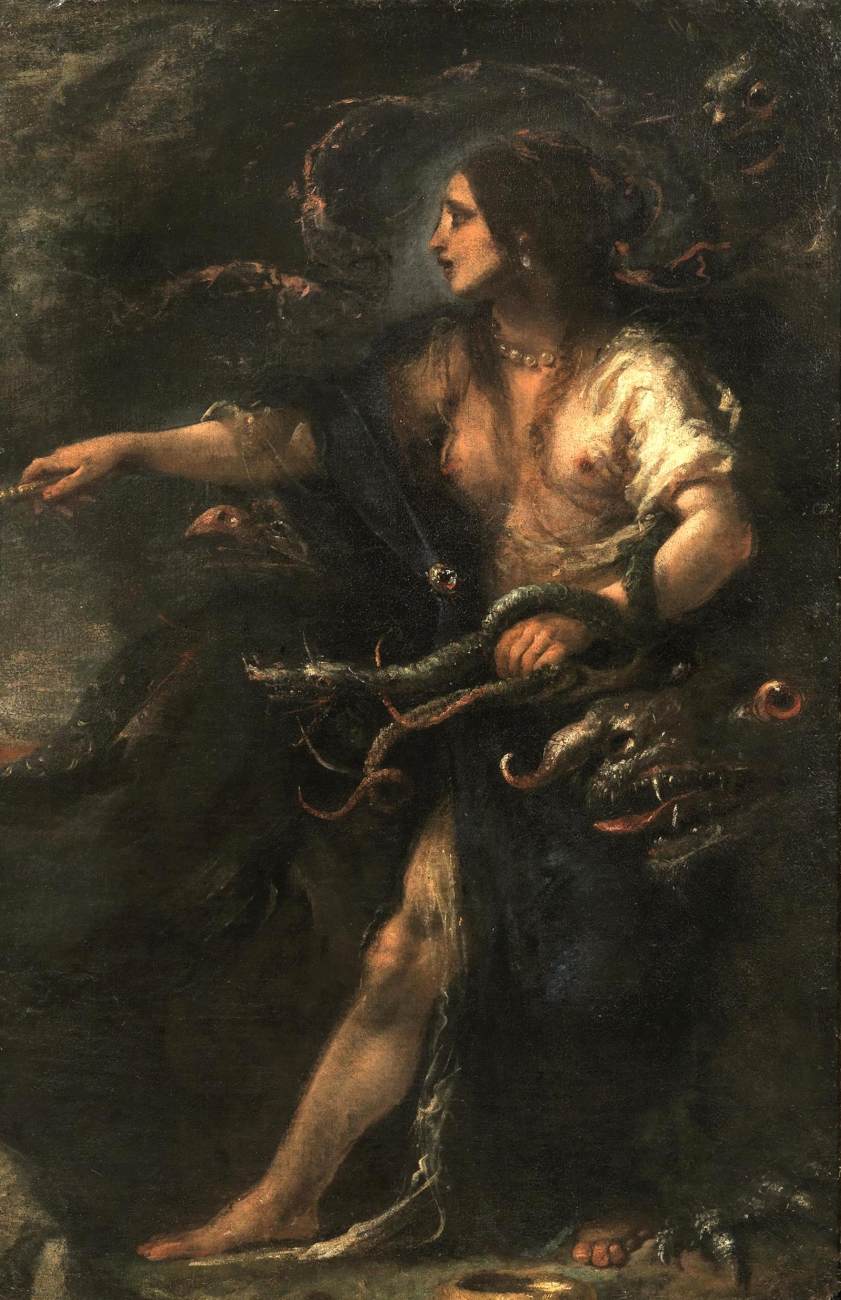
The painting depicts Armida as a full-length female figure, standing upright at the center of a shadowy nighttime scene. Her face, shown in profile facing left, turns toward the arm she extends in an active gesture, while her other hand reaches toward a greenish snake coiled in front of her torso. Several serpentine forms and reptilian creatures cluster around her legs and advance toward the lower-right corner. Her dark hair, light necklace of rounded pieces, and draped fabrics—a light garment over her shoulder and a dark blue mantle below—stand out against the barely illuminated background of vegetation or organic forms.
Armida is the powerful enchantress in Jerusalem Delivered, Torquato Tasso’s epic poem. In the story, her spells allow her to attract the Christian knight Rinaldo and divert him from his mission, giving rise to one of the poem’s most memorable romantic and dramatic plots. The painting condenses this world of chivalry into a theatrical apparition: a woman with a seductive, commanding presence, surrounded by signs of magic, danger, and enchanted nature. The literary episode is thus transformed into a condensed vision, closer to fascination and enchantment than to the narration of a specific action.
The snakes form the symbolic core of the composition. Their sinuous bodies encircle the figure’s hands and lower body, creating a visual web that links Armida to hidden, seductive, and threatening forces. Her outstretched arm and contact with one of the snakes suggest control, invocation, or familiarity, while the reptiles’ open mouths on the right intensify the tension of the scene. The light necklace and carefully arranged fabrics introduce a note of courtly theatricality: beauty and danger coexist in the same presence. The surrounding darkness makes each illuminated creature an extension of the protagonist’s enchanting power.
The vertical structure guides the eye from the face and torso, defined by warm light, to the diagonal band of reptiles extending toward the ground. The left arm breaks the verticality with a horizontal movement toward the edge, while the animals’ curves echo this gesture with a sinuous rhythm. The contrast between illuminated skin, ivory whites, olive greens, and muted reds against deep browns and blacks creates a sense of depth without resorting to an open space. The fluid brushwork and the background forms, deliberately absorbed into the gloom, make the scene seem to emerge from the night.
In this work, Cecco Bravo approaches the expressive language of the Florentine Baroque through elongated, theatrical figures, concentrated lighting, dark colors, and a surface that appears agile. Armida dominates the painting not only through her scale, but also through the network of lines that emerges from her gesture and extends into the reptiles. Notice how the light first draws the eye to the face and torso, then leads it toward the creatures surrounding her hands and legs: here, the literary character, seduction, and menace converge. The painting transforms Armida into a captivating and dangerous presence, suspended between the gesture of one who commands nature and the moment when nature might respond.
Have questions about our oil painting reproductions? See our frequently asked questions.